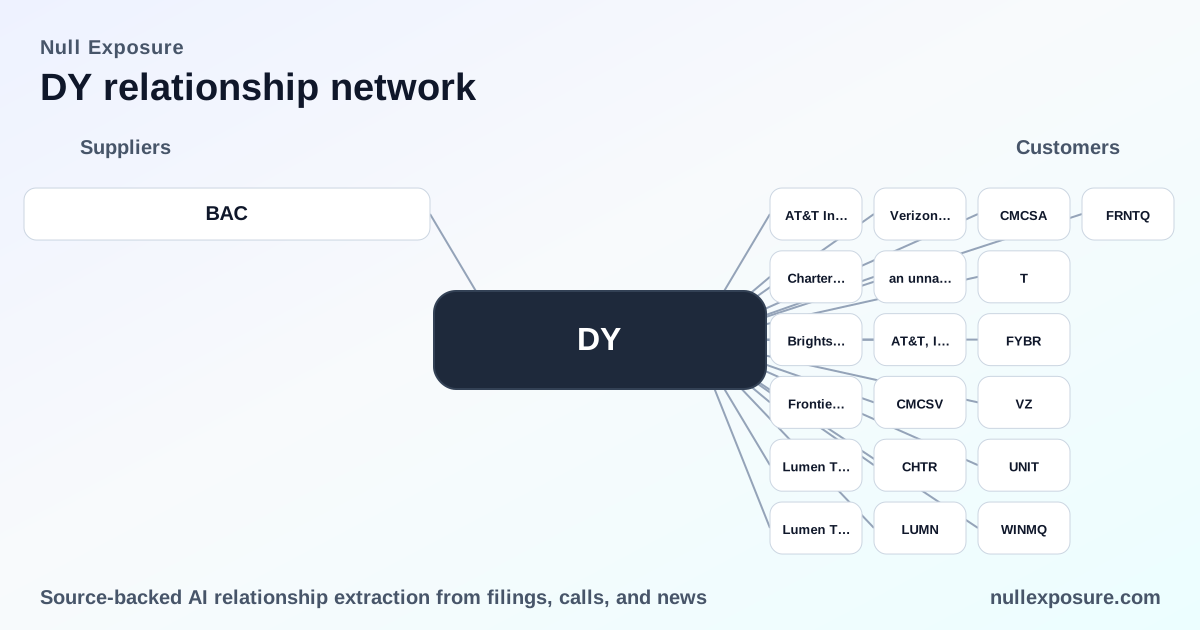
Dycom Industries (DY) — supplier relationships and what they mean for investors
Dycom Industries operates as a contractor in the engineering and construction space and, per company disclosures, generates revenue by providing specialized recruiting and field services billed under contract to customers across its sectors. The business monetizes through volume-driven, project and time-based contracting with a large network of field subcontractors and relies on working capital and committed bank financing to smooth cash flow. For investors evaluating supplier risk and financing counterparties, the combination of broad subcontractor usage and an active bank-led credit facility are the two operational levers that matter most.
Explore supplier and counterparty intelligence at https://nullexposure.com/ for deeper supplier-risk views.
Quick financial context for a supplier lens
Dycom is not a micro-cap contractor; market capitalization sits above $10.7 billion and trailing revenue is roughly $5.545 billion (TTM) with EBITDA of $713 million, giving an EV/EBITDA multiple in the high-teens. The company’s profit margin is modest (about 5.1% net) while operating margin is roughly 4.7%, indicating the business is thin-margin and sensitive to labor and subcontractor cost volatility. Analyst coverage is constructive: consensus target price sits north of current trading (analyst target ~$461.42), and institutional ownership is high (approximately 94% institutional ownership), signaling strong market interest from professional investors. These numbers derive from the company’s latest quarter ending 2026-01-31 and public market data.
The supplier footprint investors should model
Dycom’s operating model relies heavily on field execution delivered by subcontractors. Company disclosures describe the contractor base: “These subcontractors are typically small, privately owned companies that provide their own employees, vehicles, tools and insurance coverage.” That disclosure drives two company-level signals:
- Counterparty type: small business. The subcontractor population is predominantly small, privately owned firms that provide their own workforce and equipment.
- Materiality: immaterial at the single-counterparty level. The company explicitly states that no individual subcontractor is financially significant to Dycom.
Those signals imply a low-concentration supplier posture with many small, replaceable vendors rather than a small set of strategic suppliers. At the same time, the reliance on many small subcontractors creates operational criticality—project delivery, timing, and quality depend on effective coordination of numerous small operators rather than contractual leverage over a few suppliers. These are company-level characteristics reflected in public disclosures and should be incorporated into any supplier-risk model.
Bank of America — the financing anchor you need to know
Dycom executed a credit agreement amendment with Bank of America acting as Administrative Agent and a syndicate of lenders in FY2026. The amendment adjusts the company’s credit facility terms and counterparty structure, with Bank of America positioned as the administrative counterparty. This is a financing relationship, not a trade-supplier relationship, but it materially affects liquidity and working-capital flexibility for field operations. (TradingView reported on this amendment on March 9, 2026.)
Why this matters: access to a committed bank facility administered by a major commercial bank reduces short-term funding risk for an operation that pays many small subcontractors and supports seasonal swings in receivables and payroll. The amendment signals active balance-sheet management and ongoing lender engagement at scale.
Relationship-by-relationship readout
Below is every counterparty relationship identified in the supplier scope results and the plain-English takeaway for each.
- Bank of America — Bank of America is acting as Administrative Agent on Dycom’s amended credit agreement and leads other lenders in the facility, anchoring the company’s committed financing in FY2026; this directly supports working-capital needs and subcontractor payments (TradingView, March 9, 2026).
Those are the only supplier-scope relationships surfaced in the available results.
Contracting posture, concentration, criticality and maturity — what investors must infer
Translate the company-level signals into actionable operating model attributes:
- Contracting posture: transactional and distributed. Dycom contracts with many small subcontractors on a project basis rather than maintaining a concentrated set of strategic suppliers.
- Concentration: low at the supplier level. No single subcontractor is financially material, reducing supplier concentration risk but increasing vendor management complexity.
- Criticality: high operational criticality despite low financial materiality. Field execution depends on many small players; failures in labor availability, safety, or local provider solvency can cause outsized delivery disruptions.
- Maturity: mature corporate financing and overhead, fragmented field execution. The company exhibits mature capital markets engagement (syndicated bank facility) while field-supplier relationships are simpler, small-business partnerships rather than long-term strategic alliances.
These characteristics combine to create an operational profile where financing and execution logistics are the primary risks for continuity and margin preservation.
What to watch next — risk factors and monitoring signals
- Subcontractor capacity and labour tightness. Even though no single subcontractor is material, simultaneous stress across many small suppliers would impair delivery and margins.
- Working-capital funding and covenant flexibility. The Bank of America-led amendment is a stabilizer; monitor subsequent lender communications and covenant tests to assess liquidity risk.
- Mix and margin pressure. Revenue growth is healthy on a year-over-year basis, but profitability is modest; changes in competitive pricing, wage inflation, or pass-through contract structure will pressure margins.
For ongoing alerts on counterparties and credit developments, see https://nullexposure.com/ — the platform aggregates lender and supplier event signals that matter for operators and investors.
Practical investor actions
- Reconcile exposure: model operating scenarios where multiple small subcontractors are simultaneously stressed and quantify the margin and schedule impact.
- Monitor financing disclosures: track the next covenant tests and bank notices tied to the Bank of America facility to gauge short-term liquidity flexibility.
- Operational diligence: where possible, request vendor management metrics in diligence — turnover, average subcontractor tenure, and localized supplier concentration around major customer contracts.
If you are evaluating supplier-relationship exposure across a portfolio, start with Dycom’s financing counterparties and subcontractor management disclosures, and then layer in regional labor-supply data. Learn more about supplier risk frameworks and continuous monitoring at https://nullexposure.com/.
Bottom line
Dycom’s model couples a large, publicly financed corporate entity with a field execution model built on numerous small subcontractors. That structure lowers single-vendor concentration risk but raises operational coordination and labor supply sensitivity. The Bank of America credit amendment strengthens the company’s liquidity posture in FY2026, which is a positive for near-term supplier payability and operational continuity. For investors and operators, the focus should be on vendor-capacity metrics and lender covenant evolution as the decisive indicators of execution risk and margin durability. Explore further supplier and counterparty intelligence at https://nullexposure.com/ for targeted, ongoing signals.