Dyadic International (DYAI): Supplier relationships that shape commercial scale-up
Dyadic International develops, produces and licenses enzyme- and protein-expression technologies and monetizes through commercial licensing, manufacturing partnerships, and direct product sales of proteins and enzymes. The company’s growth pathway relies on partner-enabled market penetration and outsourced research and manufacturing, with revenue coming from licensing fees, partner manufacturing agreements and select product sales.
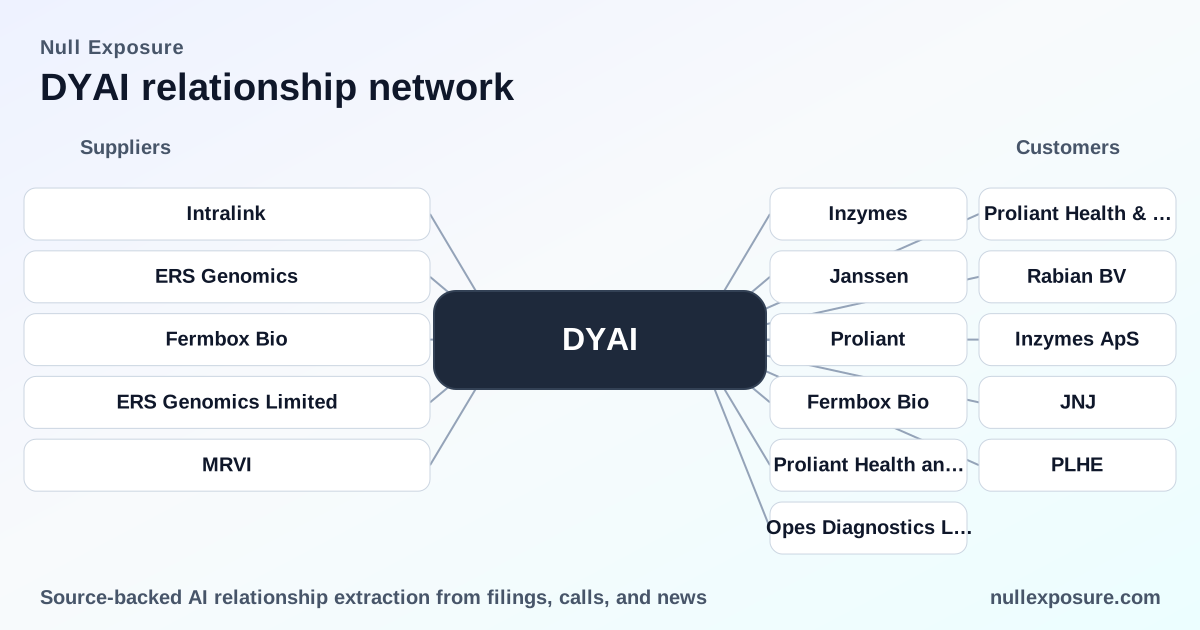
For investors evaluating supplier counterparty risk and operational leverage, this profile dissects Dyadic’s active supplier and partner relationships, highlights concentration and spend signals from company disclosures, and translates those facts into investment-relevant implications. Interested in a deeper supplier risk map? Visit https://nullexposure.com/ for more intelligence.
How Dyadic’s suppliers fit into the business model
Dyadic operates a dual commercial model: proprietary expression platforms (including the C1 and Dapibus™ systems) that it licenses to third parties, and collaborative manufacturing/commercial deals where partners manufacture and commercialize Dyadic-developed proteins and enzymes. Suppliers and contract research organizations (CROs) are integral to product development, scale-up, and regulatory testing; commercial partners execute downstream manufacturing and market access.
Key financial context: market capitalization roughly $32.8M, trailing revenue near $4.1M, and gross margin consistent with platform licensing activity. Insider ownership exceeds 25%, which aligns management incentives with continuity of these partner relationships and licensing deals.
The supplier and partner picture — every disclosed relationship
Intralink — Asia-Pacific commercial expansion (2025 Q3)
Dyadic announced a commercial partnership with Intralink to accelerate market penetration in Japan and South Korea during its 2025 Q3 earnings call, positioning Intralink as a regional business development partner to expand sales of Dyadic’s products and platform offerings. According to Dyadic’s 2025 Q3 earnings call transcript (first reported March 2026), the agreement targets accelerated market entry in key APAC markets.
ERS Genomics — CRISPR/Cas9 license to accelerate strain engineering (2025 Q3 / FY2025)
Dyadic strengthened its engineering toolkit by licensing ERS Genomics’ CRISPR/Cas9 patent portfolio to accelerate strain engineering and pathway optimization across its bioproduction platforms, enhancing productivity and product quality. This licensing arrangement was disclosed both on the 2025 Q3 earnings call and in a GlobeNewswire release describing a commercial license dated November 10, 2025.
Fermbox Bio — expanded manufacturing and commercialization collaboration (multiple notices, FY2025–FY2026)
Dyadic and Fermbox Bio expanded a strategic collaboration that authorizes Fermbox to manufacture and commercialize an expanding portfolio of Dyadic-developed proteins and enzymes using both the Dapibus™ and C1 expression systems; the announcement frames the deal as a scale-up step for animal-free proteins across life science, food, nutrition and bioindustrial markets. GlobeNewswire carried the December 17, 2025 release describing the expanded collaboration, and subsequent coverage ran through outlets including Yahoo Finance in early 2026, confirming the relationship’s continuity into FY2026.
(Additional notice) A follow-up GlobeNewswire release in December 2025 reiterated that Fermbox will use both Dapibus™ and C1 systems to commercialize Dyadic-developed products, underscoring that the relationship builds on an established commercial collaboration.
Cygnus Technologies (MRVI) — analytical support for C1-based product release testing (FY2024)
Dyadic announced a partnership with Cygnus Technologies to develop and supply a C1 Host Cell Protein ELISA assay kit to support batch release testing for C1-based products, creating a dedicated analytical supplier channel for quality control of C1-produced therapeutics and enzymes. The arrangement was included in Dyadic’s FY2024 results and described in a company release dated March 28, 2024.
Supplier concentration and procurement posture — company-level constraints
Dyadic’s public disclosures surface several company-level supply-chain constraints that are material to valuation and operational continuity:
- High vendor concentration in research services: For the year ended December 31, 2024, two CROs accounted for approximately 93% of total research services purchased and 58.9% of accounts payable, a concentration the company itself calls out in its filings. This is a critical procurement risk that directly links research continuity to a small number of vendors.
- Spend scale and contractual posture: The disclosed spend band for research services is in the $1M–$10M range, indicating meaningful annual cash flow committed to outside research and development. Dyadic’s role is predominantly buyer of research services, while also functioning as a service provider in commercial manufacturing and licensing contexts through partner agreements.
- Active and mature third‑party relationships: The company confirms ongoing engagements with multiple research providers, cGMP manufacturers and contract research organizations, signifying active operational dependence on external suppliers to achieve scientific and commercial objectives.
These signals together indicate a procurement model that prioritizes specialized third-party execution over internal scale, concentrating risk where a small number of CROs account for the majority of research spend.
Financial and strategic implications for investors
- Concentration risk is a valuation lever. When two CROs drive 93% of research spend, any disruption or pricing shift at those vendors would have immediate P&L and timeline consequences for pipeline programs; this raises scenario risk in discounted cash flow models and underpins the stock’s elevated EV/revenue multiple relative to cash flows.
- Partnerships are the primary commercialization vector. Agreements with Fermbox Bio signal a go-to-market strategy that outsources manufacturing and market access, reducing capital intensity but transferring operational execution risk to partners.
- Technology stack expansion improves optionality. The ERS Genomics CRISPR license increases Dyadic’s technical capability for strain optimization, which is strategically valuable and potentially reduces unit costs per product, but value realization depends on successful partner commercialization.
If you want a deeper supplier-risk breakdown integrated with financial modeling, explore dyadic supplier profiles at https://nullexposure.com/.
Investor action points
- Monitor vendor concentration disclosures in upcoming quarterly filings and any changes in accounts payable mix; a shift away from the two major CROs would materially reduce operational risk.
- Track commercial milestones and revenue recognition tied to Fermbox Bio manufacturing and Intralink’s APAC market expansion to validate revenue ramp assumptions.
- Evaluate the timetable and output from strain-engineering projects enabled by the ERS Genomics license as a leading indicator of margin improvement potential.
For a tailored supplier-risk report and counterparty scoring tied to Dyadic’s financials, go to https://nullexposure.com/.
Bottom line
Dyadic’s business model depends on a small set of high-impact supplier and partner relationships: CROs for R&D execution, Fermbox for manufacturing/commercial scale, ERS Genomics for engineering capability, and regional partners like Intralink for market penetration. Those relationships create asymmetric benefits—rapid scale with low capital intensity—but also concentrate operational risk in a way that investors must price explicitly. Monitor vendor concentration metrics and partner commercialization milestones as the highest-signal inputs to any valuation or operational-risk assessment.