Dyne Therapeutics (DYN): Capital markets-backed clinical-stage developer with concentrated manufacturing exposure
Dyne Therapeutics is a clinical-stage biotechnology company developing therapies for genetically-derived muscle diseases. The company currently monetizes through capital markets activity and milestone/license arrangements while pursuing product approvals; near-term funding is equity-driven, not product revenue-driven, and strategic relationships with investment banks and contract manufacturers underpin both liquidity and operational continuity.
For a direct view of supplier exposures and market relationships, visit Null Exposure.
Why the underwriting syndicate matters to investors and operators
Dyne’s latest financing cycle underscores how the company funds R&D and operations: equity raises executed through a syndicate of major underwriters. That underwriting relationship is not just a financing footnote — it is a signal of market access and investor appetite that reduces short-term liquidity risk while the company advances clinical programs.
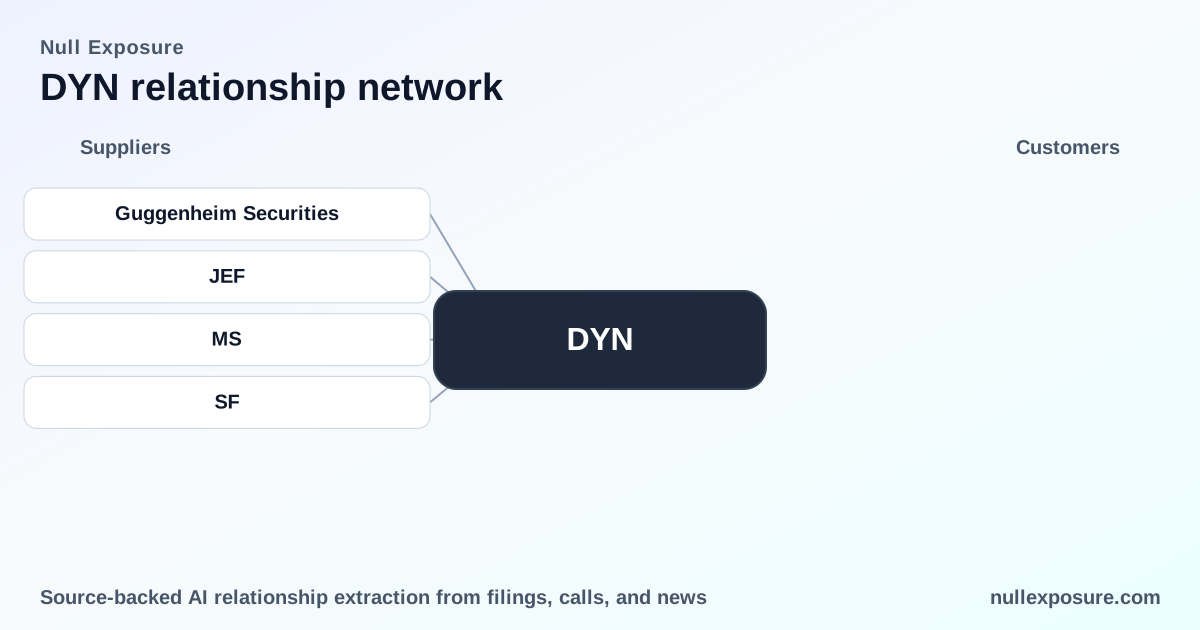
According to a March 9, 2026 news release, Morgan Stanley, Jefferies, Stifel and Guggenheim Securities acted as joint book-running managers for an upsized public offering that included full exercise of the underwriters’ option to purchase additional shares, demonstrating both demand and flexible execution capacity in the equity markets. (InvestingNews, March 9, 2026) See Null Exposure for deeper supplier network analysis.
Guggenheim Securities
Guggenheim Securities served as a joint book-running manager on Dyne’s upsized common stock offering, participating in the syndicate that executed the transaction on March 9, 2026. Source: InvestingNews report on March 9, 2026 (transaction announcement).
Jefferies
Jefferies was named among the joint book-running managers on the same offering, acting as an underwriter in the March 2026 financing and helping place the additional shares exercised by underwriters. Source: InvestingNews report on March 9, 2026.
Morgan Stanley
Morgan Stanley functioned as a joint book-runner for the upsized offering, providing distribution and institutional placement capabilities that supported the full exercise of the underwriter option. Source: InvestingNews report on March 9, 2026.
Stifel
Stifel completed the four-firm syndicate as a joint book-running manager on the equity offering, contributing to syndicate execution and aftermarket support for the March 2026 placement. Source: InvestingNews report on March 9, 2026.
Manufacturing, contracting posture and supplier concentration — the operational constraints that matter
Dyne’s operating model is characterized by a mix of fixed and flexible contracts and a high degree of manufacturing concentration that translates into operational fragility:
-
Contracting posture: The company holds a long-term real estate commitment — an 8.5-year lease that began when it occupied office and lab space in September 2021 — which fixes part of its cost base and supports laboratory continuity. At the same time, Dyne uses shorter-term, cancellable commercial contracts with many service providers, giving the company flexibility to scale or halt engagements but limiting guaranteed purchase volume. (Company filings)
-
Concentration and criticality: Dyne relies on a small number of third-party suppliers and CMOs for essential components (Fab antibody, linkers, payloads) and for conjugation and testing. There is no guaranteed redundant supply for all critical raw materials, and a disruption at one approved manufacturer could materially delay programs because qualifying an alternative requires regulatory supplements. (Company filings)
-
Spend and contractual commitment: One manufacturing agreement obligates Dyne to pay at least $60 million for production of certain product candidates through 2026, placing the supplier relationship in a $10m–$100m spend band and making these CMOs financially significant counterparties. (Company filings)
-
Relationship maturity and stage: The majority of supplier relationships are active and service-oriented — CROs and CMOs for preclinical/clinical work — reflecting a clinical-stage company that does not yet generate product revenue and will continue to rely on external service providers to reach commercialization. (Company filings)
These constraints are company-level signals rather than attributes of the bank syndicate; they drive supplier risk and should inform procurement and contingency planning.
What this means for investors, operators and procurement teams
The combined picture of strong capital-market access plus concentrated supplier risk creates a clear set of strategic priorities:
-
For investors: Underwriter support reduces immediate funding risk and validates market interest, but operational risk is concentrated — supply interruptions could force costly delays and regulatory steps that equity financings do not directly insulate against. Monitor cash runway, milestone timing and any indemnities or guarantees tied to manufacturing contracts.
-
For procurement and operations: The lack of redundant supply for critical materials elevates the importance of qualification pipelines and proactive multi-sourcing strategies. Negotiate contractual protections (service levels, supply continuity clauses, penalty regimes) and map lead times needed to qualify alternate CMOs through regulatory supplements.
-
For business development: License obligations (for example to the University of Mons) create future royalty/milestone payment profiles that will shape commercial economics post-approval and should be modeled into long-term value scenarios.
Bold takeaways:
- Capital markets provide near-term funding flexibility, evidenced by the March 2026 upsized offering run by Morgan Stanley, Jefferies, Stifel and Guggenheim Securities.
- Manufacturing is a critical single point of failure; Dyne’s dependence on a small set of CMOs and a $60 million contractual commitment through 2026 materially raises operational concentration risk.
- Contract mix is bifurcated: long-term fixed real estate costs coexist with cancelable, short-term service contracts that provide program-level flexibility but limited purchase guarantees.
If you want a structured supplier risk report and contract-mapping for Dyne’s supply chain, review our portfolio intelligence at Null Exposure.
Quick checklist for diligence teams
- Confirm the remaining term, scope and recovery options under the $60M+ manufacturing agreement through 2026.
- Map alternate CMOs and estimate time and cost to qualify each through regulatory filings.
- Stress-test cash runway under scenarios where a regulatory supplement delays a manufacturing switch by 6–12 months.
Bottom line: invest with eyes open
Dyne Therapeutics is a capital markets–financed clinical-stage biotech with credible banking partners and real operational concentration in manufacturing. The underwriting syndicate gives the company runway and market validation; supplier dependence and contractual rigidity create the most actionable downside risks for timelines and value realization. Active monitoring of manufacturing contracts, qualification pathways and cash management should be a priority for investors and operators evaluating Dyne.
For more on supplier exposures and relationship mapping, see Null Exposure.