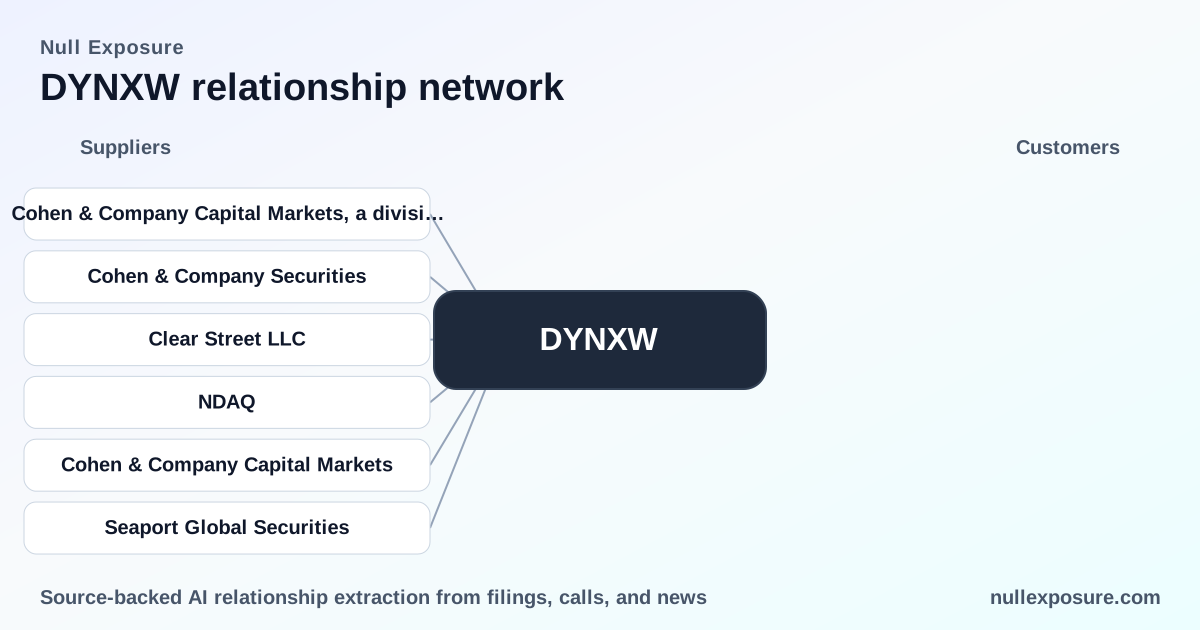
Dynamix (DYNXW) — Who Underwrote the Launch and What it Means for Supplier Risk
Dynamix Corporation pursued public-market capital by selling units in an IPO structure and listing its Class A shares and warrants (including the DYNXW warrant) on Nasdaq; the company monetizes primarily through the sale of equity units and the aftermarket trading of its listed securities, while its near-term operational profile is defined by relationships with a small set of capital‑markets partners who executed the offering. For investors and vendor managers, the immediate supplier footprint is concentrated and transactional: underwriting banks, a co‑manager, and the exchange itself provided the critical services that enabled the listing and initial liquidity event.
Explore deeper partner-level intelligence at https://nullexposure.com/
How Dynamix brought the deal to market — the headline story
Dynamix priced a 15,000,000‑unit IPO at $10.00 per unit and completed the offering that produced the listed shares and warrants investors now trade under DYNX/DYNXW; the offering was run by a compact underwriting syndicate rather than a large, diversified bank consortium, concentrating execution and placement risk with a few firms. According to a PR News release in FY2025, the company completed a $201.25 million initial public offering that closed with the named managers executing their roles (https://markets.financialcontent.com/prnews/article/gnwcq-2025-10-31-dynamix-corporation-iii-completes-20125-million-initial-public-offering). This concentrated supplier configuration is the primary operational signal for counterparties evaluating credit, settlement, and market‑making dependencies.
If you monitor capital‑markets counterparties for exposure or vendor diligence, start your workflow with this supplier map at https://nullexposure.com/
Partner-by‑partner read: who did what
Below are every relationship surfaced in the filings and press coverage, with concise, plain‑English summaries and source references.
Cohen & Company Capital Markets / Cohen & Company Securities
Cohen & Company Capital Markets (a division of Cohen & Company Securities, LLC) acted as the lead book‑running manager on the offering, responsible for pricing, distribution strategy and primary market execution (FY2025 and FY2024 reporting). According to the PR News announcement and related deal coverage, Cohen & Company Capital Markets led the syndicate that brought the units to market (https://markets.financialcontent.com/prnews/article/gnwcq-2025-10-31-dynamix-corporation-iii-completes-20125-million-initial-public-offering; https://www.renaissancecapital.com/IPO-Center/News/105578/Energy-SPAC-Dynamix-Corp-files-for-a-$150-million-IPO).
Clear Street LLC
Clear Street LLC served as a co‑manager on the offering, supporting allocation, settlement coordination and secondary market plumbing that helps newly listed securities establish tradeable liquidity (FY2025/FY2024). The company is explicitly named as co‑manager in the pricing and listing disclosures (https://markets.financialcontent.com/prnews/article/gnwcq-2025-10-31-dynamix-corporation-iii-completes-20125-million-initial-public-offering; https://www.quiverquant.com/news/Dynamix+Corporation+Announces+Pricing+of+Initial+Public+Offering+and+Nasdaq+Listing).
Seaport Global Securities
Seaport Global Securities acted as a joint book runner alongside Cohen & Company, sharing responsibilities for institutional placement and investor outreach during the IPO book‑build (FY2024). The joint book runner role is documented in the company’s offering pricing announcement (https://www.quiverquant.com/news/Dynamix+Corporation+Announces+Pricing+of+Initial+Public+Offering+and+Nasdaq+Listing).
Nasdaq
Nasdaq is the listing exchange for Dynamix’s Class A shares and warrants, where the company expected the separate securities to begin trading under DYNX and DYNXW once units split; market access, listing compliance and continuous trading venue services are therefore critical ongoing suppliers to the company’s public float (FY2024). The listing intent and ticker designations were published in the IPO pricing notice (https://www.quiverquant.com/news/Dynamix+Corporation+Announces+Pricing+of+Initial+Public+Offering+and+Nasdaq+Listing).
What this supplier mix signals about Dynamix’s operating model
- Contracting posture: Dynamix used a small, focused underwriting syndicate rather than a broad bank consortium; this indicates a contracting posture that favors concentrated, high‑touch relationships for capital‑raising rather than diversified distribution channels. That raises counterparty concentration and execution dependency on the named managers.
- Concentration: The underwriting and market‑making ecosystem for the IPO is narrowly concentrated across Cohen & Company (lead), Seaport Global (joint), and Clear Street (co‑manager), increasing single‑point risks if any partner underperforms in aftermarket support.
- Criticality: The Nasdaq listing is a critical supplier function—without the exchange’s listing and compliance services, the warrants and Class A shares would lack price discovery and secondary liquidity, which would materially affect investor exit options.
- Maturity: This is an early‑stage public company relationship; the offering completed in FY2024–FY2025 and the supplier relationships are primarily transactional around the IPO lifecycle rather than embedded, long‑term vendor contracts.
Risk and operational implications for investors and operators
The concentrated underwriting footprint creates practical considerations for treasury teams, liquidity providers, and vendor managers:
- Execution risk: A compact syndicate can deliver faster decision‑making but concentrates execution risk in primary and early secondary markets. Verify settlement practices and capacity of the co‑managers on odd‑lot handling and warrant float support.
- Liquidity partner dependency: If market‑making and aftermarket support are not broadened beyond the initial managers, warrants like DYNXW could exhibit higher bid‑ask spreads and larger price jumps on news—assess trading counterparties’ depth.
- Compliance and governance dependency: Nasdaq’s listing rules and ongoing compliance obligations are non‑transferable supplier functions—monitor exchange notifications and delisting risk indicators closely.
Key action items for counterparties and vendor risk teams:
- Reconfirm settlement and custody arrangements with the named managers and exchange.
- Monitor trading liquidity and spreads in DYNXW as a leading indicator of underwriting follow‑through.
- Maintain direct lines to the lead manager (Cohen & Company) for resale and block trade facilitation.
For a structured supplier‑risk assessment and real‑time partner monitoring, see how we map capital‑markets relationships at https://nullexposure.com/
Bottom line and recommended next steps
Dynamix’s market debut was executed through a compact, clearly identified set of capital‑markets suppliers—Cohen & Company (lead), Seaport Global (joint), Clear Street (co‑manager), with Nasdaq supplying the listing venue. That structure delivered the IPO quickly but leaves a persistent concentration of settlement, distribution and liquidity risk that commercial counterparties should explicitly address in vendor diligence and exposure limits.
- For investors: focus on aftermarket liquidity signals for DYNXW and confirm block execution capacity with Cohen & Company and Seaport Global.
- For operators and vendor managers: treat Nasdaq compliance milestones and co‑manager settlement capabilities as critical vendor controls.
If you want a tailored supplier exposure report for Dynamix and its underwriting counterparties, start here: https://nullexposure.com/