Eni SpA ADR (E): Supplier map and what it means for investors
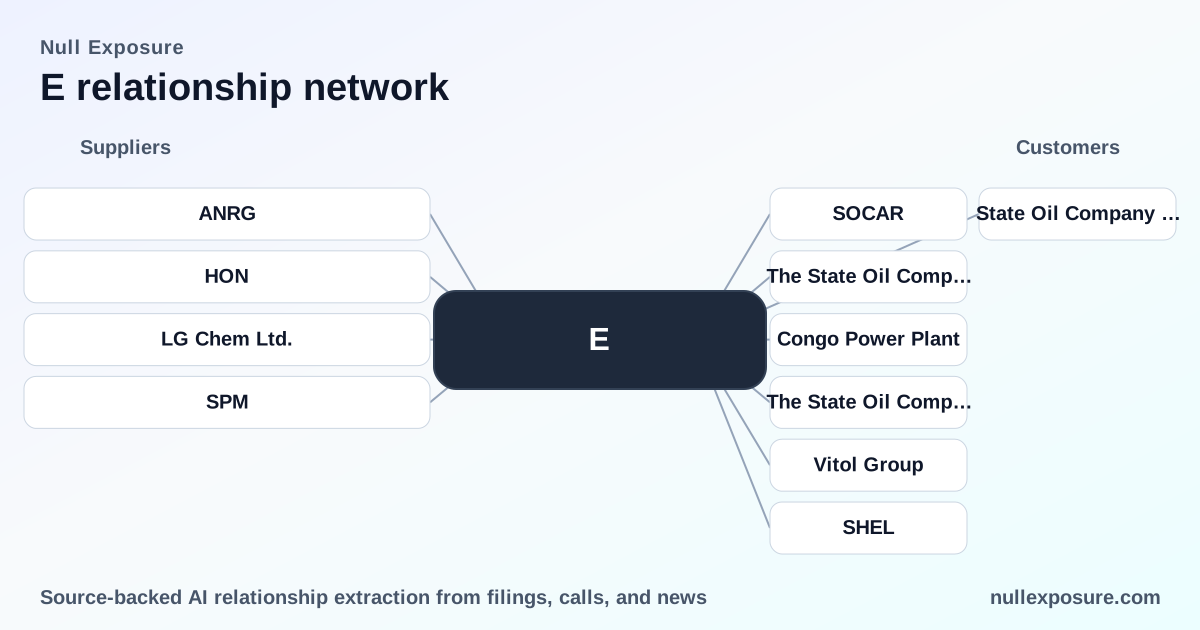
Eni is an integrated oil & gas major that monetizes through upstream production, refining and trading, and an accelerating push into biofuels and circular feedstock processing. The company funds capital-intensive exploration and refining while increasingly relying on specialized technology and EPC partners to scale its Ecofining and biorefinery roll‑outs; supplier relationships therefore matter as execution levers for Eni’s transition strategy and near‑term cash generation. For a concise supplier-risk and strategic view, visit https://nullexposure.com/.
How Eni runs procurement and why it matters to returns
Eni operates as a capital-heavy, vertically integrated operator: upstream discoveries and production deliver commodity exposure and cash flow, while refining and new‑energy projects capture margin through processing and higher‑value product conversion. Supplier contracts therefore split into two practical buckets: (1) long-cycle engineering and technology partnerships that determine the pace and economics of bio-refinery rollouts, and (2) field services and drilling providers that govern exploration upside and reserve replacement. This duality shapes contracting posture, concentration and criticality in observable ways.
- Contracting posture: Eni pursues joint development and technology licensing for biofuels and takes fixed-scope EPC/contract drilling for exploration — a mix of partnership and contractor models that transfers technical risk but leaves capital and commodity risks with the company.
- Concentration: Publicly visible relationships show Eni engaging a small number of high‑capability vendors (technology licensers and global engineering/drilling firms) rather than thousands of commodity suppliers; this concentrates counterparty and execution risk.
- Criticality: Technology partners for Ecofining and biorefinery development are mission‑critical for Eni’s energy‑transition roadmap, while drillers are critical to reserve additions that underpin upstream cash flow.
- Maturity: Relationships range from established (Ecofining with Honeywell UOP) to project-stage or contracted supply (Anaergia’s digestion technology for Gela), which implies a staggered execution timetable across assets.
Key company signals: Eni carries scale with a USD 76.5bn market capitalization and USD 83.6bn trailing revenue, but quarterly revenue and earnings growth are negative year‑over‑year, indicating short‑term cyclicality; margins are thin relative to revenue but the balance of refining and new projects supports medium‑term resilience. These are company-level signals, not supplier-specific constraints.
Supplier relationships that shape the roadmap
Anaergia Inc. — digestion tech for Gela biorefinery
Anaergia has been contracted through its Anaergia S.r.l. subsidiary to supply anaerobic digestion technology as part of a €50 million initiative at Eni’s Gela biorefinery, positioning Anaergia as a feedstock processor in Eni’s circular fuels stack (AIJourn, March 9, 2026: https://aijourn.com/anaergia-eni-and-crevolution-unveil-breakthrough-platform-to-scale-demand-for-biodiesel-and-saf/).
Honeywell UOP — co‑developer of Ecofining technology
Honeywell UOP is the established technology partner behind Eni’s Ecofining process used to convert biogenic feedstocks into drop‑in biofuels; the collaboration is cited in coverage of Eni’s expanding biorefinery program in Italy and the Priolo project with Q8 (Inspenet, March 9, 2026; OFI Magazine, March 9, 2026: https://inspenet.com/en/noticias/eni-its-third-biorefinery-in-italy/ and https://www.ofimagazine.com/news/eni-and-q8-partner-for-construction-of-priolo-biorefinery). This is a core licensor/technology relationship for Eni’s fuel‑conversion economics.
LG Chem Ltd. — South Korea biorefinery partner
Eni previously announced a partnership with LG Chem to develop a biorefinery in South Korea, with a final investment decision originally expected by end‑2024; that partnership supports Eni’s geographic expansion of biofuel capacity in Asia (Inspenet, March 9, 2026: https://inspenet.com/en/noticias/eni-its-third-biorefinery-in-italy/).
Saipem — drilling and offshore services on Murene discovery
Saipem’s drillship Santorini drilled the Murene‑1X well and intersected nearly 50 meters of net hydrocarbon pay, demonstrating that Saipem’s field services are directly enabling Eni’s exploration success in deepwater blocks (The Globe and Mail reporting on Eni press release, March 9, 2026: https://www.theglobeandmail.com/investing/markets/stocks/E/pressreleases/285880/eni-unveils-energy-discovery-in-block-ci-501-with-murene-south-1x-well/).
What these relationships imply for risk and upside
The supplier map shows a clear strategic posture: outsourced technology and specialized field services accelerate Eni’s transition and exploration agenda while keeping capital and commodity exposure on the company. That levered model amplifies both upside and execution risk:
- Upside: Successful rollouts of Ecofining and allied biorefineries convert feedstock access into higher‑margin refined products, improving long‑term EBITDA contribution relative to simple commodity sales. This is supported by Eni’s reported EBITDA of USD 13.97bn and an EV/EBITDA of ~3.9, which leave headroom to fund strategic capex if execution stays on plan.
- Execution risk: Concentrated reliance on a handful of technology and engineering partners concentrates counterparty and schedule risk; delays or technology setbacks in biofuel projects would directly hit near‑term margin expansion assumptions.
- Exploration leverage: Saipem‑type drill successes translate to reserve growth and optionality; conversely, drilling cost inflation or contractor availability could impede near‑term production additions.
For a deeper supplier-risk dashboard and portfolio-level scoring, review the supplier insights at https://nullexposure.com/.
Trading and valuation context for investors
From a valuation standpoint, Eni trades at a trailing P/E of 28.8 but a forward P/E of 14.8, reflecting analyst expectations for earnings recovery or normalization; the stock shows relatively low beta (0.57), indicating muted market volatility compared with peers. Institutional ownership is modest in the provided snapshot, and consensus analyst ratings skew toward hold with isolated sell views. These data points reinforce the idea that execution on biofuels and steady upstream cash flow will drive the next re-rating.
Practical takeaways and tactical considerations
- Execution focus: Monitor project milestones with Honeywell UOP and Anaergia for timing of capacity coming online; these are the primary levers for margin improvement in Eni’s transition path.
- Reserve-risk balance: Track drilling activity and success rates with Saipem to gauge upstream cash‑flow upside that underpins dividend capacity and capital allocation.
- Geographic diversification: Partnerships like LG Chem expand Eni’s footprint into Asia, reducing single‑market policy or feedstock risk and supporting volume growth.
If you want a consolidated supplier-risk profile and timeline for Eni’s biorefinery rollouts, see the supplier dossiers at https://nullexposure.com/ — they streamline vendor exposure into investable signals.
Bottom line
Eni’s supplier relationships reveal a deliberate strategy: leverage best‑in‑class technology licensors and field contractors to scale biofuels while preserving upstream control of commodity economics. That strategy supports medium‑term earnings resilience but concentrates execution risk in a small set of partners; investors should watch technology deployment milestones and exploration outcomes as the highest‑impact catalysts. For further supplier intelligence and monitoring tools, visit https://nullexposure.com/.