Electronic Arts (EA): who’s supplying capital, IP and services as the company navigates a $55B takeover
Electronic Arts is a large-cap video-game publisher that monetizes through premium game sales, recurring live-service revenue (in-game purchases and subscriptions), and licensing of major sports IP; recent headlines show the company becoming the center of a leveraged buyout financed by a large banking syndicate. EA generates steady cash from live services and royalties while exposing itself to concentrated third‑party licensor and financing relationships that change its risk profile during a buyout. Learn more at https://nullexposure.com/.
The financing story — banks are underwriting the LBO and that matters for suppliers
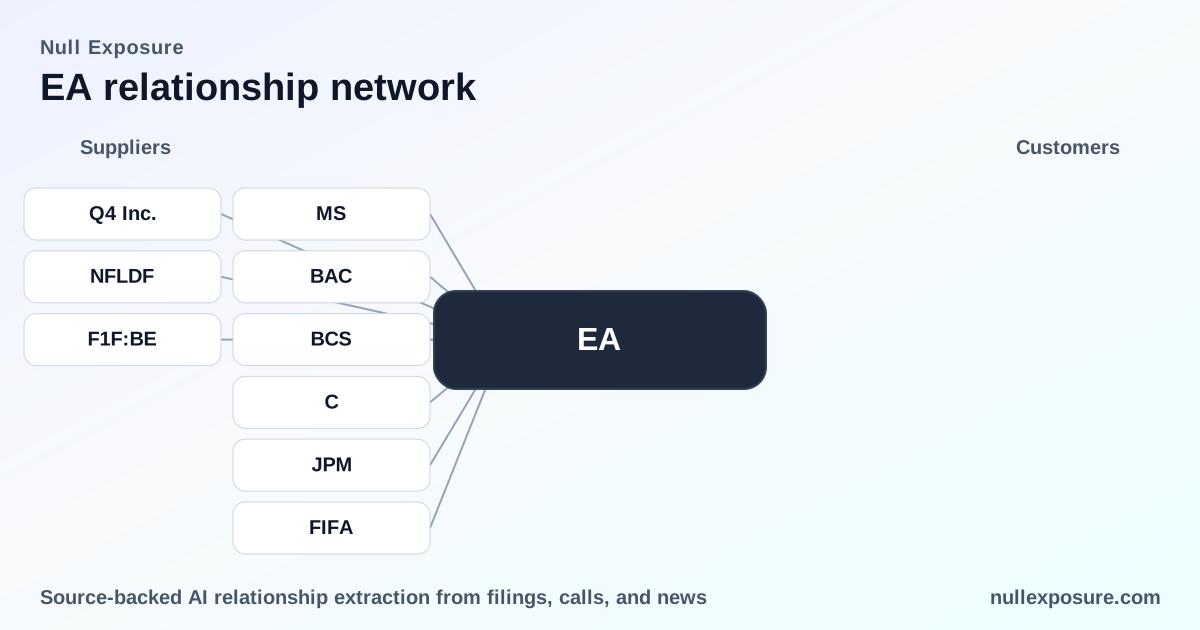
A consortium led by Silver Lake, anchored by Savvy Games Group, agreed to take EA private in a roughly $55 billion transaction that uses about $20 billion of syndicated debt underwritten by a banking syndicate. JPMorgan is the lead arranger and will market the debt; roughly 20 banks are reported as participating in the financing, including Bank of America, Citigroup, Morgan Stanley and Barclays. This financing commitment shifts EA’s counterparty exposure toward its lenders and raises the practical importance of banks as suppliers of capital and underwriting services. (RTTNews, March 9, 2026; Markets FinancialContent, February 20, 2026).
Visit https://nullexposure.com/ for a deeper supplier risk view.
How EA’s commercial model shapes supplier relationships
EA’s operating model combines IP licensing, platform/console manufacturing economics, and large-scale capital markets relationships. The company pays royalties to licensors for use of sports brands, pays per-unit royalties to console manufacturers for packaged goods, and maintains active relationships with banks and capital markets counterparties when transaction activity spikes. Those elements create a mix of predictable recurring supplier costs (royalties), episodic manufacturing and platform fees, and high-concentration capital providers during M&A activity. The result: supplier criticality varies from routine (royalties, platform fees) to strategic and high-impact (syndicated debt providers).
Comprehensive supplier relationships found in the reporting
Below I list every relationship captured in the results and explain why each matters for investors and operators.
Morgan Stanley
Morgan Stanley is named among about 20 banks participating in the syndicated financing for EA’s take-private, positioning it as a co‑underwriter in the $20 billion debt package. (RTTNews, March 9, 2026).
Bank of America Corp.
Bank of America is identified as a participating bank in the syndicated debt that will help finance the EA acquisition, making it a debt underwriter/syndicate member with fee and execution exposure tied to the LBO. (RTTNews, March 9, 2026).
Barclays Plc
Barclays appears on the list of approximately 20 banks backing the financing, implying underwriting or distribution responsibilities for the debt offering behind the takeover. (RTTNews, March 9, 2026).
Citigroup Inc.
Citigroup is another named syndicate participant, meaning Citi will share in underwriting, distribution and the reputational exposure associated with the EA LBO financing. (RTTNews, March 9, 2026).
JPMorgan Chase & Co.
JPMorgan is the lead arranger and bookrunner on the $20 billion syndicated debt for the $55 billion transaction and is cited repeatedly in market coverage as the principal banking counterparty executing the debt placement. That makes JPMorgan the single most critical capital-market supplier in the current corporate action. (RTTNews, March 9, 2026; Markets FinancialContent, February 20, 2026; MarketBeat, March 7–8, 2026).
FIFA
FIFA is listed as an intellectual property owner whose rights EA uses for its sports titles; EA acknowledges FIFA among the licensed properties used under permission, making FIFA a content licensor and a revenue-driver for EA’s sports franchises. (EA press release, July 30, 2024).
Q4 Inc.
Q4 Inc. appears as the investor-relations/web vendor powering EA’s IR content delivery ("Powered By Q4 Inc."), indicating Q4 provides communications and investor-relations software used in EA’s outreach. (EA press release, July 30, 2024).
NFL
The NFL is named as a property owner whose rights EA uses for certain titles (John Madden reference), making it another licensor of key sports IP for EA’s portfolio. (EA press release, July 30, 2024).
F1
F1 (Formula 1) is listed among the IP owners used by EA under permission, representing a specialized sports licensor for racing titles in EA’s catalog. (EA press release, July 30, 2024).
Constraints and what they tell investors about EA’s supplier posture
EA’s public disclosures contain two company-level relationship signals:
-
Licensor role: EA’s contracts with licensors sometimes include minimum guaranteed royalty payments recorded as assets and liabilities when EA bears revenue risk; this indicates EA’s licensing model involves contractual guarantees and places a share of revenue volatility and cost on the company rather than the licensor. That increases fixed-cost-like obligations tied to IP agreements and raises downside underperformance risk. (Company disclosure excerpt).
-
Manufacturer role: EA pays per-unit royalties to console manufacturers for packaged goods, demonstrating that packaged distribution still incurs per-unit supplier fees and ties EA’s unit economics to hardware shipments and platform agreements. This maintains an ongoing supplier cost that scales with physical sales. (Company disclosure excerpt).
Taken together, these constraints show a mixed maturity profile: licensing agreements are long‑standing and critical to EA’s franchise economics, while manufacturing/console royalties are residual but persistent. Contracts include fixed commitments that can be material if revenues soften, and capital sourcing has become an acute concentration risk during the LBO process.
What this means for investors and operators
- Banks matter now more than usual. The LBO forces EA into a capital structure with concentrated lender exposure; underwriting fees are near-term revenue for banks and long-term balance-sheet implications for EA. (RTTNews; Markets FinancialContent).
- Licensing is both a moat and a liability. High-profile sports IP drives revenue but brings minimum guarantee obligations that act like fixed costs. (EA press release and company disclosures).
- Operational counterparties remain diverse but asymmetric. IR platforms like Q4 are low-friction suppliers; console manufacturers and licensors carry higher operational and financial consequence.
If you’re evaluating counterparty risk or supplier concentration for EA—whether for procurement, credit, or investment analysis—start by mapping the syndicate commitments and by stress-testing royalty guarantee scenarios against live-service revenue trajectories. For a supplier-focused analysis and historical relationship traceability, visit https://nullexposure.com/.
Actionable next steps
- Review the syndicate composition and underwriting terms in the deal prospectus to quantify lender covenants and repayment timelines; JPMorgan is the lead arranger and therefore the primary contact point on execution. (RTTNews; Markets FinancialContent).
- Audit royalty guarantees and console-fee schedules in EA’s most recent filings to model fixed-cost exposure under downside scenarios; the company discloses minimum guaranteed royalties and per-unit console fees in its contract summaries.
- For a supplier-level risk map and monitoring cadence tailored to EA and peer publishers, start here: https://nullexposure.com/.
Bold takeaways: EA’s revenue mix secures steady cash flows but contractual guarantees and the recent LBO financing materially concentrate supplier risk toward licensors and banks. Investors and operators should prioritize covenant analysis and royalty‑obligation stress tests as part of valuation and counterparty diligence.