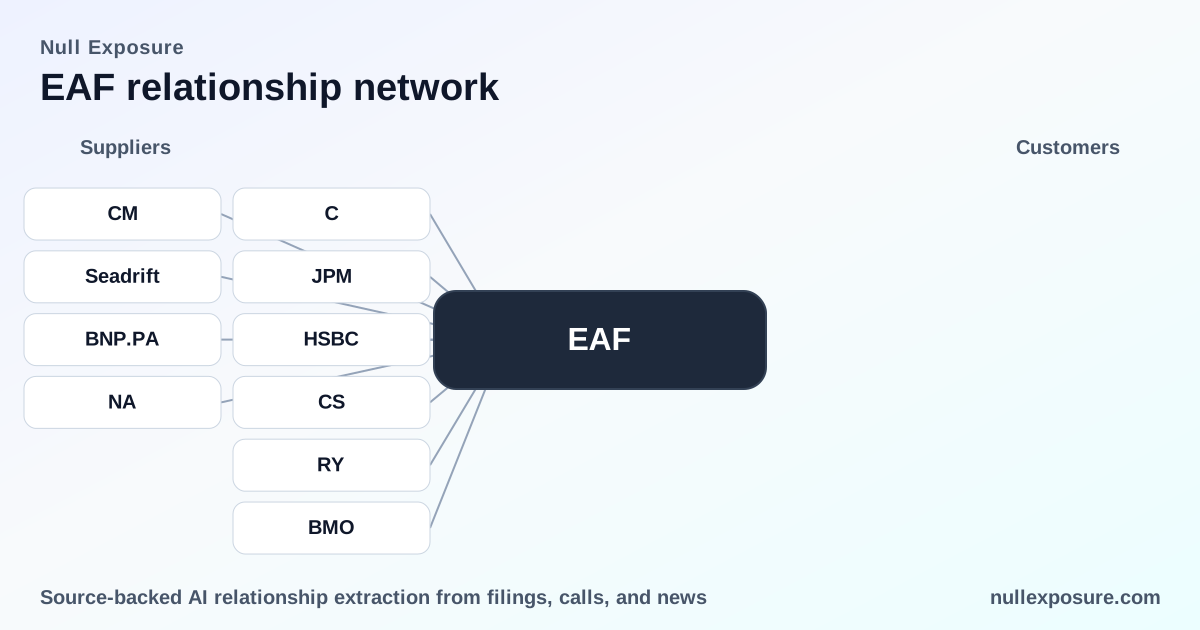
GrafTech (EAF): Supplier relations and contract signals that matter to investors
GrafTech International Ltd. manufactures graphite and carbon products and monetizes through industrial sales to steelmakers, battery component manufacturers and other industrial end‑markets, with revenue generation driven by product sales, vertical integration of feedstock (needle coke) and contractual raw‑material procurement. The company’s commercial posture is a manufacturing supplier with meaningful procurement commitments and a small market capitalization relative to revenue, making counterparty relationships — both capital markets partners and feedstock buyers/suppliers — material to cash flow stability and operational continuity.
If you want a concise map of GrafTech’s counterparties and what they imply about procurement and underwriting risk, start here: https://nullexposure.com/
Operational and financial snapshot GrafTech reported roughly $504.1M in trailing‑twelve‑month revenue with negative EBITDA (about -$12.0M) and a deeply negative EPS (diluted EPS -8.55). Market capitalization sits around $148M, insiders control a substantial stake (~37%) and institutions hold ~40%. These facts frame counterparty risk: suppliers and underwriters are important because the firm operates with narrow equity value and negative profitability.
Key business model characteristics
- Contracting posture: committed purchase obligations for raw materials are explicitly reported, indicating binding procurement that supports production but creates fixed cash outflows.
- Concentration: vertical integration with Seadrift for needle coke supply introduces a concentrated supply chain relationship that is strategically important.
- Criticality: feedstock and decant oil sourcing are operationally critical inputs; disruptions would directly affect production.
- Maturity: the company’s relationships include institutional investment banks that managed an IPO, signaling an established capital markets engagement despite public company financial stress.
Read more on GrafTech counterparties and contract exposure at https://nullexposure.com/ (it’s a practical starting point for diligence).
Counterparty map: underwriters, co‑managers and a strategic vertical partner Below I cover every named relationship found in public reporting and earnings commentary — each entry is a plain‑English single point with a concise source reference.
- J.P. Morgan — Co‑lead underwriter for GrafTech’s IPO, listed alongside other global banks that syndicated the offering; this establishes institutional distribution capacity and a formal capital markets relationship. (MarketBeat instant alert, Jan 20, 2026)
- Credit Suisse — Co‑lead underwriter and principal syndicate participant in the IPO, indicating engagement by European capital markets intermediaries. (MarketBeat instant alert, Jan 20, 2026)
- Citigroup — Co‑manager on the IPO syndicate, providing distribution and research reach across client networks. (MarketBeat instant alert, Jan 20, 2026)
- RBC Capital Markets — Syndicate co‑manager for the offering, supplying Canadian capital markets coverage and institutional placement capabilities. (MarketBeat instant alert, Jan 20, 2026)
- HSBC — Co‑manager on the IPO syndicate, adding global banking distribution to GrafTech’s equity event. (MarketBeat instant alert, Jan 20, 2026)
- BMO Capital Markets — Co‑manager on GrafTech’s IPO, contributing North American syndication capacity. (MarketBeat instant alert, Jan 20, 2026)
- BNP PARIBAS — Part of the co‑manager group for the IPO syndicate, confirming Continental European participation. (MarketBeat instant alert, Jan 20, 2026)
- CIBC Capital Markets — Included among co‑managers, reinforcing Canadian institutional placement for the equity issuance. (MarketBeat instant alert, Jan 20, 2026)
- National Bank Financial — Listed as a co‑manager for the offering, representing regional capital markets support. (MarketBeat instant alert, Jan 20, 2026)
- Seadrift — Strategic vertical partner for needle coke/raw material integration; GrafTech cited vertical integration with Seadrift as a competitive advantage in supplying needle coke and other raw materials. (Earnings call transcript coverage, Q3 2025, InsiderMonkey)
These relationships split into two functional buckets: the banking syndicate that handled GrafTech’s equity issuance (J.P. Morgan, Credit Suisse, Citigroup, RBC, HSBC, BMO, BNP Paribas, CIBC, National Bank Financial) and the industrial commercial partner (Seadrift) that affects supply chain and margin.
What the counterparty list implies for procurement and financing risk
- Bank syndicate breadth reduces placement concentration risk for capital events: the IPO was syndicated across major global and regional banks, providing distribution depth. (MarketBeat, Jan 2026)
- Vertical integration with Seadrift increases supply stability but creates counterparty concentration on feedstock flows; the company explicitly cites Seadrift integration as an advantage for needle coke supply, which is critical for certain end markets. (Q3 2025 earnings call transcript)
- Committed raw‑material purchase obligations indicate fixed procurement cash flows, which tighten working capital demands in a negative‑EBITDA environment; GrafTech reports committed purchases line items that translate into non‑discretionary spend. This is a company‑level signal drawn from reported committed purchase obligations in fiscal filings.
Constraints and procurement signals you need to factor into valuation
- Geography and sourcing: Seadrift sources decant oil from U.S.‑based suppliers, indicating North American supply chains for certain inputs and potential benefits from domestic supplier stability. (Earnings call Q3 2025)
- Buyer role and spend magnitude: the same excerpt positions Seadrift as a buyer of decant oil; constraints data map that relationship into a $1M–$10M spend band, which suggests material but not multi‑hundred‑million dependency. (Earnings call Q3 2025; committed purchase reporting)
- Company procurement posture: GrafTech’s published committed purchase obligations for raw materials demonstrate contractual purchasing that supports production continuity but reduces flexibility when volumes or prices shift.
Mid‑report practical next step: evaluate counterparty legal terms and purchase timing Underwriting relationships explain past capital access; procurement and vertical integration explain future margin resilience. Focus diligence on the length and cancellability of purchase obligations, pricing pass‑through mechanics for needle coke and decant oil, and whether Seadrift arrangements are exclusive or preferred. Use the public filings and call transcripts as primary documents. For investors building a relational due diligence pack, see https://nullexposure.com/ for an organized starting point.
Closing view and investor action GrafTech’s topline scale and vertical feedstock linkages are real advantages, but negative margins and committed procurement obligations compress financial flexibility. The bank syndicate behind the IPO provides capital markets credibility, while Seadrift represents a strategically critical supplier/buyer relationship that requires close monitoring. For portfolio managers and operators, the immediate priorities are (1) obtain the purchase‑obligation schedules and contract break clauses, (2) quantify the economic benefit and exclusivity of Seadrift integration, and (3) stress‑test cash flow under higher input costs and lower revenue scenarios.
For a streamlined way to map those counterparty contracts and obligations during diligence, start here: https://nullexposure.com/
If you need a tailored briefing or a counterparty risk deck for GrafTech, the path is clear: assemble contract schedules, underwriter engagement letters and the Seadrift integration term sheet, then stress test liquidity under committed purchase outflows and depressed EBITDA. For more on counterparty mapping and supplier constraints, visit https://nullexposure.com/