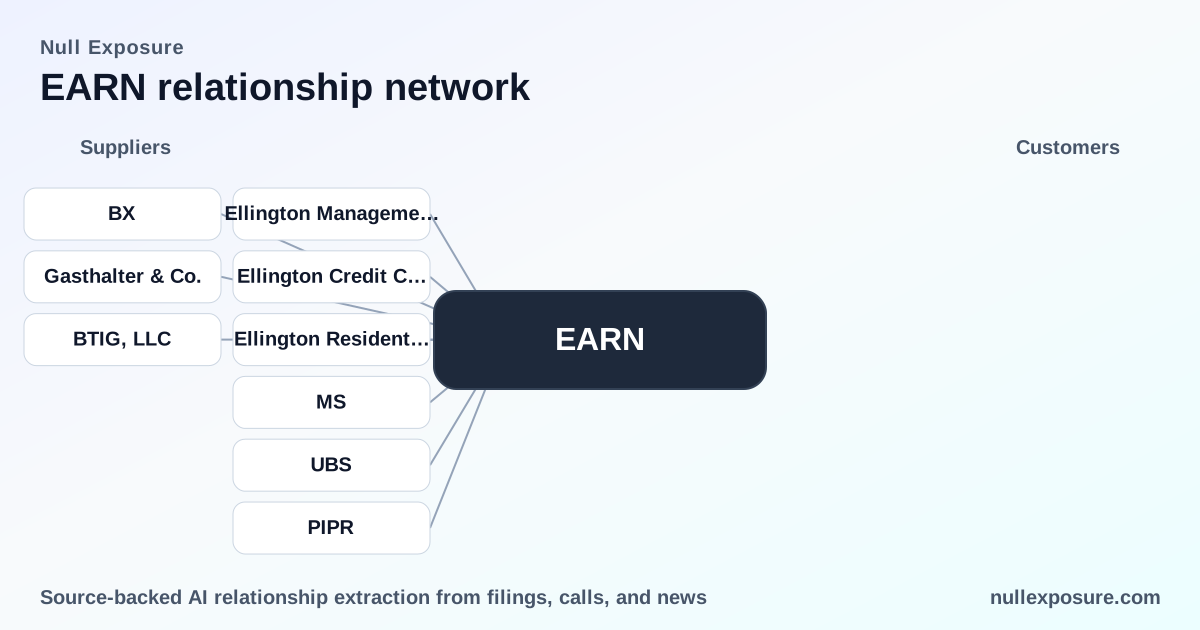
Ellington Residential Mortgage (EARN): supplier map and what it means for investors
Ellington Residential Mortgage operates as an externally managed mortgage REIT that acquires and manages residential and mortgage-related credit and monetizes through interest income on mortgage assets and fee arrangements with its external manager and administrator; the manager collects a 1.50% annual management fee on shareholders’ equity, while the REIT finances a material portion of its portfolio with short-term repurchase agreements. This combination of asset yield, externally supplied operating capability, and short-term funding drives both the upside and the principal operating risks investors must price. For a concise supplier-risk dashboard and further analysis visit https://nullexposure.com/.
How the company structures its operating spine
Ellington uses an externalized operating model: investment decisions, back-office administration, and day-to-day operations are provided by affiliate managers and administrators rather than in-house employees. That posture reduces fixed payroll costs and concentrates execution risk in a small set of vendors; it also creates predictable fee lines (notably the 1.50% management fee) and recurring service contracts that are subject to renewal and governance approvals. The REIT relies on short-term repo financing (typical tenors 30–364 days) to leverage its mortgage holdings, exposing it to liquidity roll and market-repricing risk when counterparties re-price or decline to renew facilities.
- Contracting posture: evidence shows a mix of multi-year advisory and administration agreements with automatic renewal provisions alongside a steady reliance on short-term financing instruments.
- Concentration and criticality: the Adviser/Administrator role is critical — the REIT has no direct employees and depends on affiliates for investment, operations, and information systems.
- Maturity and renewal: management/administration arrangements have initial multi-year terms and annual renewal mechanics that require board or shareholder approvals, embedding governance checkpoints but also vendor-dependence.
- Funding and counterparty risk: repo funding tenor and counterparty mix indicate exposure to both large global banks and middle-market CLO issuers, creating a hybrid counterparty profile that is sensitive to market stress.
Supplier relationships — what the market references
Below I cover every supplier relationship surfaced in the filings and press coverage, with plain-English summaries and source notes.
Ellington Management Group, LLC
Ellington Management Group is the parent manager network providing investment professionals and services; the REIT is externally managed by an affiliate of Ellington Management Group under a management/advisory relationship. According to investor commentary and high-dividend coverage in 2026, Ellington’s affiliate acts as the external manager. (Source: SureDividend coverage referencing FY2025).
Ellington Credit Company Management LLC
Ellington Credit Company Management LLC is identified as the external manager and adviser for the company (the entity named in recent press releases describing advisory and administration arrangements). The company’s 2025 press release on distribution tax treatment confirms that the REIT is externally managed and advised by this Ellington-affiliated manager. (Source: FinancialContent / BizWire press release, Jan 31, 2025).
Ellington Residential Mortgage Management LLC (former name / rebrand)
The management entity formerly known as Ellington Residential Mortgage Management LLC was renamed in the conversion and rebranding process; a 2024 corporate release documents the rebrand to Ellington Credit Company Management LLC, confirming continuity of services under a new legal name. (Source: BizWire corporate rebranding release, Apr 19, 2024).
Morgan Stanley & Co. LLC
Morgan Stanley acted as a joint book-running manager for a public offering of common shares, indicating capital markets relationship capacity for equity raises. (Source: BizWire offering notice, Jun 15, 2021).
UBS Securities LLC
UBS Securities likewise served as a joint book-running manager for the same offering, showing participation by large investment banks in the REIT’s equity issuance process. (Source: BizWire offering notice, Jun 15, 2021).
Piper Sandler & Co.
Piper Sandler participated as a co-manager on the equity offering, representing the broader syndicate of underwriters used to place new shares. (Source: BizWire offering notice, Jun 15, 2021).
Blackstone Securities Partners L.P.
Blackstone Securities Partners is listed among the co-managers for the offering, signalling institutional distribution partners and an ability to access sizeable underwriting syndicates. (Source: BizWire offering notice, Jun 15, 2021).
BTIG, LLC
BTIG is another co-manager named on the 2021 offering, completing the mix of boutique and bulge-bracket banks used for distribution. (Source: BizWire offering notice, Jun 15, 2021).
Gasthalter & Co.
Gasthalter & Co. appears as the media/PR agency for distribution of investor communications and press contacts for the REIT’s corporate filings and releases. (Source: FinancialContent / Penticton Herald pick-up of the Jan 31, 2025 press release).
Operational constraints and what they signal for investors
The source material surfaces multiple constraint signals that shape vendor risk and funding stability.
- Contract tenor mix (company-level signal): the firm runs longer-term management and administration agreements with initial two‑year terms and automatic renewal mechanics, which supports operational continuity but concentrates control with the manager/administrator. Simultaneously, the balance sheet relies on short-term repo funding (30–364 days), creating a liquidity profile that is inherently sensitive to market repricing and roll risk.
- Service-provider dependency (company-level signal): the REIT has no employees and depends on external managers and administrators to perform investment, accounting and operational functions; that elevates third‑party operational and cyber risks as central enterprise risks.
- Counterparty and geographic footprint (company-level signal): investments include exposure to middle-market CLOs and large global financial institutions and may extend to non‑U.S. CLO issuers, implying a blended counterparty risk across domestic and international channels.
- Materiality signals (company-level signal): disclosures contain both statements that cybersecurity incidents have not materially affected operations to date and explicit language that operational failures or valuation errors could materially impact performance — investors should treat operational risk as economically meaningful even if not yet realized.
- Spend and fee visibility: quarterly management fees reported around $0.9 million in Q1 2025 give a read on the recurring cash outflow to the manager and the relative scale of external operating spend (company-level signal).
If you want a formatted risk-and-contract summary or a supplier-concentration heatmap, visit https://nullexposure.com/ for the full vendor-risk toolkit.
Investment implications — the short list for investors
- Positive: the external manager provides institutional investment capability and access to markets and distribution partners; the REIT’s structure concentrates fee economics and lowers fixed employment cost. The management fee is explicit and predictable.
- Negative: reliance on short-term repo financing creates roll and market liquidity risk; vendor concentration and externalized operations create operational and governance dependencies that can magnify stress during market dislocations.
- Practical action: value the security of the manager/administrator relationship and the REIT’s ability to roll repos under stress when modelling downside scenarios.
For a direct look at supplier relationships and to compare EARN against peers on vendor concentration, go to https://nullexposure.com/.
Bottom line: Ellington Residential Mortgage is an externally run, fee‑driven REIT with clear operational centralization and short-term funding exposure that investors must model explicitly into yield, volatility and liquidity assumptions. If you are evaluating EARN for a yield allocation, scrutinize counterparty diversity on repo lines and the governance mechanics that renew management and administration agreements. For more supplier-focused investment research, visit https://nullexposure.com/.