EASY supplier relationships: what investors need to know
EASY operates as a supplier in the enterprise communications ecosystem, with its commercial footprint built around the ownership, transfer, and servicing of messaging assets and related subsidiaries; the company monetizes through discrete asset transactions, cash consideration on divestitures, and the follow-on provisioning of support and licensing for those messaging services. This record of transactions is consistent with a supplier whose revenue profile is driven by asset-level deals and contract renewals rather than high‑volume recurring SaaS subscriptions. For a concise supplier-risk briefing and deeper counterparty mapping, visit https://nullexposure.com/.
Market signal and quick take
- Key takeaway: The relationship records show a notable asset transaction tied to enterprise messaging brands, underlining EASY’s exposure to communications infrastructure and legacy messaging IP.
- Investment implication: Investors should treat EASY as a specialist supplier whose cash flows are sensitive to one-off asset sales and the economics of maintaining legacy messaging services.
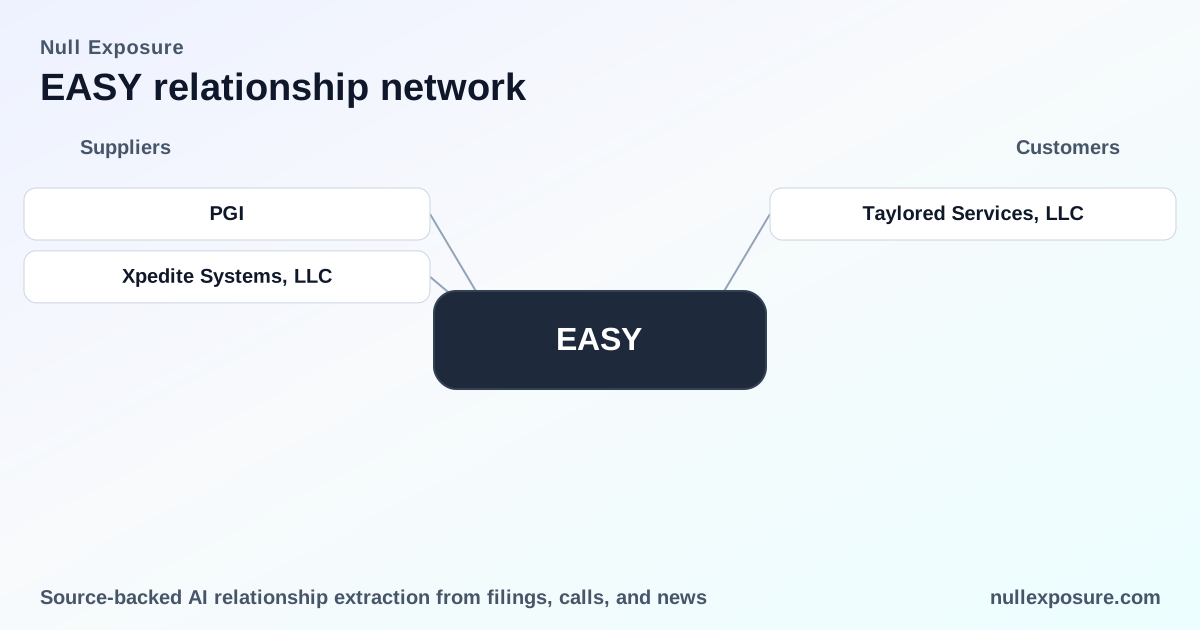
How the public record ties EASY to messaging assets The relationships returned for EASY show two linked entities: Premiere Global Services, Inc. (PGI) and Xpedite Systems, LLC. Both entries point to the same corporate action: the sale of PGiSend and PGiNotify advanced messaging businesses through the transfer of Xpedite Systems for $105 million in cash. According to a contemporaneous news report, this was an explicit asset transaction recorded in the FY2010 cycle (https://www.nbcnews.com/id/wbna39785028). That transaction is the principal public touchpoint between EASY and these legacy messaging assets.
Detailed relationship summaries
-
Premiere Global Services, Inc. — The record documents the disposition of PGiSend and PGiNotify by Premiere Global Services via the sale of its wholly owned subsidiary, Xpedite Systems, in FY2010 for $105 million in cash, illustrating a material messaging‑asset divestiture. Source: NBC News reporting on the FY2010 transaction (https://www.nbcnews.com/id/wbna39785028).
-
Xpedite Systems, LLC — Xpedite is named as the wholly owned subsidiary that carried PGiSend and PGiNotify and was sold for $105 million in cash; the company functioned as the corporate vehicle for those messaging capabilities prior to the transfer. Source: NBC News reporting on the FY2010 transaction (https://www.nbcnews.com/id/wbna39785028).
What these relationships imply about EASY’s operating and business model
-
Contracting posture: EASY demonstrates an asset‑centric contracting posture. The public record highlights discrete M&A-style transfers rather than long-term platform licensing announcements. That indicates negotiations and contracting cycles are transaction-driven and episodic, with significant legal and cashflow events at the point of transfer.
-
Concentration and criticality: The visible relationships concentrate on enterprise messaging — a service class that is operationally critical to customers that rely on legacy messaging for alerts, notifications, or regulated communications. Investors should note that even a small number of asset relationships can imply high criticality if those assets underpin customer operations.
-
Revenue mechanics and maturity: The FY2010 timing of the documented sale signals that at least part of EASY’s supply-side activity involves mature, legacy technology stacks. Revenue from such assets often includes upfront consideration from sales plus ongoing support or migration services, rather than large, fast-scaling subscription revenue.
-
Counterparty profile: The linkage to a public company (Premiere Global Services, NYSE:PGI) for a cash sale suggests EASY’s counterparties operate at scale and transact in sizable cash deals; this raises both opportunity (large-ticket transactions) and operational scrutiny (complex integration or transfer risks).
Constraints and what’s not in the record
- The relationship data contains no recorded constraints for EASY at the company level. This absence is itself a signal: there are no flagged contractual restrictions, explicit maturity flags, or concentration metrics captured in these relationship entries that would otherwise alter the supplier risk profile. Investors should treat this as a neutral data point that requires corroboration from contract-level diligence and tranche-specific filings.
Risk vectors investors should monitor
- Asset concentration risk: A supplier focused on a narrow set of messaging assets is exposed if demand shifts to cloud-native notification platforms.
- Legacy maintenance liability: Mature messaging systems carry ongoing cost and compliance burdens that can erode margins over time.
- Counterparty execution risk: Large one-off transactions with public entities elevate execution and integration risk; timelines and cashflow recognition can be lumpy.
- Information gaps: The public relationship list is short; absence of broader partner data increases the premium on primary diligence.
Practical next steps for investors and operators
- Demand contract-level disclosure for any material messaging assets and confirm service-level obligations that survive divestiture.
- Quantify revenue run-rate tied to legacy messaging versus new-service revenue to assess sustainability.
- Stress-test scenarios where customers migrate off legacy messaging platforms and model the cost of support/transition.
For a deeper supplier risk profile or to map EASY’s full counterparty universe, consult the centralized resource at https://nullexposure.com/ — it provides investor-grade relationship intelligence and remediation tools.
Final assessment and action EASY’s recorded supplier relationships are concentrated and transaction-driven, centered on legacy enterprise messaging assets that historically move via sizable cash transactions. For investors, the priority is to distinguish recurring service economics from one‑off asset sale proceeds and to understand the post-sale service obligations that can affect margins and cashflow. Operators negotiating with EASY should insist on clear transition support terms and an audit of legacy systems to avoid unforeseen maintenance liabilities.
If you want a tailored briefing or a deeper exposure map for EASY, start here: https://nullexposure.com/.