Brinker International (EAT): supplier posture, material relationships, and what investors should price in
Brinker International operates and monetizes a portfolio of casual-dining restaurants through company-owned locations and franchise relationships, collecting revenue from on-premise sales, franchise fees and royalties, and property-level economics. The company converts scale and standardized operations into operating margin through labor optimization, menu engineering, and capital investments in kitchen automation. For investors and operators underwriting Brinker exposure, the supplier map is a lens on fixed-cost leverage, capex cadence, and third-party operational dependencies — all of which feed directly into margin sustainability and downside sensitivity. Visit https://nullexposure.com/ for a consolidated view of supplier risk across restaurant portfolios.
Why supplier relationships matter for a restaurant operator’s financial profile
Brinker’s income statement and cash flow profile are tightly coupled to two supplier realities: large, long-dated occupancy commitments and technology/capital equipment suppliers that drive throughput and labor productivity. Revenue of roughly $5.69 billion (TTM) and reported EBITDA of about $809.9 million give the company scale, but scale amplifies supplier concentration effects — a change in lease structure, a rollout of new kitchen equipment, or an outsourcing vendor failure would have outsized impact on branch-level economics and margin flow-through.
- Occupancy economics act as fixed-cost leverage: Brinker discloses initial lease terms of 10–20 years with renewal options, and the company records meaningful lease costs on its books. These are not short-term, easily reversible inputs.
- Capital equipment rollouts transform variable cost profiles into capex-driven productivity gains: Kitchen automation programs reduce hourly labor needs and raise throughput, shifting the cost base from wages toward depreciation and service contracts.
- Selected processes are outsourced to service providers: Critical functions such as credit-card authorization, payroll, tax filings, and certain IT services run through third parties, creating operational dependency beyond simple vendor supply.
If you are evaluating supplier risk for premium finance or strategic contracting, Brinker’s profile demands both covenants around lease and capex exposure and proactive monitoring of automation adoption rates. For tools to map and monitor these supplier relationships, see https://nullexposure.com/.
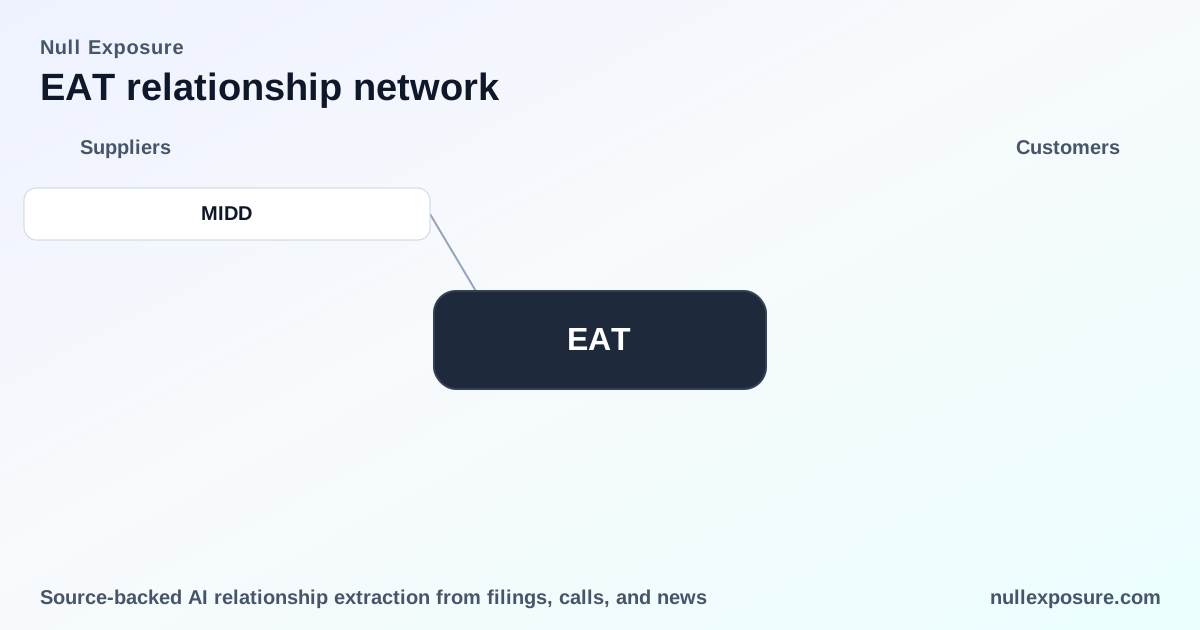
TurboChef (inferred MIDD) — the one material supplier relationship flagged
TurboChef is identified in public reporting as a component of Brinker’s kitchen automation strategy; industry commentary tied TurboChef rollout to ongoing throughput and cost-structure improvement. A Simply Wall St analysis published March 9, 2026 highlights the TurboChef rollout as a programmatic element of the company’s operational-efficiency plan, tying kitchen automation to sustained operating-margin improvement (source: Simply Wall St, Mar 9, 2026 — https://simplywall.st/stocks/us/consumer-services/nyse-eat/brinker-international/news/assessing-brinker-international-eat-valuation-after-analyst).
- TurboChef (inferred ticker MIDD) is described as part of Brinker’s automation stack and is being rolled out to improve throughput and reduce labor-driven costs; the rollout is a direct driver of the company’s operating-margin target. (Simply Wall St, FY2026 commentary, March 2026.)
This supplier relationship is notable because automation suppliers directly influence the shape of Brinker’s future cost structure and the timing of productivity-related margin gains. Investors should read the TurboChef linkage as a capital-equipment dependency rather than a commodity purchase — replacement cycles, warranty coverage, and installation cadence all affect how quickly labor savings flow to EBITDA.
Contracting posture and operating constraints that shape supplier risk
Company disclosures and filings provide clear, company-level signals about Brinker’s contracting posture and exposure:
- Long-term lease commitments dominate occupancy economics. Brinker states that leased restaurants typically have initial lease terms of 10–20 years with renewal terms of 3–10 years; this creates durable fixed-cost obligations and limits near-term flexibility on footprint changes.
- Usage-based rent structures are embedded in many leases. Several leases provide for fixed rent plus percentage rent tied to sales volume, which aligns landlord and operator incentives but increases sensitivity of cash rent to topline declines.
- Brinker is a buyer with material procurement scale. The company expressly depends on acquiring products from reliable sources to maintain consistent quality and supply continuity across brands.
- Selected business processes are outsourced to third-party service providers. Brinker outsources functions including IT processes, gift-card authorization, credit-card processing, insurance claims, payroll, tax filings and other accounting processes — creating managed operational dependencies and third-party concentration risk.
- Lease cost scale is material to the P&L. The company reports substantial total lease costs (reported as $285.8 on the lease line), which signals a spend band consistent with very large occupancy expense and confirms lease economics as a primary financial lever.
These are company-level constraints: treat them as fundamental inputs when modeling downside scenarios, covenant packages, or counterparty dilution in premium financing.
What this means for underwriting, pricing and remediation
The supplier profile produces three practical consequences for investors and operators:
- Credit and covenant design should recognize fixed-cost rigidity. Long lease tails reduce near-term flexibility; financing structures should include covenant triggers tied to occupancy coverage metrics and defined remedial steps for material capex failures.
- Capex versus opex trade-offs are central to forecasting margin. Investments in automation (TurboChef) accelerate labor productivity but convert variable wage exposure into capital and service obligations; forecast models must include installation schedules, depreciation, and service agreement cost curves.
- Third-party operational dependencies require vendor SLAs and substitution paths. Outsourced services are critical-path items — contracts must include continuity-of-service clauses, clear data-handling provisions, and contingency options to switch providers without material interruption.
If you are actively underwriting Brinker risk or structuring supplier-backed financing, incorporate explicit break-even scenarios for lease coverage and a sensitivity analysis tied to the automation adoption curve. For a structured supplier-risk assessment toolkit, consider the resources at https://nullexposure.com/.
Practical checklist for investment teams and operators
- Map lease maturities and percentage-rent exposure by geography and brand; quantify near-term rollover risk.
- Track automation rollout metrics (units installed, store-by-store performance delta), vendor warranty and spare-parts availability, and service contract terms.
- Audit outsourced vendor SLAs for payments and continuity; require incident-response commitments and substitution clauses.
- Stress-test EBITDA under combined topline shock and delayed productivity realization to size covenant buffers.
Bottom line
Brinker’s supplier landscape is defined by durable occupancy commitments and an active push toward kitchen automation. Those two axes—long-dated leases that fix cost and capital equipment suppliers that change the cost structure—are the primary vectors through which supplier relationships will influence the company’s credit profile and margin outlook. For investors and operators, the necessary work is straightforward: quantify lease tail risk, price automation implementation into cash-flow models, and enforce strong service-level protections with outsourced vendors. For ongoing monitoring and curated supplier intelligence for restaurant portfolios, visit https://nullexposure.com/.