eBay Inc.: Supplier relationships, operational posture, and what investors should price in
eBay is a marketplace operator that monetizes by taking fees on listings and transactions, selling advertising and promoted listings, and increasingly capturing margin through managed payments and ancillary financial services. The company grows both organically and by targeted acquisitions that expand resale and vertical capabilities; it funds operations with a mix of long-term credit and short-term commercial paper while relying on a set of large financial and technology service providers to run payments, fraud screening, and identity services. For investors and operators, the critical lens is how these supplier relationships convert to revenue optionality and operational concentration risk.
Read more about supplier risk exposure at Null Exposure.
How to read eBay’s supplier posture — concise investor implications
eBay runs a hybrid contracting posture: long-term credit facilities for liquidity stability, short-term commercial paper for working capital flexibility, and framework master agreements for derivatives and netting. These financing choices indicate a corporate preference for liquidity optionality and classic enterprise credit practices rather than transactional, ad-hoc funding. The company explicitly limits financial counterparty relationships to major institutions, which reduces counterparty risk but concentrates dependency on large banks and payment processors.
Operationally, eBay designates third parties as service providers for critical functions — payment processing, identity verification, fraud analysis, currency exchange, and disbursements — and classifies these relationships as material. That classification signals that supplier failure would have direct business consequences: seller disruption, higher costs, and reputational damage. These are company-level characteristics drawn from eBay’s public disclosures and are central to underwriting both operational risk and insurable exposure.
The active supplier relationships you need on your radar
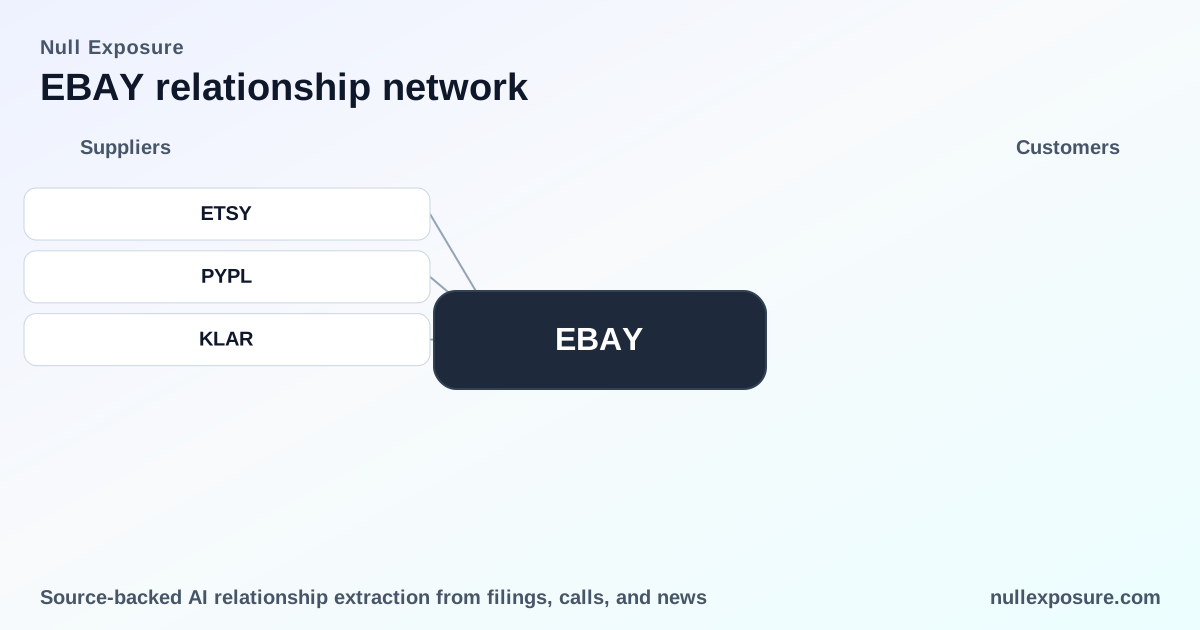
Below are the supplier and commercial relationships surfaced in recent coverage — each summarized plainly with source context.
-
eBay agreed to acquire Depop from Etsy for roughly $1.2 billion, expanding eBay’s footprint in resale and younger-consumer marketplaces. This transaction was reported in March 2026 and positions eBay to accelerate circular commerce growth through a specialty resale brand. (Simply Wall St — March 9, 2026)
-
eBay’s managed payments handles payment processing directly for U.S. sellers while allowing buyers to pay with cards, PayPal, and local methods; the payment stack therefore combines internal processing with external rails. Recent coverage noted the practical shift in buyer payment options under managed payments in the U.S. (Ad-hoc-News — March 9, 2026)
-
Klarna has scaled embedded resale functionality with eBay into six new markets, converting routine purchases into circular-commerce opportunities and embedding buy-now-pay-later rails into the resale experience. This expands financing and UX options for buyers on eBay’s resale channels. (Finviz — March 9, 2026)
Each of these relationships advances revenue capture (Depop acquisition), transaction control and take-rate optimization (managed payments), and conversion/checkout flexibility (Klarna partnership). Together they reshape eBay’s product stack from pure listing platform to a commerce and payment services operator.
Discover deeper supplier intelligence at Null Exposure.
What these relationships mean for risk, concentration, and resilience
-
Concentration and counterparty profile: eBay deliberately works with large financial institutions for payment and liquidity functions, which reduces idiosyncratic counterparty risk while increasing systemic exposure to a handful of major providers. This is a trade-off: lower vendor-default probability, higher systemic-correlated outage risk.
-
Contracting maturity: The company’s financing posture includes a five-year, $2.0 billion unsecured revolving credit facility (entered January 2024) and a commercial paper program up to $1.5 billion with maturities under 397 days. These instruments establish dual liquidity channels — long-term committed capacity and short-term issuance flexibility — supporting both strategic M&A and day-to-day operations. (Company filing — 2024)
-
Framework agreements and netting: eBay’s use of master netting agreements for derivatives creates operational efficiencies and lowers gross exposures to market movements under standardized close-out rules. This indicates a mature treasury function that actively manages market and counterparty exposures. (Company filing — period disclosed in public filings)
-
Material third‑party dependence: eBay explicitly classifies several third-party services as material. Interruptions to payment processing, identity verification, or fraud detection would materially impair seller and buyer experience and could drive sellers off-platform, increasing operational cost and regulatory scrutiny. (SEC filing language — company disclosure)
For underwriters and ops teams, the combination of materiality and active service-provider relationships elevates the priority of continuity planning, SLAs, and replacement sourcing for payments and identity services.
Practical implications for investors and operators
-
Upside thesis: The Depop acquisition and expanded partnerships with BNPL providers like Klarna accelerate eBay’s push into circular commerce and higher-margin financial services, which should improve take-rates and buyer retention over time. eBay’s managed payments posture centralizes transaction economics and supports incremental revenue capture from processing and disbursement activity.
-
Key risks: Operational concentration in payments and identity services, the centralization of transaction processing, and dependency on large counterparties create correlated risk. Credit facilities and commercial paper reduce liquidity shock risk but do not eliminate service-level outages.
-
Balance-sheet context: eBay is financially strong by multiple measures — market capitalization in excess of $41 billion, operating margin around 16.2%, and return on equity above 40% — providing the corporate flexibility to execute acquisitions and to invest in resilience. These metrics support continued investment in controlled vertical expansion while underwriting near-term integration and operational investments.
Recommended next steps for investors and operators
- For investors: weight eBay’s revenue optionality from payments and resale initiatives against operational concentration; monitor integration milestones for Depop and adoption metrics for managed payments and Klarna-enabled flows.
- For operators and insurers: prioritize service continuity clauses, escalation protocols, and financial remedies in contracts with eBay and its major payment/service providers.
Act now to map your counterparty exposure: visit Null Exposure for supplier-by-supplier risk detail and scenario modeling.
Conclusion — eBay is executing a deliberate strategy to internalize more of the transaction stack and to expand resale capabilities, unlocking higher-margin levers while concentrating operational risk in a few mission‑critical service providers. Investors should price both the earnings upside from payments and resale and the non-trivial operational concentration that accompanies that strategic pivot.