Eastern Bankshares (EBC): Supplier and lending relationships that shape credit and operational posture
Eastern Bankshares operates as the holding company for Eastern Bank, a Boston-headquartered regional bank that originates commercial loans, funds retail and small-business deposit franchises, and earns through net interest margin and fee income on banking products. The company monetizes its franchise by deploying balance sheet lending (commercial and consumer), underwriting and construction financing, and by contracting third-party services for critical data and processing functions. For investors and counterparties, the practical takeaway is simple: Eastern blends local community lending with an outsourced service model that relies on a mix of short‑ and long‑term funding and vendor relationships. Learn more about how these patterns are tracked at https://nullexposure.com/.
Why supplier and borrower relationships matter to Eastern's valuation and risk profile
Eastern's business model is driven by two correlated dynamics: balance sheet lending that produces interest and fee revenue and outsourced operational infrastructure that supports scale and regulatory compliance. That dual posture creates a hybrid risk picture for counterparties and investors:
- Contracting posture: Eastern publicly documents that its capital and liabilities include both short‑term and long‑term borrowings, and it elects short‑term lease recognition where allowable — a signal that funding and operational contracts are a mix of tenors and flexible arrangements. In filings the company states, "Our borrowings may consist of both short-term and long-term borrowings..." and notes the short‑term lease exemption where applicable.
- Vendor criticality and scale: Eastern explicitly notes it uses third‑party vendors for "key components of our business infrastructure, including certain data processing and information services." This positions service providers as critical for continuity and compliance.
- Counterparty concentration signal: Eastern indicates some vendors are “large national entities,” which is a company‑level signal pointing to relationships with established suppliers that lower counterparty operational risk but can increase dependency on a small number of large providers.
These company‑level signals should shape diligence: expect a portfolio of both short‑lived construction or working capital exposures and longer‑dated loans, plus reliance on a handful of major vendors for processing and information services.
Recent, disclosed relationships (what to watch)
Below are every supplier/borrower relationship referenced in the available reporting, presented with a concise description and source.
-
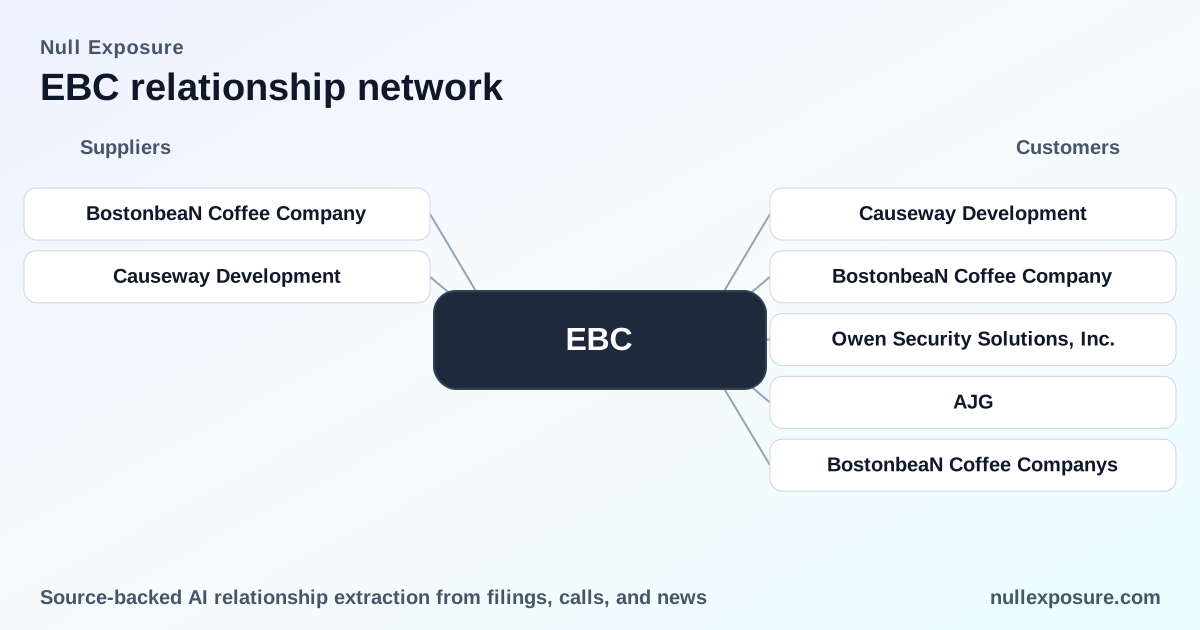
Eastern provided financing to support BostonbeaN Coffee Company's transition to employee ownership. This is presented as a community-oriented loan that supports an ownership structure change for a local business. Source: Finviz news coverage, March 9, 2026 — https://finviz.com/news/281797/eastern-bank-ebc-reports-q4-everything-you-need-to-know-ahead-of-earnings
-
Eastern extended a $15.5 million affordable housing construction loan to Causeway Development. This transaction is an example of Eastern’s commercial real estate and construction lending in the affordable housing sector. Source: Finviz news coverage, March 9, 2026 — https://finviz.com/news/281797/eastern-bank-ebc-reports-q4-everything-you-need-to-know-ahead-of-earnings
These entries reflect the bank’s community and CRE lending footprint as highlighted in public news reporting; they also underline the mix of short‑duration construction financing and longer, outcome-driven commercial loans in Eastern’s loan mix.
If you want a consolidated view of Eastern’s counterparties and supplier posture, see how we track counterparty relationships at https://nullexposure.com/.
What these relationships reveal about strategy and execution
The two reported items — a financing to enable employee ownership and a sizable construction loan for affordable housing — are consistent with a dual emphasis on community banking and commercial real estate finance:
- Community-first origination: The BostonbeaN financing demonstrates Eastern’s positioning as a community lender that supports local transitions in ownership and small-business continuity, which feeds deposit and fee engines while enhancing reputation in regional markets.
- CRE and construction exposure: The $15.5 million Causeway loan is structural: construction loans are inherently short to medium term and cyclical, and they increase near-term credit and interest-rate sensitivities for the portfolio.
Together, these relationships show Eastern executing on its core commercial lending strategy while sustaining brand and deposit-generation benefits tied to community engagement.
Operational constraints that influence supplier and counterparty risk
Beyond specific name‑level relationships, Eastern’s public disclosures include discrete signals that matter to counterparties and operators:
- Long‑ and short‑term borrowing posture: the company documents both borrowing tenors as funding sources; this implies a liquidity management strategy that balances immediate funding needs with longer-term liabilities.
- Short‑term lease recognition practice: Eastern uses the short‑term lease exemption for qualifying leases, indicating a preference for shorter operational commitments where flexibility is valuable.
- Reliance on large vendors for infrastructure: filings note the use of "large national entities" and third‑party vendors for critical data and information services, which implies counterparty concentration risk on the vendor side but potentially higher vendor maturity and resilience.
These constraints should be interpreted at the company level: they do not assign a given constraint to a specific loan or vendor unless Eastern names that relationship explicitly.
Risk considerations for investors and operators
For investors underwriting Eastern as a counterparty, the headline risk‑reward tradeoffs are clear:
- Credit risk episodic, concentrated in CRE: Construction lending in affordable housing is socially constructive but exposes the bank to development cycle risk and completion risk. This is accentuated if construction loans are a meaningful share of the portfolio.
- Operational dependency on vendors: Outsourced processing and information services reduce fixed-cost burdens but elevate vendor operational and concentration risk; continuity planning and vendor diversification are material considerations.
- Funding flexibility vs. rollover risk: The company’s mixed use of short‑ and long‑term borrowings delivers funding flexibility but necessitates active liquidity management under stress scenarios.
Investors should prioritize exposure limits for CRE construction loans, monitor vendor concentration metrics, and stress‑test funding rollovers against higher short‑term interest rate backdrops and deposit volatility.
If you want a structured assessment of Eastern’s counterparty map and operational constraints, view our research tools at https://nullexposure.com/.
Bottom line and action items
Eastern Bankshares runs a community-anchored lending franchise complemented by outsourced operational infrastructure, which creates a blend of local credit exposure and vendor dependency. The two disclosed relationships — a financing for BostonbeaN Coffee Company’s employee‑ownership transition and a $15.5 million construction loan to Causeway Development — exemplify that hybrid strategy. Key investor takeaways: watch CRE construction concentrations, vendor concentration on large national providers, and the company’s funding tenor mix.
For a deeper, trackable view of Eastern’s supplier and borrower relationships and how they affect counterparty risk, visit https://nullexposure.com/ for our latest coverage and analytical tools.