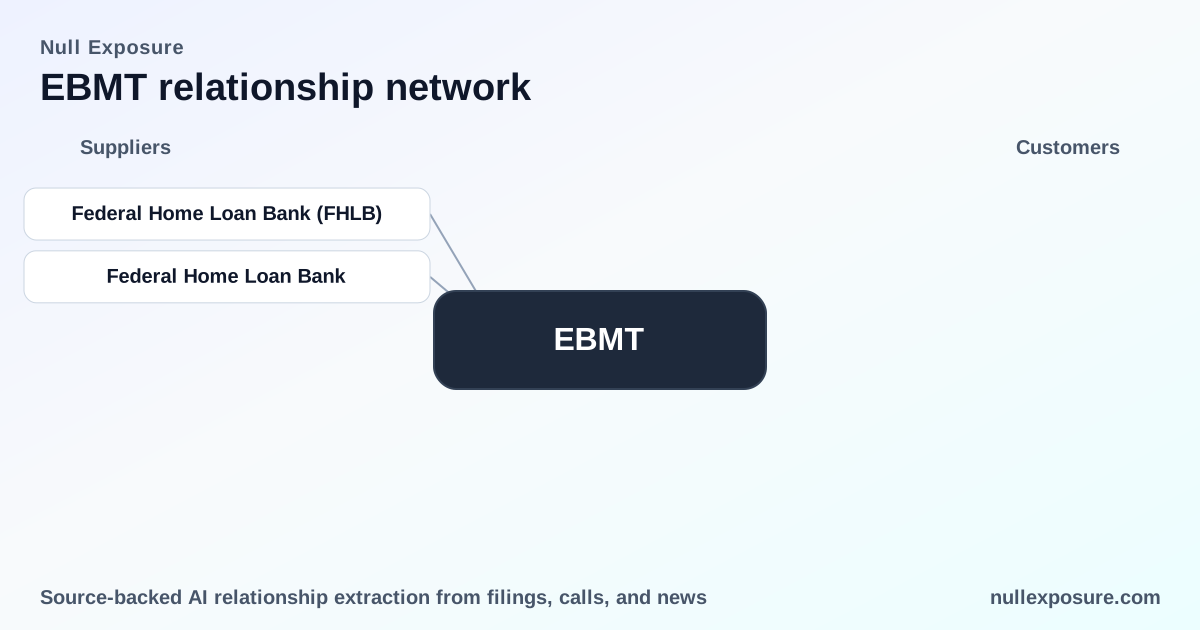
Eagle Bancorp Montana (EBMT): Supplier relationships and what they signal for investors
Eagle Bancorp Montana, Inc. operates as the holding company for Opportunity Bank of Montana, a small regional bank that earns through net interest margin on retail and commercial lending and supplements income with fees and ancillary services. The company monetizes a deposit franchise concentrated in Montana, funds growth and liquidity through a mix of core deposits and short-term borrowings, and returns capital via a modest dividend. For investors evaluating supplier and counterparty risk, the most relevant relationships center on liquidity counterparties and third‑party service providers that underpin operations and cyber resiliency. Learn more about supplier exposures and compliance signals at https://nullexposure.com/.
How to read these supplier signals as an investor
Eagle Bancorp Montana is a compact, regional banking franchise: small market cap, low beta, and a shallow geographic footprint concentrate both opportunity and risk. From the relationships and constraints in public filings and press releases we extract several operating-model characteristics that matter to investors:
- Contracting posture — short-term funding: The company uses short-duration borrowing programs and access to emergency facilities when needed, which favors flexibility but increases rollover risk during stress. Evidence in company disclosures shows past access to one-year facilities and rapid pay-downs within quarters.
- Concentration — counterparty reliance: A regional bank of this scale shows material reliance on a handful of liquidity counterparties for contingency funding; changes in those balances have immediate balance-sheet effects.
- Criticality — vendors are operationally essential: Third‑party security and monitoring services are described as integral to daily operations, raising counterparty criticality beyond simple service provisioning.
- Maturity — established banking model, but limited scale: The business exhibits a mature banking margin profile (positive ROE and dividend history) alongside scale constraints that accentuate supplier and funding concentration risk.
These are company-level signals derived from disclosures and news releases, not a claim that any single supplier is uniquely responsible for a given constraint. If you want a structured view of vendor exposure for portfolio diligence, start a supplier scan at https://nullexposure.com/.
The relationships in the public record (each entry covered)
Below are every relationship occurrence surfaced in the available results, described plainly with sources.
Federal Home Loan Bank — FY2026 (press recap on March 9, 2026)
Eagle Bancorp Montana reported that FHLB advances and other borrowings decreased to $37.9 million at December 31, 2025, down sharply from $140.9 million at year-end 2024 and $79.2 million at September 30, 2025, indicating significant pay-down of wholesale funding during 2025. This update was reported in a company news release summarized by market services in March 2026. (Source: company press release summarized on Quiver Quant, March 9, 2026.)
Federal Home Loan Bank — FY2025 (quarterly disclosure on October 28, 2025)
A prior disclosure shows FHLB advances and other borrowings were $79.2 million at September 30, 2025, which compared to $219.2 million at September 30, 2024 and $119.4 million at June 30, 2025, documenting large swings in advance usage through 2024–2025. This sequence underscores the bank’s active management of wholesale liquidity through the FHLB system. (Source: GlobeNewswire press release, October 28, 2025.)
Federal Home Loan Bank — FY2026 (earnings release on January 27, 2026)
An earnings release covering fourth quarter results reiterated that FHLB advances and other borrowings were $37.9 million at December 31, 2025, down from $140.9 million at the prior year end, framing the reduction as part of year-end balance-sheet positioning in the FY2026 results. (Source: GlobeNewswire earnings release, January 27, 2026.)
What the FHLB activity tells investors about funding and risk
The three disclosures together create a clear narrative: Eagle Bancorp Montana materially reduced its FHLB and other borrowings through 2025, with borrowings fluctuating from roughly $219 million at peak in 2024 to under $40 million by year‑end 2025. For investors this means:
- Improved deposit or liquidity position enabled balance-sheet de‑leveraging, which supports capital and reduces interest‑rate sensitivity.
- Funding concentration remains a structural consideration because the bank has historically relied on FHLB advances as a primary non‑deposit liquidity source; a small bank cannot diversify funding as readily as a larger regional competitor.
- Short-term borrowing behavior is consistent with a conservative post‑stress posture: pay down short-duration lines when deposit liquidity returns.
These dynamics validate the earlier company-level signal that the bank’s contracting posture includes short-term funding arrangements and active use of emergency facilities in prior periods.
Operational supplier signals and cyber posture
Company disclosures also flag third‑party vendor arrangements that investors should treat as governance and operational risk signals:
- Eagle Bancorp Montana uses a third-party Managed Security Service Provider (MSSP) to deliver 24x7 threat detection and response and conducts security risk assessments at onboarding and contract renewal, indicating a formal vendor risk management process.
- Public language describes vendor controls and renewal‑based risk reassessment, which is evidence of mature vendor governance, but the counterparty types for many service relationships are reported as unknown in summary datasets; that is a company-level data gap to reconcile in diligence.
These are company-level signals derived from filings and should prompt targeted questions in vendor due diligence: contract length, termination terms, concentration of critical services, and service‑level agreements for cyber resilience.
For a deeper vendor and counterparty map that supports investment decisions, visit https://nullexposure.com/.
Investment conclusions and next steps
Eagle Bancorp Montana is a small, consistently profitable regional bank that demonstrates prudent post‑stress deleveraging by reducing FHLB advances in 2025. The core investor thesis is straightforward: a stable deposit franchise supplemented by conservative liquidity management and an active vendor governance program supports dividend continuity and modest earnings growth, but the bank’s size creates exposure to funding concentration and third‑party operational dependencies.
Actionable next steps for investors and operators:
- Validate deposit trends versus short-term borrowings for the next two quarters to confirm sustainable funding improvement.
- Request granular vendor inventories and MSSP contract terms to assess operational criticality and counterparty concentration.
- Monitor FHLB advance balances as a leading indicator of balance-sheet stress and contingency usage.
For a focused supplier-profile and relationship diligence package, start an engagement at https://nullexposure.com/.