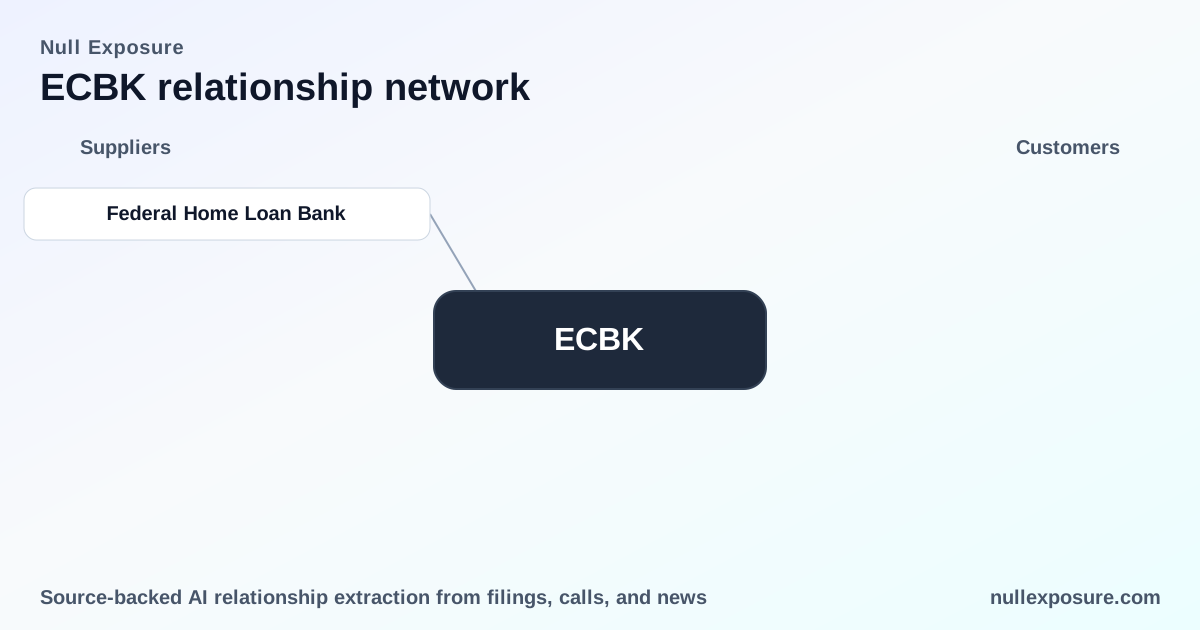
ECB Bancorp (ECBK): Supplier Relationships and What They Mean for Investors
ECB Bancorp Inc. operates as the holding company for East Cambridge Savings Bank, earning spread income from residential and commercial lending, generating fee income from deposit and wealth-management services, and funding growth through a mix of core deposits and wholesale borrowings. The company monetizes by extending loans against local-credit portfolios and preserving margin via deposit pricing and selective wholesale advances. Investors should evaluate how supplier and counterparty relationships—particularly wholesale funding and professional services—affect liquidity, cost of funds, and operational resilience. For a concise supplier-risk dashboard and deeper supplier signals, visit https://nullexposure.com/.
Quick operating thesis: funding mix drives near-term risk and optionality
ECB Bancorp’s balance-sheet expansion in FY2025 was financed through both deposit growth and material Federal Home Loan Bank (FHLB) advances, supporting a 20.7% year‑over‑year loan increase to $1.38 billion and total assets of $1.61 billion. That combination of local deposit traction and sizable wholesale advances defines the bank’s operating posture: localized franchise with meaningful reliance on secured wholesale funding. Market metrics—market cap ~$150 million, a trailing P/E of 17.8 and a price-to-book of 0.87—suggest investors are pricing a modest growth premium while discounting execution and funding risk.
For an investor-grade summary of supplier exposures and their implications, see https://nullexposure.com/.
The one supplier relationship that matters: Federal Home Loan Bank
Federal Home Loan Bank — ECB Bancorp uses FHLB advances as a funding source, with disclosures indicating the advances materially supported deposit and loan growth during FY2025. According to a Globe and Mail press release on March 9, 2026, deposit increases and higher certificates of deposit were supported by FHLB advances, which helped drive asset growth to $1.61 billion and loans to $1.38 billion. (Globe and Mail coverage of ECB Bancorp press release, Mar 9, 2026.)
- The company’s public disclosures list $234.0 million of FHLB advances outstanding as of December 31, 2024, with scheduled maturities across 2025–2029, indicating multi‑year funding commitments and a long-term borrowing posture. This detail comes from the company’s financial disclosures and maturity schedules filed with its annual statement (company filing disclosure, FY2024/FY2025 reporting).
What the relationship set tells you about ECB Bancorp’s operating model
ECB Bancorp’s supplier picture is compact but consequential. From the evidence:
- Contracting posture and maturity: The bank’s advances from the FHLB are structured across multiple maturities through 2029, demonstrating a deliberate, long-term borrowing posture that smooths refinancing risk but locks the bank into fixed maturity obligations. The maturity schedule and total outstanding of $234 million are explicit in company filings.
- Concentration and criticality: Wholesale funding through the FHLB represents a material, concentrated counterparty exposure relative to the bank’s balance sheet; that concentration elevates counterparty and liquidity monitoring as an essential risk-management focus.
- Service-provider footprint: ECB Bancorp also engages third‑party consultants and independent auditors for cybersecurity testing and related controls. Those arrangements indicate outsourced operational testing and audit dependencies that are typical for community banks but critical for operational resilience (company disclosure on third‑party testing).
- Spend profile and related-party activity: Disclosures show a mixed spend picture: relatively modest recurring professional and facility costs (for example, net annual rental payments ~$30,000 and law‑firm fees in the low‑six figures per year), alongside significant wholesale borrowings; this split indicates most supplier dollars flow to financial counterparties rather than large vendor ecosystems (company filings).
Relationship-by-relationship breakdown (complete)
Federal Home Loan Bank — ECB Bancorp uses FHLB advances materially to fund loan and deposit growth, with $234.0 million outstanding and scheduled maturities through 2029, making the FHLB a high‑criticality funding counterparty for the bank (company filings; Globe and Mail press release, Mar 9, 2026).
Risks and investor implications
- Funding concentration risk: The reliance on $234 million of FHLB advances is a structural exposure. If market or regulatory conditions tightened access to secured wholesale funding, ECB Bancorp’s liquidity flexibility would contract quickly. That concentration is an execution risk for a small regional bank.
- Refinancing timeline: Long‑dated maturities reduce short‑term rollover pressure but create a calendar of refinancing events. Investors should monitor the upcoming maturity schedule and interest-rate environment ahead of each rollover.
- Operational vendor dependencies: Outsourced cybersecurity assessments and audit services are essential controls; lapses or vendor disruptions raise operational risk, though disclosed spend levels suggest these are typical service engagements rather than transformational vendor dependencies (company disclosure).
- Related‑party and small vendor spend: The bank discloses modest related‑party and lease expenditures—net rental payments (~$30k) and law‑firm fees in the low six figures—indicating predictable, low-dollar operational outlays that do not materially alter supplier concentration but are worth monitoring for governance and independence signals (company filings).
What investors should watch next
- Track announcements around FHLB advance maturities and any refinancing activity; each maturity is a potential liquidity test. Company filings and quarterly reporting will be the primary channels for those updates.
- Monitor deposit trends and margin compression: if core deposits slow, the bank will rely more on wholesale funding, increasing counterparty sensitivity.
- Watch vendor and audit outcomes tied to cybersecurity testing; material findings would be disclosed in risk‑factor disclosures or subsequent filings.
For a focused supplier-risk report and monitoring tools tuned to regional banks like ECB Bancorp, visit https://nullexposure.com/ for more detail and analyst resources.
Bottom line and recommended actions
ECB Bancorp combines strong local deposit traction with material FHLB funding—this mix boosts growth but concentrates funding risk. For investors and operators, the priority is clear: maintain visibility on FHLB maturities, deposit momentum, and vendor‑related control outcomes. If you evaluate or operate within this franchise, prioritize scenario planning around funding stress and vendor contingency.
To subscribe for ongoing supplier monitoring and to access supplier-level signals for ECB Bancorp, go to https://nullexposure.com/.