ECC-P-D: Supplier Relationships and Operational Profile for Investors
Eagle Point Credit Company Inc.’s preferred issue ECC-P-D is a fixed-income-style security issued by a closed-end credit vehicle that monetizes through coupon-like preferred dividends backed by a managed portfolio of corporate and structured credit assets. The company outsources portfolio management and key operational functions, generating returns for preferred holders via disciplined credit selection and yield pickup across structured-credit strategies while relying on third-party agents for custody, redemption execution, and investor communications. For a focused view of counterparty exposure and operational dependencies, read on — and visit https://nullexposure.com/ for deeper supplier-risk intelligence.
Why the supplier map matters to income investors
Preferred shares are fundamentally hybrid instruments: they deliver contractual cash flows but depend on the issuer’s operational plumbing to pay, redeem, and communicate. ECC-P-D’s economics are driven by three core components: the portfolio manager’s ability to produce income in structured credit, the legal and administrative mechanics that effect dividend and redemption payments, and external communications that shape investor expectations. External management creates a concentrated operational counterparty; custody and DTC settlement mechanics create single points of failure for trade and redemption processing. These are not theoretical — they are visible in recent filings and press releases.
If you want a supplier-risk brief tied to commercial outcomes, start here: https://nullexposure.com/.
The supplier relationships you need on your radar
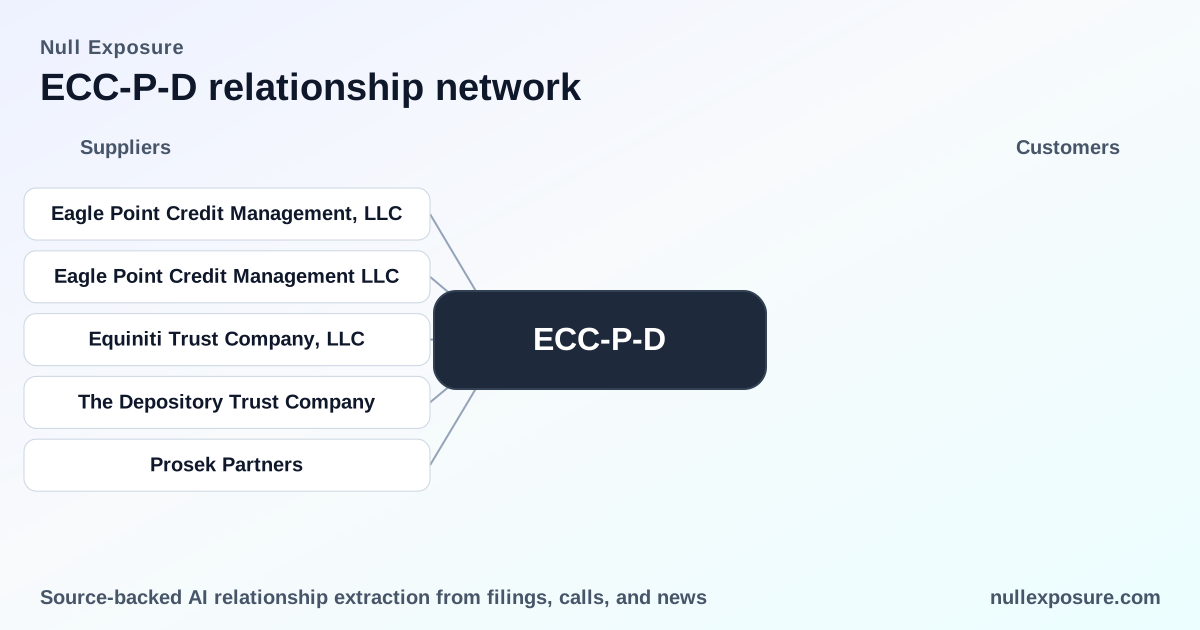
Below I list every relationship captured in public reporting and press coverage related to ECC-P-D. Each entry is a plain-English summary with the original source noted.
-
Eagle Point Credit Management, LLC — The company is externally managed and advised by Eagle Point Credit Management, LLC, which runs the day-to-day credit investing and portfolio decisions that ultimately fund preferred dividends; this external management posture is referenced across multiple corporate announcements (FY2025 and FY2026). Source: MarketBeat instant alert (Ladenburg Thalmann downgrade note, March 2, 2026) and a Yahoo Finance statement on the company (FY2025) (https://www.marketbeat.com/instant-alerts/eagle-point-credit-nyseecc-downgraded-to-neutral-rating-by-ladenburg-thalmsh-sh-2026-03-02/; https://finance.yahoo.com/news/eagle-point-credit-company-inc-201500400.html).
-
Equiniti Trust Company, LLC — Equiniti acted as the redemption agent for a full redemption of a series of term preferred stock, meaning Equiniti executed the payment mechanics to DTC and holders in that transaction; that role underscores Equiniti’s operational importance to the issuer’s capital structure actions. Source: Business Wire release republished on FinancialContent regarding the Series F redemption (December 29, 2025) (https://markets.financialcontent.com/stocks/article/bizwire-2025-12-29-eagle-point-credit-company-inc-announces-full-redemption-of-the-800-series-f-term-preferred-stock-due-2029?CSSURL=36.htm).
-
The Depository Trust Company (DTC) — All shares of the referenced Series F term preferred stock are held in book-entry form through DTC, and redemptions are processed in accordance with DTC procedures; DTC is therefore the primary settlement and record-keeping mechanism for the issuer’s preferreds. Source: Business Wire release republished on FinancialContent (December 29, 2025) (https://markets.financialcontent.com/stocks/article/bizwire-2025-12-29-eagle-point-credit-company-inc-announces-full-redemption-of-the-800-series-f-term-preferred-stock-due-2029?CSSURL=36.htm).
-
Prosek Partners — Prosek Partners is listed as the investor and media relations contact, indicating the outsourced IR/communications relationship that shapes market perceptions and investor access to corporate disclosure. Source: Corporate press release republished on Yahoo Finance and FinancialContent (FY2025) (https://finance.yahoo.com/news/eagle-point-credit-company-inc-201500400.html; https://markets.financialcontent.com/stocks/article/bizwire-2025-12-29-eagle-point-credit-company-inc-announces-full-redemption-of-the-800-series-f-term-preferred-stock-due-2029?CSSURL=36.htm).
What the relationship map implies about operating posture and constraints
Treat these signals as a unified operating model rather than discrete anecdotes. The company’s supplier configuration reveals several structural characteristics:
-
Contracting posture — outsourcing-first. ECC-P-D’s issuer relies on an external asset manager and third-party agents for redemption and investor relations, signaling a lean internal operations model focused on investment decisions rather than back-office infrastructure.
-
Concentration risk — managerial dependency. External management concentrates performance and operational risk with a single manager; the manager’s decisions directly determine distributable cash flow that funds preferred dividends.
-
Criticality — settlement and redemption plumbing. DTC and the appointed redemption agent are operationally critical: settlement, record-keeping, and redemption execution run through these third parties and cannot be substituted quickly in a stress event.
-
Maturity and standardization. Use of industry-standard agents like DTC and a professional IR firm suggests operational maturity and standard capital-markets practices, which reduces idiosyncratic settlement risk but preserves single-counterparty concentration.
These are company-level signals derived from public notices and press releases rather than statutory constraint excerpts.
If you want supplier risk quantified and mapped to business outcomes, explore tailored reports at https://nullexposure.com/.
Investment implications — what to weigh before allocating
-
Forward income reliability is linked to the external manager’s execution. Preferred dividends depend on distributable income and corporate policies set by the manager and board; evaluate manager track record and alignment.
-
Operational single points of failure increase execution risk on redemptions and payments. The presence of a named redemption agent and DTC custody means settlement is standardized, but also centralized.
-
Communications control is outsourced. With IR functions handled by a specialist firm, market clarity during events (redemptions, resets, or dividend policy changes) will depend on external communications cadence and accuracy.
-
Liquidity and market price dynamics are separate from operational execution. Trading ranges reported historically for the issue provide a market reference, but cash flow and legal priority determine recovery and dividend treatment.
Key takeaway: ECC-P-D’s credit and yield story is inseparable from its supplier ecosystem — management, settlement, and communications are the levers that convert portfolio income into paid dividends.
Practical next steps for investors and operators
-
For investors: verify the manager’s mandate, recent portfolio performance disclosures, and any proxy or board communications that affect dividend policy; also confirm custody and redemption procedures in your broker/dealer documentation.
-
For operators and risk teams: map SLA and escalation paths with the external manager, the redemption agent, and DTC; identify substitute providers and test contingency plans for redemption or settlement failures.
-
To commission a supplier-risk briefing tailored to this capital structure, or to review counterparty concentration across your holdings, start here: https://nullexposure.com/.
This supplier map is built from company press releases and market coverage; refer to the cited notices for the primary language of each relationship and to confirm timelines and formal roles. For hands-on analysis and portfolio-level supplier intelligence, visit https://nullexposure.com/ and request a tailored assessment.