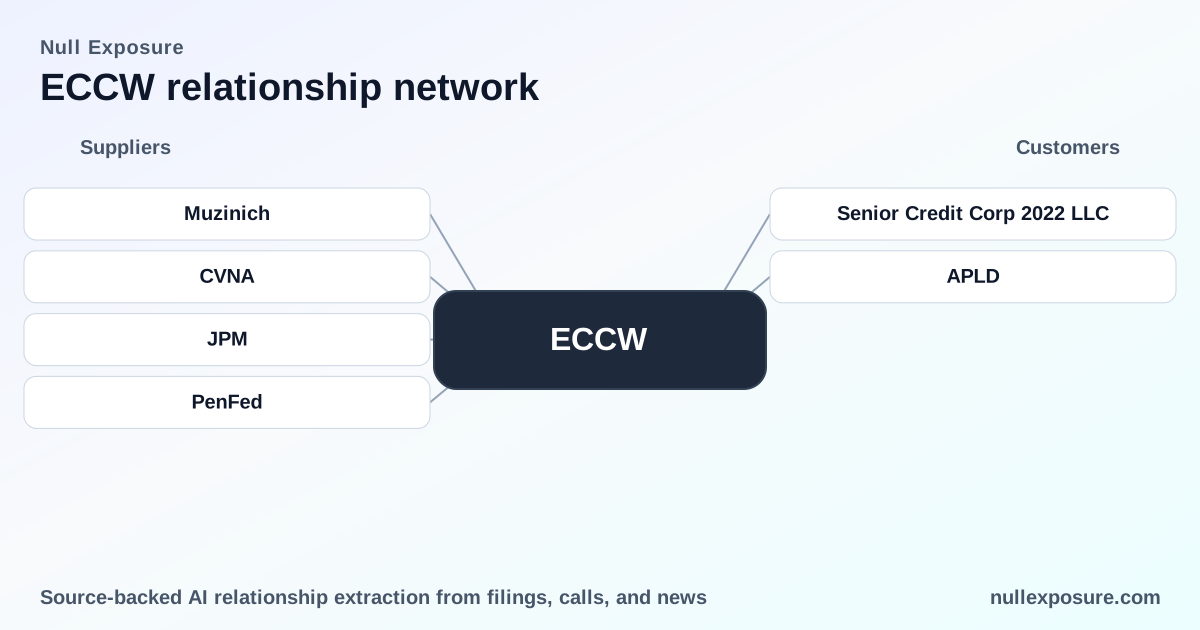
Eagle Point Credit Company (ECCW): Supplier Relationship Map and Investment Implications
Eagle Point Credit Company (ECCW) runs as an income-focused credit investor that monetizes via interest and fee income from a diversified portfolio of collateralized loan obligations (CLOs) and other asset-backed securities, with a strategy that emphasizes yield generation for dividend distribution (the current dividend yield is 7.29% and a dividend date of 2026-03-31 is recorded). The firm generates returns by selecting and supporting collateral management platforms, structuring exposure to specialty ABS, and harvesting carry from middle‑market credit positions. For a concise supplier-relationship view and further sourcing on counterparties, visit https://nullexposure.com/.
How to read ECCW’s supplier relationships: why they matter to investors
ECCW is not a traditional operating company; its value accrues through manager selection, collateral exposure, and active portfolio rebalancing. That makes the company’s supplier universe — principally collateral managers and ABS issuers — both a performance driver and a risk channel. Relationships that deepen manager capability or broaden asset-class access translate directly into yield opportunities, while concentration in stressed ABS issuers or a narrow set of managers raises downside exposure.
- Contracting posture: ECCW behaves as a strategic investor and partner to collateral managers, backing platform growth and new initiatives rather than acting as a simple passive creditor.
- Concentration and criticality: ECCW’s mentions of specific ABS names indicate targeted exposures within ABS stacks; these counterparties can be materially critical to cashflow if concentrated.
- Maturity and operational posture: Public disclosures in FY2026 show the firm actively supporting both U.S. and European collateral platforms, signaling a mature, expansionary posture rather than a wind‑down or static hold strategy.
For managers and allocators who want a deeper supplier mapping and credit exposure breakdown, visit https://nullexposure.com/ for direct access to the reference material.
Publicly reported relationships (what ECCW disclosed)
The following relationships were cited in ECCW’s FY2026 public comments and are presented here with plain-English summaries and source citations.
Muzinich
ECCW reported that it advanced strategic initiatives supporting Muzinich’s U.S. CLO collateral management platform and backed the firm’s launch of a European CLO collateral management capability, reflecting an active partnership to scale collateral management services across regions. According to the FY2026 earnings transcript published on The Globe and Mail (Motley Fool) on March 9, 2026: https://www.theglobeandmail.com/investing/markets/markets-news/Motley%20Fool/260656/eagle-point-credit-ecc-earnings-transcript/
Carvana
ECCW’s commentary lists Carvana as part of asset-backed securities exposure inside its portfolio, signaling direct ABS credit exposure tied to consumer auto receivables originated by a high-profile, high-volatility originator. The FY2026 earnings transcript notes “asset-backed securities, which includes Carvana…,” as reported on The Globe and Mail (Motley Fool), March 9, 2026: https://www.theglobeandmail.com/investing/markets/markets-news/Motley%20Fool/260656/eagle-point-credit-ecc-earnings-transcript/
Chase (JPMorgan)
ECCW identifies Chase autos among referenced ABS holdings, indicating exposure to large‑bank originations in the auto ABS market that typically provide structural diversification and scale versus specialty originators. This was noted in the same FY2026 earnings transcript on The Globe and Mail (Motley Fool), March 9, 2026: https://www.theglobeandmail.com/investing/markets/markets-news/Motley%20Fool/260656/eagle-point-credit-ecc-earnings-transcript/
PenFed
The company also lists PenFed autos within its ABS mix, reflecting exposure to credit originated through a federal credit union channel and further demonstrating ECCW’s blend of originator types within its ABS sleeve. The mention appears in ECCW’s FY2026 earnings transcript reported by The Globe and Mail (Motley Fool), March 9, 2026: https://www.theglobeandmail.com/investing/markets/markets-news/Motley%20Fool/260656/eagle-point-credit-ecc-earnings-transcript/
What these supplier links imply about ECCW’s operating model
These public ties provide a clear operational signal: ECCW actively partners with collateral managers and selects ABS originators to shape risk/return, not merely to passively hold syndicated paper.
- The Muzinich link indicates a strategic partnership posture: the company is willing to invest in manager platforms and geographic expansion (U.S. and Europe), which increases the firm’s ability to source and manage CLOs across jurisdictions.
- The Carvana / Chase / PenFed references signal asset-class breadth within ABS, combining specialty originators and large-bank paper to balance yield and structural protection.
- The information set shows maturity of approach: ECCW executes both platform support and portfolio composition decisions, consistent with an institutional investor with active credit allocation capabilities.
These are company-level operational characteristics derived from ECCW’s FY2026 disclosures rather than discrete contractual terms, and they shape the firm’s risk profile and value capture.
Investment implications: what investors and operators should prioritize
- Upside: Strategic support for collateral managers like Muzinich increases ECCW’s ability to access higher-yielding or differentiated CLO tranches and to scale fee-bearing activities across regions. That can drive sustainable yield capture and portfolio diversification.
- Risk: Direct ABS exposure to names like Carvana introduces originator-specific credit and residual-value risk that investors should monitor through vintage performance and delinquency trends. Large-bank ABS (Chase) provides diversification but does not eliminate concentration risk if ABS positions are large relative to NAV.
- Operational focus: Operators should interrogate manager governance, monitoring cadence, and ECCW’s internal oversight of ABS stress testing; investors should demand transparency on position-level concentrations and collateral manager economics.
- Dividend context: With a recorded dividend yield of 7.29% and a scheduled dividend date of 2026-03-31, ECCW is distributing income aggressively, making portfolio stability and ABS performance central to funding those payouts.
If you want a supplier-centric vantage that maps counterparty exposures to potential downside scenarios, explore the research portal at https://nullexposure.com/ for proprietary relationship analytics.
Actionable next steps for allocators and corporate counterparties
- Request ECCW’s latest investor presentation and position-level ABS/CLO exposure by manager and vintage.
- Monitor performance metrics for Carvana, Chase, and PenFed ABS vintages and review Muzinich-managed collateral performance metrics for early signs of stress or outperformance.
- Validate governance and contractual protections around platform investments and any fee-sharing that affects net yield to ECCW.
For a consolidated view of ECCW’s counterparties and supplier-risk mapping, go to https://nullexposure.com/ — the quickest way to align portfolio diligence with supplier-level risk.