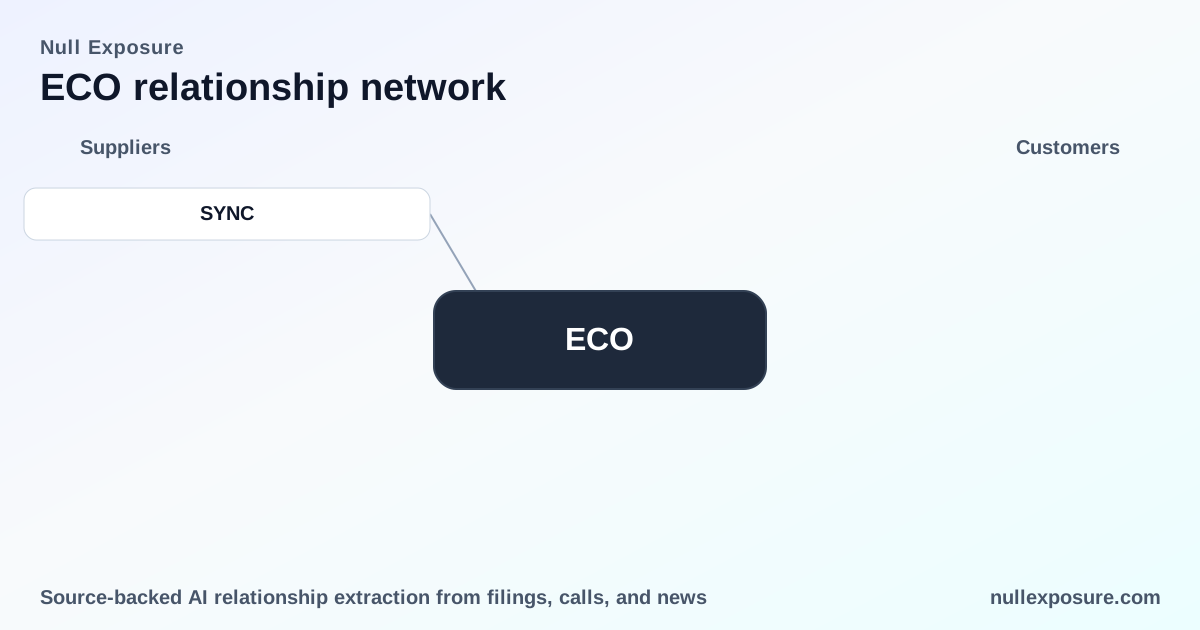
Okeanis Eco Tankers (ECO): supplier exposure and what investors should know
Okeanis Eco Tankers operates and monetizes by owning a modern, fuel-efficient fleet of crude and product tankers and extracting margin through time charters and voyage contracts with energy companies and charterers; the business model is fleet-capital intensive, cash-flow driven and benefits from durable charter relationships and a premium for eco‑efficient assets. For investors focused on counterparties and supplier exposure, the supplier records available for ECO show limited supplier detail but flag one notable market actor; see below for relationship specifics and implications. If you want a consolidated view of counterparty exposure across suppliers and counterparties, visit https://nullexposure.com/ for deeper research tools.
Why ECO's fleet and contract mix matter to returns
ECO earns its returns by deploying ships under charter and by capturing the spread between asset utilization and financing costs. Key financials from the latest reported quarter (2025‑12‑31) underline a profitable operating model: revenue of $391.5m, EBITDA of $204.0m, and an operating margin of 54.1%. The company is returning cash to shareholders with a dividend yield of 7.57% (Dividend per share $3.32) while trading at a trailing P/E of 12.13 and a forward P/E of 7.06, signaling market expectations of continued earnings support.
Operational characteristics that drive investor returns and counterparty risk:
- Capital intensity and maturity: modern, emission‑compliant vessels command higher upfront capital but also support premium charter rates and lower fuel/maintenance volatility.
- Contracting posture: ECO emphasizes long-term charters and strong customer relationships as the pathway to stable utilization and predictable cash flow.
- Concentration and governance: insiders control ~53% of shares, which concentrates decision-making but can align strategic asset deployment with long-term shareholder value.
These characteristics create a payoff profile that is defensive in stable shipping markets and cyclical in downturns — a critical context when evaluating supplier and counterparty relationships.
Supplier relationships: what the records show
An audit of the supplier-scope records returns a single, explicit relationship mention.
- Synacor (inferred ticker SYNC): An earnings-call excerpt from ECO’s 2025Q4 materials reported that “Synacor consolidating the VLCC market … owning and operating, and waiting to be delivered a fleet of around 150 VLCCs.” This flags Synacor as a significant owner/operator in the VLCC segment, a scale factor that could influence VLCC supply dynamics and charter-rate competition. (Source: ECO 2025Q4 earnings call transcript, first seen 2026-03-07.)
The record set contains no other named suppliers in the supplier scope; the single mention should be treated as a directional signal rather than a comprehensive map of all counterparties.
Interpreting the Synacor mention for ECO's competitive environment
The Synacor mention is notable for scale: a 150‑ship VLCC program is a market‑shaping footprint. For ECO, a manufacturer of eco-efficient smaller tanker classes and a participant in crude and product trades, the strategic implications are straightforward: large VLCC ordering impacts tonnage supply, freight-rate cycles and charter negotiation leverage across segments. Investors should track whether Synacor’s buildout compresses spot rates or shifts charter demand toward ECO’s eco-efficient niche, which could be a source of either downward pressure on rates or an opportunity to secure long-term, higher-margin charters for differentiated vessels. (Source: ECO 2025Q4 earnings call excerpt, reported 2026-03-07.)
Constraints, silence, and what that signals about supplier risk
There are no supplier constraints extracted in the supplier-scope records for ECO. The absence of explicit constraint disclosures is itself a company-level signal: limited supplier-specific disclosure in the available sweep reduces visibility on supplier contracting posture, concentration and criticality. In practical terms for investors:
- Contracting posture likely skews toward durable, charter-like arrangements given ECO’s corporate description emphasizing long-term contracts, but direct supplier constraint evidence is not present in the sourced records.
- Concentration and criticality cannot be quantified from the supplier extraction set; lack of named suppliers suggests either a dispersed supplier base or simply low public disclosure on third-party supplier terms.
- Maturity of supplier relationships is not documented in the extracted items; investors should assume standard industry practices (multi-year charter arrangements and maintenance contracts) until direct contracting evidence is obtained.
Treat this silence as a signal to pursue targeted diligence: request charter schedules, long-term charter counterparties and major maintenance vendors during investor calls or through data services.
If you want a more complete counterparty map that integrates earnings transcripts and filing disclosures, explore https://nullexposure.com/ for tools that cross-index relationships across filings and calls.
Investment considerations — where the risk/reward sits
- Upside drivers: strong operating margins (54.1%), healthy EBITDA, and a low forward P/E imply potential earnings resilience; modern eco‑ships support a premium in some charter markets.
- Downside risks: shipping cyclicality, exposure to global oil demand swings, and the potential for large newbuilding programs (industry-wide, including Synacor’s scale) to depress charter rates.
- Ownership dynamics: high insider ownership (53%) centralizes strategy and could accelerate fleet investments or dividend policy changes without broad institutional consensus (institutions hold ~29%).
- Valuation context: with an analyst target of $55 and a 52‑week high near $55.67, market expectations already price in recovery or continued strength; downside protection will depend on charter coverage and fleet utilization.
What to do next (actionable)
- Request ECO’s charter backlog and top counterparty list to quantify revenue concentration and counterparty credit risk.
- Model freight-rate sensitivity to newbuilding deliveries in the VLCC segment to assess indirect competitive pressure from large-scale owners like Synacor.
- Use third-party tools to reconcile earnings‑call mentions with filing schedules; our platform aggregates these cross-references for institutional diligence — see https://nullexposure.com/ for subscription and data access.
ECO’s business is anchored in hard assets and charter economics; the supplier-level record available today is sparse but flags a potentially market‑moving player in Synacor. For portfolio managers and operators the next step is targeted, counterparty-level diligence combined with scenario analysis of global tanker supply additions. Visit https://nullexposure.com/ to connect those relationship signals with filing-based contract data and make a calibrated investment decision.