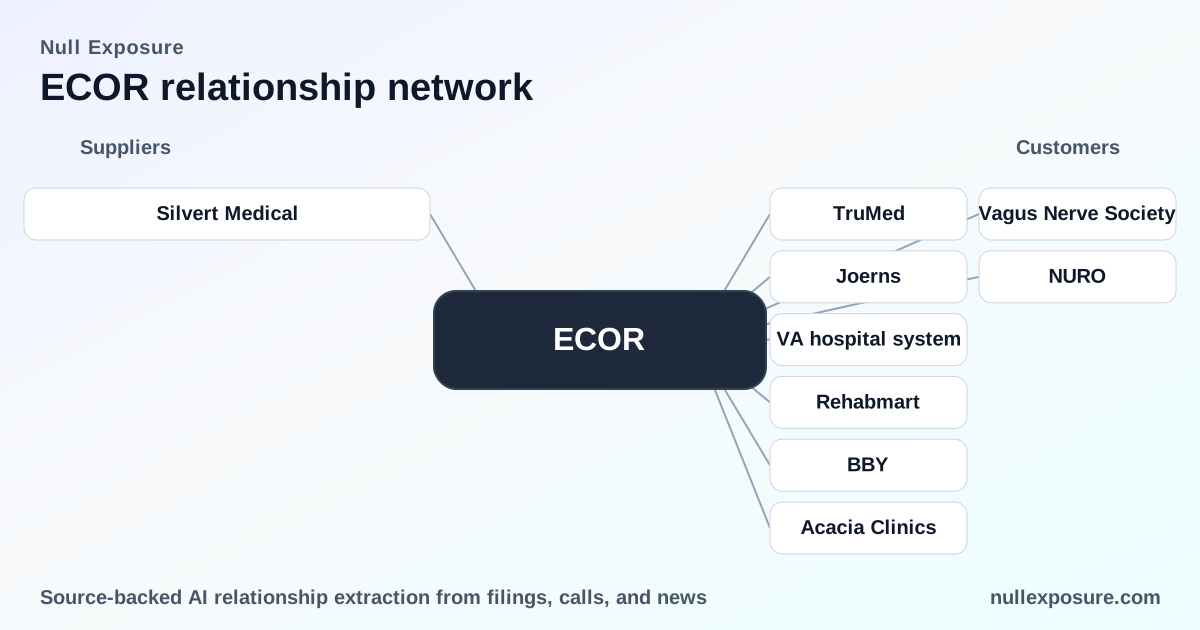
electroCore (ECOR): supplier relationships, operational constraints, and what investors should act on now
electroCore is a commercial-stage medical-device company that sells non-invasive vagus nerve stimulation (nVNS) devices (branded gammaCore) and captures revenue through device sales and the downstream benefit of reimbursement approvals that broaden market access. The company monetizes primarily via product sales supported by distribution agreements and payer coverage wins; gross margins are healthy, but the company is operating at a net loss while investing in commercialization. For primary diligence and supplier-risk tracking, start with the company’s commercial distribution map and supplier roster. Learn more about practical supplier analytics at https://nullexposure.com/.
How electroCore generates revenue and where profit pressure lives
electroCore’s go-to-market is straightforward: sell gammaCore devices through a mix of direct and third-party channels while expanding reimbursement to accelerate uptake. Revenue last twelve months: $29.8M; gross profit: $25.7M — indicating product-level margin strength — but the company runs negative operating and net margins (TTM operating margin -33.2%, profit margin -47.5%). Market capitalization is roughly $50.3M with significant insider ownership (36.6%) and light institutional ownership (11.4%), reflecting a tightly held small-cap commercialization story with active analyst interest (consensus target $19.75).
Key commercial facts for investors:
- Device-driven revenue model: gammaCore sales and attendant accessories/service.
- Reimbursement is a growth lever: payer approvals materially change addressable demand.
- Capital structure and liquidity signal: negative EBITDA and EPS reflect ongoing commercialization investment rather than mature cash generation.
Supplier and distribution posture — concentration and criticality
electroCore depends heavily on third parties across manufacturing, distribution, and back-office services. That structure delivers scalability but concentrates operational risk.
- Manufacturing outsourcing: electroCore relies on third‑party contract manufacturers for substantially all product components, creating single‑point manufacturing exposure that elevates supply disruption risk.
- Geographic concentration in component sourcing: the company sources a significant portion of components from Chinese suppliers, which introduces tariff, trade-restriction, and logistical risk that can affect cost and continuity.
- Distribution concentration outside the U.S.: the company uses a single third‑party distributor for the majority of its ex‑U.S. distribution, concentrating revenue exposure and commercial execution risk.
- Outsourced finance functions: certain finance and accounting tasks are outsourced to reduce cost, which accelerates scalability but requires strong vendor controls for accurate financial reporting.
Takeaway: the operating model trades capital intensity for speed-to-market, but that trade introduces concentration risk and supply-chain criticality that investors must quantify and monitor.
Geographic sourcing risk: China exposure is material
electroCore’s filings disclose dependence on suppliers located in China for components and packaging. This is a direct operational lever: tariffs, export controls, or supplier disruptions in APAC would have an immediate impact on cost and fill rates. Investors should treat China-sourced component exposure as a primary supply-chain risk.
Distribution concentration: a single non-U.S. distributor carries outsized importance
The company states it relies on a single third-party distributor to distribute the majority of its products outside the United States. Loss of that distribution relationship, or any sustained performance issue by that partner, would have an outsized effect on international revenue flows.
Where outsourcing is efficient and where it is risky
Outsourcing manufacturing and some finance functions reduces fixed cost and enables faster scaling, but it also reduces internal control and visibility. Effective diligence for investors requires contractual visibility (lead times, minimum purchase commitments, dual-sourcing clauses, and service-level penalties) rather than simple assurances.
Material relationship: Silvert Medical and the Belgium reimbursement win
Silvert Medical is electroCore’s distribution partner in Belgium and played the lead role in securing payer reimbursement for gammaCore from Belgium’s RIZIV‑INAMI. A GlobeNewswire release dated September 29, 2025, noted that the reimbursement approval was achieved through the leadership and commitment of Silvert Medical. This relationship directly translates into expanded near‑term commercial opportunity in Belgium. (Source: GlobeNewswire news release, Sep 29, 2025.)
Constraint-driven implications for commercial valuation and diligence
Translate the supplier and relationship constraints into three investor‑grade lenses:
- Concentration premium/discount: price the company for supply and distribution concentration risk; a single-distributor dependency outside the U.S. creates downside that is not reflected in device-level gross margins.
- Reimbursement optionality: tangible upside exists when local payers approve gammaCore — Belgium is an example where a distributor secured coverage, accelerating adoption and reducing patient out-of-pocket friction.
- Operational maturity: the combination of outsourced manufacturing and finance signals a company still building internal controls and scale capabilities; expect execution volatility during rapid commercial expansion.
Mid-read action: if you are assessing supplier risk or commercial concentration for due diligence, validate critical supplier contracts and exactly which products/components are China-sourced. For an operational intelligence baseline, visit https://nullexposure.com/.
Practical next steps for investors and operators
For research teams and operating investors preparing deeper diligence, the recommended checklist:
- Obtain the master distribution agreements for all non‑U.S. markets and confirm termination provisions, exclusivity, and revenue thresholds.
- Map component-level sourcing to specific suppliers in APAC and confirm dual-source or qualified-alternative plans.
- Request manufacturing quality and capacity attestations from contract manufacturers.
- Verify reimbursement pipelines and the role of local distributors in payer engagement (Belgium example: Silvert Medical).
Final call to action: prioritize contractual visibility and scenario analysis around supply interruption and loss of distribution. If you want systematic supplier intelligence and to operationalize these checks, start here: https://nullexposure.com/.
Bottom line
electroCore is a product-centric medical-device company with proven payer upside and healthy product-level margins, but material operational risks exist through concentrated distribution and China-based component sourcing. Reimbursement wins — such as the Belgium approval driven by Silvert Medical — unlock real commercial value, while supplier concentration and outsourced functions create quantifiable downside that should be priced into any investment thesis. For targeted supplier and distribution diligence tools and to monitor these relationships continuously, visit https://nullexposure.com/.