ECARX Holdings (ECXWW Warrants): supplier relationships and what they mean for investors
ECARX is an automotive software and systems integrator that monetizes through platform licensing, system integration for OEMs, and the sale of connected-vehicle hardware, supported by strategic R&D and manufacturing partnerships. The ECXWW instrument represents warrants tied to that enterprise exposure, and the company's near-term operational profile is shaped as much by partner commitments and financing rounds as by unit economics. For investors and operators evaluating supplier exposure, the critical questions are liquidity of the equity/warrant structure, durability of strategic R&D ties, and the company's contracting posture when it negotiates manufacturing and financing obligations.
Read more about supplier signals and monitoring at https://nullexposure.com/.
How ECARX actually operates and collects cash
ECARX positions itself at the intersection of automotive software, connectivity modules, and platform-level integration. Revenue comes from software licensing, platform deployments to OEMs, and associated hardware sales, while margins are influenced by large-scale manufacturing and R&D investments. The company reported TTM revenue of $847.9 million and gross profit of $161.3 million, but it runs negative EBITDA (-$33.5 million) and a negative book value (-0.829), signaling a capital-intensive growth phase supported by external financing rather than free cash flow.
From a business-model viewpoint:
- Contracting posture: ECARX structures long-term technological partnerships and manufacturing commitments rather than spot buys; those relationships shift commercial risk toward multi-year integration and co-development agreements.
- Concentration & criticality: Strategic ties with global players for R&D and production make a subset of suppliers both high-concentration and mission-critical to successful product rollouts.
- Maturity: Financial metrics show a company still in scale-up mode—revenue scale exists, but profit conversion and balance-sheet robustness lag, which increases reliance on external capital.
- Financing behavior: The 2025 Q4 commentary highlights active capital raising and structured financings as a core part of ECARX’s financial strategy.
These operating characteristics create both upside—through platform leverage—and risk—through concentrated supplier dependencies and elevated financing needs.
Supplier relationships ECARX disclosed in its 2025 Q4 earnings call
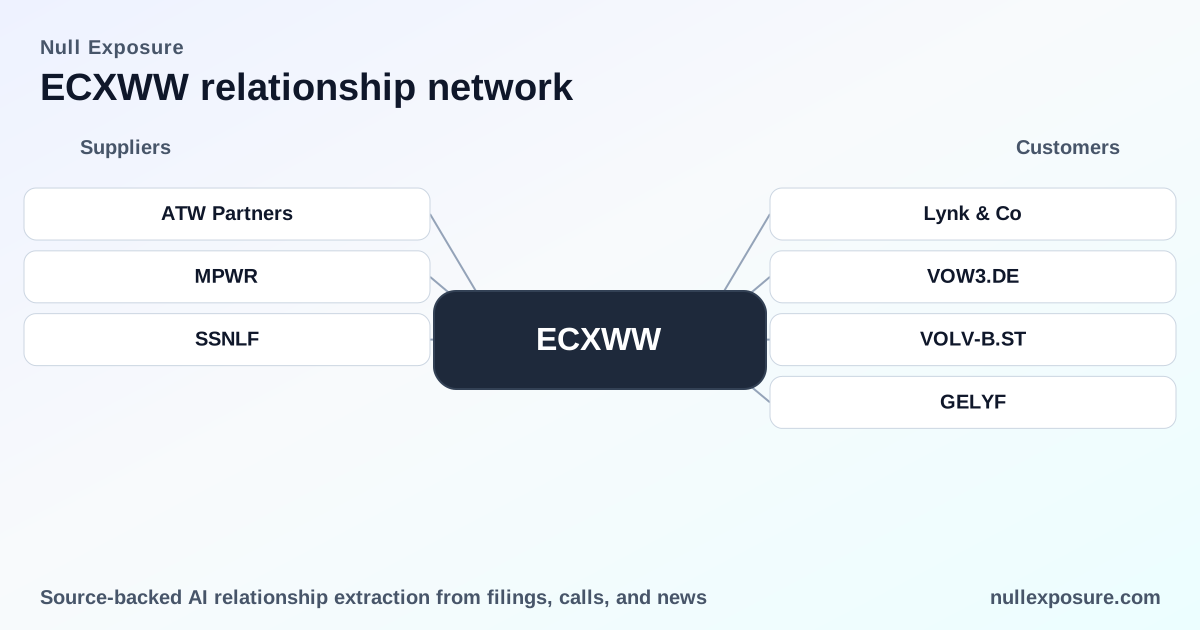
ECARX listed three supplier/partner relationships during its 2025 Q4 earnings call; each is directly relevant to R&D, manufacturing scale, or financing.
ATW Partners
ECARX said it signed a convertible bond financing agreement of up to $150 million with ATW Partners as part of recent liquidity actions. This is a direct financing relationship that alters the company’s capital structure and underscores reliance on structured credit to fund execution. According to ECARX’s 2025 Q4 earnings call (first reported March 7, 2026), the convertible bond with ATW forms a material piece of near-term financing.
Monolithic Power (MPWR)
ECARX described a global partnership with Monolithic Power to leverage combined R&D capabilities at its Fuyang intelligent manufacturing facility and to advance system integration and platform adoption. This is a technology and supply partnership focused on integrating power and systems components into ECARX’s platforms, noted on the company’s 2025 Q4 earnings call (first seen March 7, 2026).
Samsung (SSNLF)
ECARX named Samsung alongside Monolithic Power as a global partner contributing to the intelligent industrial ecosystem at its Fuyang facility, emphasizing joint R&D and platform adoption efforts. The 2025 Q4 earnings call (first seen March 7, 2026) frames Samsung as a strategic collaborator on system integration and scale manufacturing capabilities.
Why these relationships matter for investors and operators
The three disclosures combine to create a practical profile for diligence:
- Financing vs. supplier risk: The convertible bond with ATW is a financing instrument that directly affects capital structure and dilution potential for warrant holders; investors must treat it as a contractual obligation with potential conversion and covenant outcomes. The mention of a $456 million raise from a strategic partner (Geily) alongside the ATW facility in the same call shows ECARX is using both equity/strategic capital and structured debt-like instruments to fund growth, which reduces near-term solvency risk but increases capitalization complexity (as disclosed in the 2025 Q4 earnings call).
- R&D and manufacturing convergence: Partnerships with Samsung and Monolithic Power indicate deep technical co-development and supply alignment, which reduces execution risk in product development and speeds platform adoption, but simultaneously creates concentration risk if either partner exerts outsized influence on component supply or IP terms.
- Operational leverage vs. financial leverage: ECARX’s revenue scale and platform positioning provide operational leverage, while negative EBITDA and active financing show the company is deploying financial leverage to extend that runway. Investors should weigh commercial de‑risking from strong partners against balance-sheet dilution and covenant complexity.
If you need a concise supplier risk scorecard built from these disclosures, start with contract terms, conversion clauses in the ATW bond, and IP/licensing carve-outs in the Samsung/Monolithic relationships — more detail is available at https://nullexposure.com/.
Practical diligence checklist for operators and procurement teams
Focus on contractual mechanics and resilience:
- Confirm the convertible bond terms (coupon, conversion price, dilution cap, and covenants) and their trigger points.
- Validate manufacturing capacity commitments at Fuyang and contingency plans for supply disruption.
- Verify IP ownership and licensing boundaries in R&D collaborations with Samsung and Monolithic Power.
- Assess supplier concentration: determine alternative sources for critical modules and time-to-replace.
- Review governance and strategic capital arrangements with strategic investors (e.g., Geily) that create cross-shareholder rights or operational constraints.
Bottom line: strategic partnerships strengthen the product story, financing complicates the capital story
ECARX is executing a classic platform-scale play: technical partnership to accelerate product-market fit, combined with structured financing to buy time for commercial rollout. That combination creates asymmetric outcomes—meaningful upside if integration and customer adoption proceed, and clear downside if financing terms prove onerous or a partner’s role becomes a single point of failure. For warrant investors, the leverage introduced by convertible instruments and ongoing capital raises is central to valuation sensitivity and dilution risk (as described in ECARX’s 2025 Q4 call).
For deeper supplier intelligence and monitoring of counterparties, visit https://nullexposure.com/ to access structured relationship signals and alerts.
If you’re evaluating operational risk or negotiating supplier terms with ECARX, the three disclosures above frame the immediate priorities; for bespoke analysis and watchlists, start at https://nullexposure.com/.