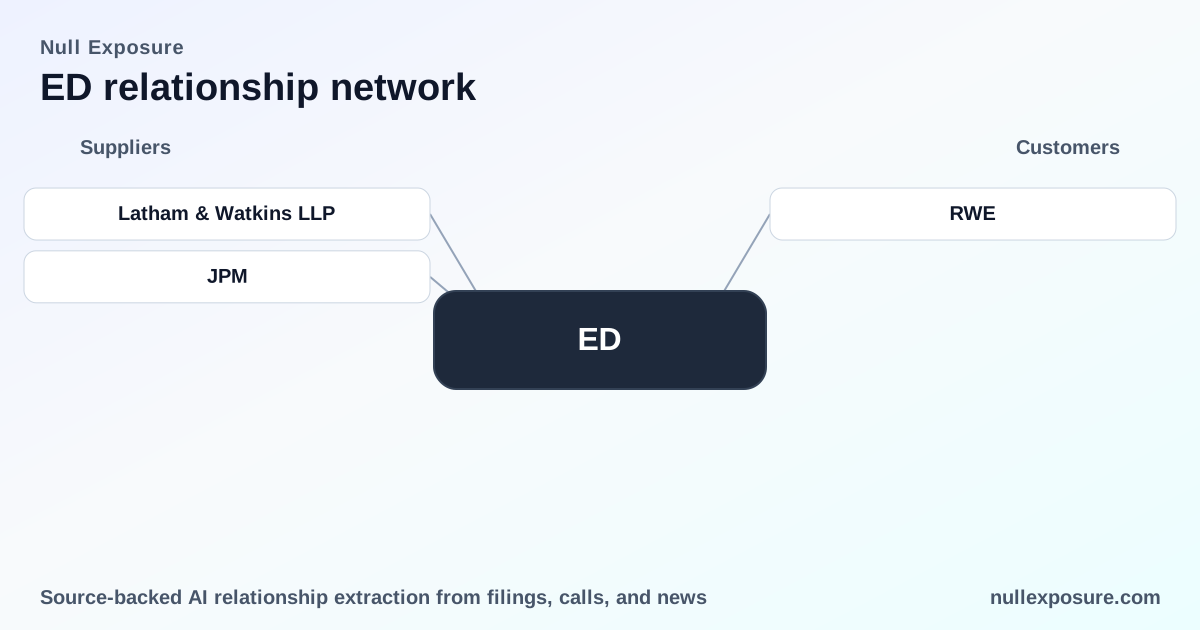
Con Edison (ED): Supplier relationships that shape capital and operational risk
Consolidated Edison operates as a large, regulated utility that monetizes through regulated electricity and gas delivery, merchant power sales, and long-term commodity contracts. The company converts capital investment in infrastructure into rate-base returns while purchasing bulk energy through a mix of wholesale markets and contracted supply, creating supplier relationships that directly influence cash flow volatility and regulatory narratives. For investors evaluating supplier counterparty risk and procurement posture, Con Edison’s supplier map is as relevant as its balance sheet. Explore supplier signals and relationship implications at https://nullexposure.com/.
Why supplier relationships matter for a regulated utility investor
Suppliers influence both short-run margin volatility and long-run regulatory outcomes for Con Edison. The company reported roughly $16.9 billion in revenue TTM and carries large fixed obligations tied to power and transportation contracts; supplier arrangements therefore feed into capital planning, rate cases, and earnings-per-share stability. Two themes matter most to investors: the mix of spot market purchases versus contracted supply, and the criticality of service providers that protect operational continuity (for example, cybersecurity and underwriting partners). For timely research and supplier intelligence, see https://nullexposure.com/.
The active supplier relationships you need to know
Below I list every supplier relationship flagged in the available public records and news for FY2026, with plain-English summaries and source context.
Latham & Watkins LLP — legal adviser on renewable dispositions
Con Edison retained Latham & Watkins LLP to represent the company in the transaction selling renewable-energy subsidiaries, with an M&A team led by New York partners Christopher Cross and Leah Sauter. This engagement signals reliance on top-tier transactional counsel for strategic portfolio moves. (Source: Latham & Watkins announcement on lw.com, March 2026.)
J.P. Morgan Securities — underwriter for share transactions
J.P. Morgan Securities served as the underwriter selling shares in a Con Edison offering; the firm executed distribution and underwriting responsibilities for the sale. Underwriting relationships are standard for capital-raising and reflect the company’s access to institutional capital markets. (Source: Finviz summarizing coverage of the March 2026 transaction; the report references J.P. Morgan Securities as the underwriter.)
What constraints and procurement posture reveal about operational risk
Con Edison’s public disclosures and the relationship evidence produce a coherent set of operating-model signals that matter for counterparty risk, concentration, and contract maturity.
- Contracting posture: market-facing with significant spot participation. Company language states that “almost all the electricity and gas the Utilities sell to their full-service customers is purchased through the wholesale energy markets or pursuant to contracts with energy suppliers.” This establishes a procurement model where short-term market exposure is material to supply economics.
- Buyer and service-provider duality. Con Edison operates both as a large buyer of wholesale electricity and gas and as a contracting party for professional services (legal counsel, consultants). Filings reference ElectricityPurchasedMember activity for 2024 and explicit engagement of independent advisers for cybersecurity, indicating active procurement across commodity and services categories.
- Concentration and spend scale: large, multi-year obligations. The company reports fixed charges of approximately $422.3 million in 2024 tied to supply and transportation contracts, and contracts extend to 2027 for supply and to 2046 for transportation and storage, demonstrating a blend of short-term market exposure and long-duration commitments. The vendor spend profile is therefore high-dollar and strategically important, consistent with the constraint signal classified as 100m+.
- Relationship stage and maturity: active and structural. Contracts are characterized as active and integral to day-to-day operations, not one-off projects; the mix of spot and long-term commitments means liquidity and counterparty credit are persistent governance items for management.
These constraints collectively depict a procurement model that is operationally critical, capital-intensive, and balanced between market-driven purchases and multi-decade infrastructure agreements.
Investment implications and what operators should watch
For investors and operating executives, the supplier map and constraints produce immediate, actionable implications:
- Earnings sensitivity to market prices. The material use of wholesale markets for commodity purchases introduces earnings volatility that is not fully offset by rate mechanisms; track commodity stacks and regulatory amortization mechanisms in upcoming rate cases.
- Counterparty credit and concentration risk. Large, long-dated transportation and storage contracts that extend into the 2040s create concentrated exposures that matter in stress scenarios; credit protections and collateral clauses should be evaluated in filings and transaction documents.
- Service-provider dependency. Engagements with elite legal counsel and major investment banks for M&A and capital markets activity indicate Con Edison leans on high-quality external advisers for strategic execution; cybersecurity advisory spend underscores the operational criticality of third-party services.
- Regulatory interplay. Because Con Edison is a regulated electric utility, supplier costs are frequently litigated and reconciled in rate proceedings; the company’s contracting choices feed directly into regulatory narratives and allowed returns.
Tactical monitoring checklist for investors
- Monitor rate-case filings for pass-throughs of fuel and purchased-power costs.
- Watch quarterly disclosures for changes in fixed-charge levels and counterparty concentration.
- Read transaction filings for indemnities, collateral, and long-term transportation commitments that could surface in downside scenarios.
For ongoing monitoring and relationship-level intelligence, visit https://nullexposure.com/ to see how supplier exposures map to credit and operational risk.
Bottom line and next steps
Con Edison’s supplier footprint combines material spot-market purchasing with strategically important, long-duration contracts and selective reliance on top-tier advisers and underwriters. That mix defines both near-term volatility and long-term structural obligations that investors must price into valuation and risk models. For further supplier-focused diligence and to track counterparties across the utility sector, start your analysis at https://nullexposure.com/.
Key takeaway: supplier relationships are a direct lever on Con Edison’s cash-flow volatility and regulatory outcomes—treat procurement disclosure, counterparty terms, and contract durations as primary inputs to your investment thesis.