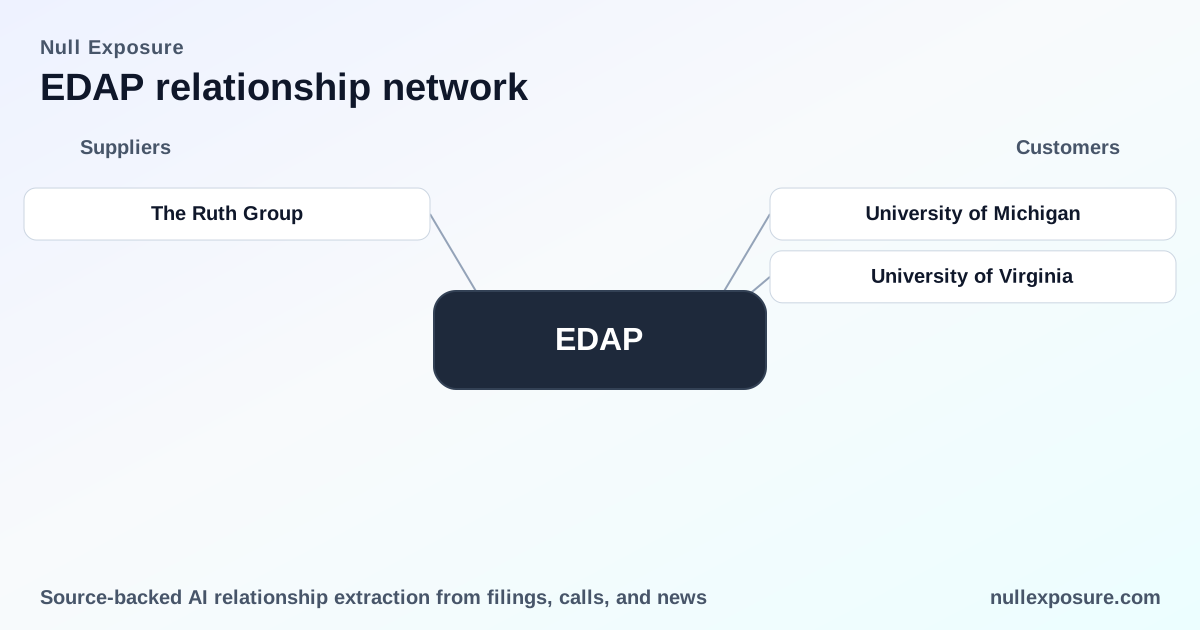
EDAP TMS SA — supplier relationships, operating posture, and what investors should price in
EDAP TMS SA develops, manufactures and sells minimally invasive urology devices and monetizes through direct product sales, aftermarket service and distribution agreements across Europe, the U.S. and Asia. The company’s economics are driven by installed base growth (device sales plus recurring maintenance and disposables), regulatory compliance that unlocks market access, and selective geographic distribution partnerships that scale revenue without proportional fixed-cost expansion. For investors and procurement operators, the critical question is whether EDAP can convert regulatory clearance and installed-product momentum into consistent gross-to-operating margin expansion while managing a concentrated supplier and commercialization footprint. Explore deeper intelligence and supplier mapping at https://nullexposure.com/.
How EDAP makes money and why that matters to supplier counterparties
EDAP’s core revenue comes from sales of its focused urology platforms and the consumables and service contracts that follow installation. Revenue TTM of $63.8M with gross profit of $27.6M shows that product economics are viable at the gross line, but operating margin is negative (-35.5%) and EBITDA is negative, indicating fixed-cost absorption and investment in commercialization. The company lists its commercial presence under the FocalOne brand online (https://focalone.com), confirming the product-led, installed-base monetization model that makes distributors, OEM manufacturing partners and regulatory services important levers for growth.
- Scale and capital posture: Market cap ~ $148M and negative operating results mean EDAP relies on disciplined working-capital management, selective outsourcing and revenue growth to reach operating profitability.
- Regulatory sensitivity: FDA inspections, CE certifications and similar regulatory events directly affect revenue timelines; positive inspection outcomes accelerate adoption and supplier demand.
- Concentration dynamics: With a relatively small float and modest institutional ownership, supplier negotiations and public communications carry outsized operational risk and reputational impact.
Public supplier/partner evidence: the relationships identified in the record
The public search returned one explicit relationship mention in the coverage set below. Each listed relationship is summarized in plain English with an associated source.
- The Ruth Group — A MassDevice press release dated March 9, 2026 lists The Ruth Group as the investor/media contact for EDAP’s announcement that it completed an FDA inspection of its manufacturing site; the mention functions as an outsourced investor-relations/media contact rather than an operations supplier. Source: MassDevice press release (March 9, 2026) which includes investor/media contact information attributing communications to The Ruth Group (see the press release posting).
Why the Ruth Group listing is relevant for investors and operators
The inclusion of The Ruth Group as investor/media contacts in a regulatory/inspection announcement signals outsourced investor relations and public communications. That structure affects the timing and tone of regulatory disclosures and therefore market reaction to supplier or manufacturing updates. It does not indicate a direct manufacturing or component supply relationship but is material for analysts and procurement teams tracking disclosure cadence and reputational management. The press release context makes clear this is a communications relationship rather than a supplier-of-record for components. Source: MassDevice press release (March 9, 2026).
Company-level constraints and operating model signals investors should model
Because the dataset contains no contract-level constraints, present company-level signals should guide scenario analysis:
- Contracting posture: EDAP operates with a product-centric commercial model that favors distribution agreements and regional service partners over vertically integrated global manufacturing. This posture reduces fixed-cost exposure but increases dependency on third-party logistics, calibration services and regulatory consultants.
- Concentration: Small-cap scale and modest shares outstanding create concentration risk in both supplier negotiations and liquidity; a single regional distribution partner or an adverse manufacturing event can produce outsized revenue swings.
- Criticality: Devices are high-criticality for clinical customers; therefore regulatory compliance and manufacturing quality are mission-critical—any supplier shortfall in components or calibration services directly threatens revenue and installed-base uptime.
- Maturity: The company shows early-to-mid commercial maturity—product revenue and gross margin exist, but operating leverage is not yet achieved, meaning supplier terms and cost-of-goods dynamics remain decisive for margin improvement.
These signals should be treated as company-level constraints to be reflected in procurement diligence, contract design and scenario-based forecasting.
Risk and opportunity read for investors and operators
- Regulatory wins are material: A completed FDA inspection is a positive operational milestone; such events unlock U.S. demand and can accelerate consumable and service revenue tied to installed devices. Source: MassDevice press release (March 9, 2026).
- Profitability gap is the headline risk: With negative operating margins and EBITDA, EDAP must either grow gross revenue materially or compress SG&A/R&D to reach profitability; vendor and distribution economics will determine the pace of margin recovery.
- Valuation and upside: The market is pricing growth with a forward P/E near 38.9 and EV/Revenue ~1.9; upside depends on converting regulatory progress into recurring revenue while preserving free-cash-flow runway.
- Communications and market reactions: Outsourced investor relations—visible via The Ruth Group contact—shapes news flow and can amplify regulatory milestones into share-price movements; operators and procurement teams should align on disclosure-ready supplier status for critical components.
Practical next steps for due diligence
- Verify supplier continuity plans and single-source dependencies for consumables and calibration parts.
- Confirm contractual service-level agreements for installed-base maintenance in key regions (U.S., Europe, Asia).
- Align legal/regulatory timelines with procurement forecasts to avoid missed revenue recognition windows.
For a structured supplier map and deeper relationship intelligence on EDAP and its partner network, visit https://nullexposure.com/ — the starting point for targeted counterparty analysis.
Final takeaway and how we can help
EDAP is a product-driven, installed-base growth company whose near-term valuation hinges on regulatory execution and supplier economics. The public record highlights outsourced investor relations in support of disclosures, but operational risk remains concentrated in manufacturing and distribution pathways. Procurement teams should treat supplier continuity and service agreements as the marginal lever for margin recovery.
If you are evaluating EDAP for investment or vendor partnerships, conduct focused validation of supplier SLAs, inventory buffers and regulatory readiness. Learn how to structure that diligence and access relationship-level signals at https://nullexposure.com/.