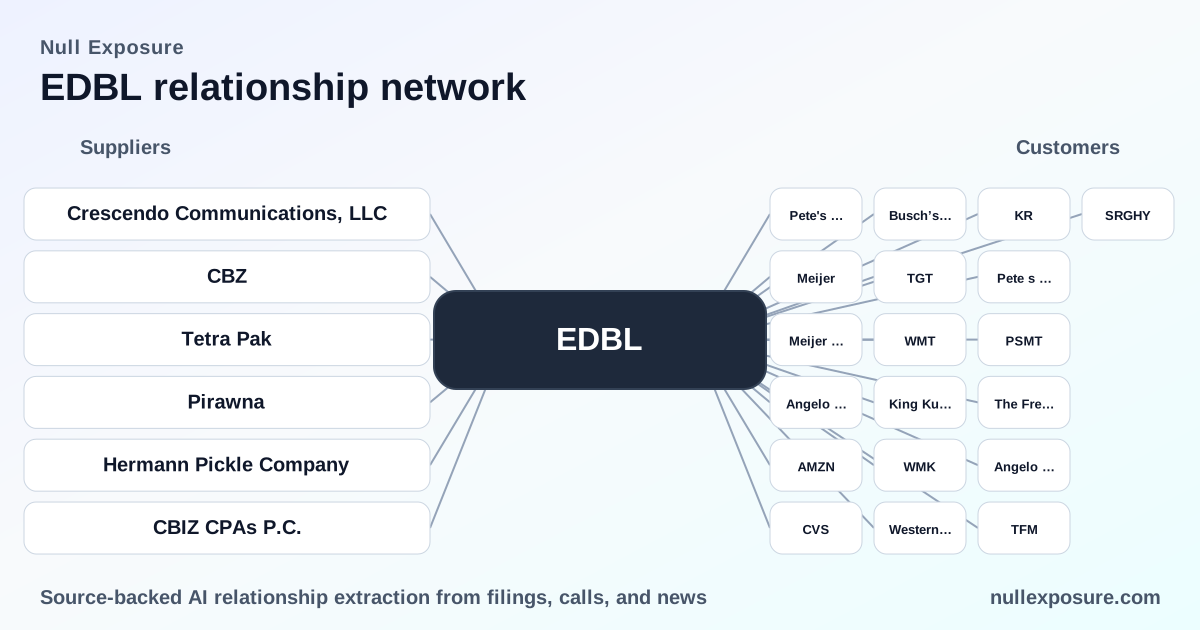
Edible Garden AG: supplier relationships that shape a microcap growth play
Edible Garden AG operates controlled-environment agriculture and packaged food businesses, monetizing through the sale of fresh and value-added food products (branded refrigerated items, sports nutrition, and new ready-to-drink lines) to retailers and e-commerce channels. Revenue is generated from product sales through retail distribution, Amazon/e‑commerce partnerships and incremental manufacturing agreements; the company supplements commercial outreach with active investor relations. For a focused view on counterparties and operational exposure, read on. If you want ongoing monitoring of supplier and commercial counterparties, visit https://nullexposure.com/ for continuous coverage.
How the business actually earns margin and uses suppliers
Edible Garden is a vertically oriented food company that combines contract-grown produce with branded packaged goods. The company reports TTM revenue of roughly $12.6 million and gross profit around $1.02 million, reflecting a business that is still scaling commercial distribution while carrying negative operating margins. Commercial partners fall into three practical categories for investors: financial/IR advisers and auditors, manufacturing and packaging partners, and distribution/e‑commerce partners. Each category has different operational criticality: packaging partners can determine speed-to-market for new SKUs, co‑manufacturers influence product quality and labeling, and e‑commerce partners drive direct-to-consumer reach.
Who Edible Garden is working with — the visible relationships
-
Crescendo Communications, LLC — Crescendo serves as investor relations contact for Edible Garden in multiple press releases, providing investor communications and contact points for market outreach. A Sahm Capital press release dated December 9, 2025 lists Crescendo as the investor contact for preliminary sales results, and a February 11, 2026 release again identifies Crescendo for investor outreach.
Source: Sahm Capital press releases (Dec 9, 2025 and Feb 11, 2026). -
CBIZ CPAs P.C. — CBIZ is referenced as the independent registered public accounting firm with the caveat that it has not audited or reviewed preliminary financial data disclosed in company releases, signalling that some published figures are unaudited. This language appears in the company’s FY2025 preliminary financial disclosures and related press mentions.
Source: Sahm Capital press release (Dec 9, 2025) and reporting on preliminary FY2025 figures. -
Tetra Pak — Edible Garden selected Tetra Pak to support a new Midwest ready‑to‑drink facility announced at Natural Products Expo West 2026, indicating a strategic packaging and processing relationship for liquid SKUs. This partnership elevates the company’s manufacturing capacity in packaged beverages.
Source: Markets.BusinessInsider / GlobeNewswire coverage (March 2026 report of Expo West announcement). -
Pirawna — Pirawna is named as an exclusive e‑commerce partner supporting Kick sports nutrition’s Amazon launch and broader online distribution, demonstrating reliance on a single e‑commerce integrator for digital channel rollout.
Source: Sahm Capital press release (Dec 11, 2025). -
Hermann Pickle Company — Edible Garden partnered with the Hermann Pickle Company to manufacture and distribute the Pickle Party™ line, leveraging an established co‑manufacturer for fermented, refrigerated, Kosher pickles and expanding retail access.
Source: Sahm Capital press release (Dec 5, 2025).
What these relationships mean for operating risk and strategy
Edible Garden’s visible counterparties reveal a company transitioning from small-batch operations to more standardized packaged production and omnichannel distribution. Key business model characteristics include:
-
Contracting posture: Company‑level signals indicate a spot, purchase‑order style relationship with certain growers rather than long-form supply contracts; Edible Garden uses purchase orders to transact with growers and does not always have formal written contracts. This suggests flexibility in sourcing but higher supply volatility when volumes or quality need to be locked down.
Source: company disclosures on grower relationships (company-level evidence). -
Manufacturing allocation and risk: Growers carry inventory risk during the growing process, per company language, which shifts harvest and crop volatility away from Edible Garden but creates exposure to supplier availability and quality swings. This is a manufacturer role signal—growers effectively act as contracted producers.
Source: company statements on grower arrangements. -
Maturity of relationships: The company classifies grower relationships as long‑term, with management ties sometimes exceeding five years, indicating operational continuity and embedded supplier knowledge even in a spot-purchase framework. That reduces onboarding risk for produce lines but does not eliminate seasonal or capacity constraints.
Source: company statements on grower relationship duration. -
Channel concentration and operational criticality: Tetra Pak and Hermann Pickle Company represent critical manufacturing and packaging partners for specific product lines (ready‑to‑drink beverages and fermented pickles, respectively). Pirawna’s role on e‑commerce creates channel dependency for online reach. Loss or disruption of any single partner would affect the associated SKU lines disproportionately.
-
Disclosure and audit posture: Repeated company statements that CBIZ has not audited certain preliminary financial data indicate a need for caution when using press release figures for valuation; audited statements remain the investor standard.
Investor takeaways and operational recommendations
-
Supply fragility is real but manageable. The mix of long personal relationships with growers and a purchase‑order contracting posture gives Edible Garden agility but exposes the company to harvest timing and quality variability. Operators should prioritize converting high‑volume growers to multi‑year purchase commitments to stabilize supply for priority SKUs.
-
Manufacturing partnerships are strategic levers. Tetra Pak and Hermann Pickle Company materially increase the company’s ability to scale packaged SKUs. Investors should treat these relationships as value drivers that can accelerate revenue growth if rollouts meet retail placement targets.
-
E‑commerce integration is a growth hinge. Pirawna’s role in Amazon launches indicates a scalable channel, but concentration in a single e‑commerce integrator creates execution risk; diversification across digital partners would strengthen resilience.
-
Verify preliminary metrics. CBIZ’s statement about unaudited preliminary data means investors must rely on audited filings for rigorous financial modeling until audited statements are available.
If you want a continuous, relationship-focused feed and risk scoring for suppliers like these, explore how we track counterparties at https://nullexposure.com/.
Final verdict for operators and allocators
Edible Garden sits at the intersection of fresh produce sourcing and branded packaged goods manufacturing. The company’s supplier network combines long-standing grower relationships, targeted co‑manufacturing partnerships, and single-channel e‑commerce dependencies—a configuration that supports rapid SKU expansion but concentrates operational risk in specific partners. For investors, the next inflection points to watch are audited financials, the commercial ramp from the Tetra Pak‑enabled beverage facility, and traction for Kick and Pickle Party in retail and online channels. For operators, converting high-value, spot-sourced inputs into stable contracts and diversifying e‑commerce execution are the most actionable priorities.
For ongoing monitoring of suppliers and partner exposures, visit https://nullexposure.com/. If you want customized supplier intelligence on Edible Garden or similar microcaps, start with a review at https://nullexposure.com/ and request tailored analysis.