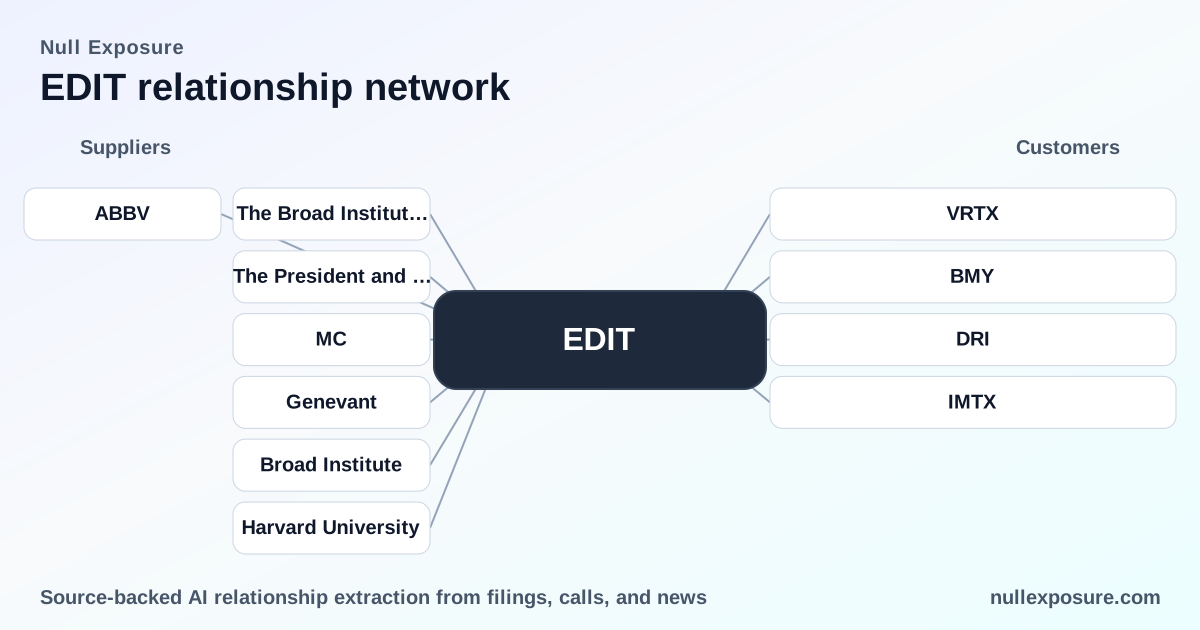
Editas Medicine (EDIT): supplier relationship map and what it means for investors
Editas Medicine is a clinical-stage genome-editing company that licenses foundational CRISPR intellectual property, outsources much of its development and manufacturing, and monetizes through partnerships, milestone/license payments and future product sales if candidates reach approval. Its balance of exclusive foundational IP licenses and reliance on third-party development partners creates a capital-efficient R&D posture but concentrates strategic risk around a small set of licensors and external suppliers.
If you evaluate counterparties or underwrite exposure to Editas, start with the IP licensing economics and the outsourcing profile — both drive revenue optionality and downside. Learn more at https://nullexposure.com/.
Why supplier relationships are the investment lever here
Editas’s commercial value is tied to two levers: exclusive access to CRISPR patent estates that allow product development, and the company’s ability to execute trials and manufacturing through external partners. Those levers set the return profile for investors: licensing gives upside optionality through partner deals and royalties; outsourcing reduces fixed costs but creates counterparty concentration risk. The most important supplier relationships therefore are the IP licensors and the technical vendors (CROs/CMOs/LNP providers) that turn bench science into clinic-ready product.
For a concise operational risk and exposure check, visit https://nullexposure.com/.
Core licensing relationships that define product rights
Broad Institute / The Broad Institute, Inc.
Editas holds exclusive licenses to Broad’s Cas12a patent estate and rights to Broad’s Cas9 estate for human medicines, and is contractually obliged to pay Broad a mid-double-digit percentage of amounts payable to Editas from Vertex under the Cas9-related license. This is a structural cost against any Vertex-derived economics and a binding intellectual property relationship. According to Editas’s 2024 Form 10‑K, those licensing arrangements are foundational to the company’s product rights (10‑K, FY2024), and corporate releases in 2025–2026 reaffirm the exclusive-license characterization (company press releases, FY2025–FY2026).
Harvard University / The President and Fellows of Harvard College
Editas’s rights to Cas9 were licensed from Harvard (the President and Fellows of Harvard College) alongside Broad, and the company owes Harvard the same mid-double-digit split on amounts payable from Vertex tied to the Cas9 license. The 2024 10‑K names Harvard explicitly as a co-licensor and co-payee under the Vertex-related economics (10‑K, FY2024). Subsequent investor communications in 2025–2026 restate Editas’s exclusive license position for human therapeutics (press releases, FY2025–FY2026).
Strategic partner and service relationships
Moelis & Company
Editas engaged Moelis & Company to lead the global process to partner or out-license its reni-cel program, signaling a formal commercialization or divestiture effort. A MedCity News report in October 2024 noted Moelis’s role in the deal process for reni-cel (MedCityNews, Oct 2024).
Genevant
Editas’s LNP (lipid nanoparticle) execution has used Genevant’s LNP expertise as part of a refocusing of clinical assets and platform capabilities, indicating reliance on third-party lipid delivery know-how rather than developing it fully in-house. Fierce Biotech reported that Editas had a deal with Genevant to leverage the company’s LNP capabilities during program refocusing (FierceBiotech, coverage reflecting FY2024 reporting).
AbbVie's Allergan unit (legacy)
A legacy alliance with AbbVie’s Allergan unit covered multiple eye-disease programs and was terminated in 2020; Editas’s historical reliance on that partnership shaped earlier development trajectories but is not an active revenue source today. Industry reporting in 2022 documented the termination of that multi-program alliance (pharmaphorum, FY2022).
How these relationships shape operational constraints and risk profile
Editas’s public disclosures and the extracted constraint signals describe an operating model with three clear characteristics:
- Licensor dependence (company-level signal tied to Broad and Harvard): Editas is the exclusive licensee for critical Cas9/Cas12a rights and has contractually material royalty/ligation obligations (the 10‑K states mid-double-digit percentages tied to Vertex payments). This makes the IP licensors both strategic enablers and ongoing cost centers.
- Outsourced manufacturing posture (company-level signal): Editas primarily relies on third-party CMOs for preclinical, clinical and anticipated commercial supply while maintaining limited in‑house capabilities, per company disclosures. That creates supplier concentration and substitution risk but lowers fixed-cost burden.
- Third-party service reliance (company-level signal): Editas routinely contracts with CROs, clinical data managers, clinical investigators and other vendors to run trials and manage data — a mature bio‑pharma operating model that transfers execution risk to external vendors while compressing capital requirements.
Put succinctly: IP licensors are critical and contractually embedded; manufacturing and clinical execution are outsourced and therefore operationally critical but replaceable with lead time. Investors should treat license economics as a persistent margin sink and supplier capacity/quality as the execution gate to revenue realization.
For a deeper counterparty audit and commercial exposure map, see https://nullexposure.com/.
Practical investor takeaways
- License economics are non-trivial. The mid‑double-digit obligation to Broad/Harvard on Vertex-derived payments reduces realized economics from key partner arrangements and should be modeled explicitly in revenue scenarios (Editas 2024 10‑K).
- Counterparty concentration matters. Reliance on a small set of licensors and external CMOs/LNP providers accelerates downside if a partner underperforms or contract disputes arise.
- Active portfolio management is under way. Engagement of Moelis indicates Editas is monetizing or reprioritizing assets (reni-cel) to unlock value; investors should watch process milestones and potential deal structures closely (MedCityNews, Oct 2024).
- Legacy partnerships are informative but not current cash drivers. The AbbVie/Allergan termination shows prior strategic reset; future partner selection will define commercialization paths (pharmaphorum, FY2022).
Closing recommendation
Editas’s roadmap is governed by exclusive IP rights plus outsourced execution — a combination that creates high upside if development and partner monetization succeed and structural downside if licensing economics or supplier performance degrade. For investment or counterparty diligence, prioritize: (1) the specifics of any Vertex-related payment flows and how they net after Broad/Harvard obligations; (2) the stability and diversification of CMOs/LNP partners; and (3) outcomes from the Moelis-led process for reni-cel.
Assess counterparty exposure and scenario-model royalty drag with direct tools at https://nullexposure.com/.
Bold, disciplined monitoring of Editas’s licensing cashflows and supplier contracts will separate speculative bets from actionable risk-adjusted positions.