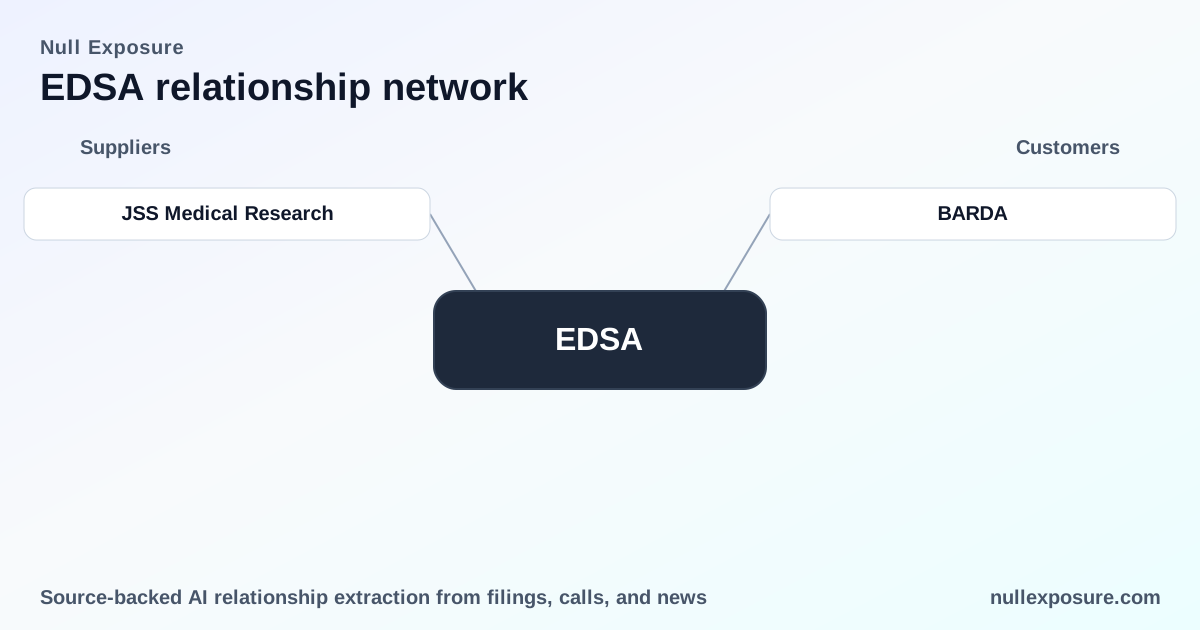
Edesa Biotech (EDSA) — supplier profile and what investors should price in
Edesa Biotech is a clinical-stage biopharmaceutical company that develops monoclonal antibodies for inflammatory and immune-related diseases and monetizes through exclusive licenses, milestone-driven partner payments, and — ultimately — product sales following regulatory approval. The company runs late-stage clinical programs managed by third-party clinical research organizations (CROs) and relies on contract manufacturing organizations (CMOs) for production; revenue today is negligible and value is driven by IP-backed milestones and successful Phase 3 outcomes. For a concise, investor-grade supplier map and ongoing monitoring, visit https://nullexposure.com/ for our supplier intelligence and alerts.
How suppliers fit into Edesa’s business model
Edesa’s operating model is a hybrid of licensor and outsourced operator. The firm holds exclusive licenses to key antibody constructs and has contractual milestone obligations that create very large contingent payouts if programs succeed. At the same time, day‑to‑day delivery of clinical trials and manufacturing is outsourced: CROs run trials and CMOs produce clinical and potential commercial material on as‑requested terms. This combination produces a contracting posture that is strategically long‑term on IP and licensing, while being operationally flexible and often spot-based for manufacturing.
Key structural signals from company disclosures and filings:
- Licensing is primary: Edesa holds multiple exclusive license agreements (Yissum, NovImmune and a 2020 construct license), which drive long-term intellectual property rights and milestone exposures as company-level obligations.
- Mixed contracting posture: the company is negotiating long-term supply agreements with CMOs while also operating under “as-requested” manufacturing arrangements and month‑to‑month facility leases.
- Government support reduces near-term cash burden: the 2023 SIF Agreement commits up to C$23 million of partially repayable funding tied to Phase 3 execution and manufacturing scale‑up.
- Spend profile is lumpy: near-term contracted cash calls are modest (aggregate contractual payments reported ~US$858k across two years), while milestone liabilities aggregate into the tens and hundreds of millions (examples in filings show commitments up to $68.9M, $18.4M, and a conditional $356M payoff).
These characteristics produce a high‑leverage, binary commercial risk profile: operational suppliers (CROs/CMOs) are critical to trial execution and sample integrity, while licensing counterparty terms determine future upside and contingent liabilities.
Supplier entries found in public reporting — the JSS Medical Research relationship
Edesa’s public disclosures and press releases identify JSS Medical Research as the CRO that managed and analyzed phases of its Phase 3 programs. Each of the following items documents that relationship in public reporting:
- JSS Medical Research managed the Phase 3 respiratory study and conducted all analyses for that trial, as disclosed in a company release. (GlobeNewswire, October 28, 2025 — https://www.globenewswire.com/news-release/2025/10/28/3175297/0/en/Edesa-Biotech-Reports-Positive-Results-in-Phase-3-Respiratory-Study.html)
- JSS Medical Research is reported again as the manager and analyst for the Phase 3 paridiprubart study in Edesa’s February 24, 2026 release describing additional positive results. (GlobeNewswire, February 24, 2026 — https://www.globenewswire.com/news-release/2026/02/24/3243711/0/en/edesa-biotech-reports-additional-positive-results-from-phase-3-paridiprubart-study.html)
- The same February 24, 2026 announcement was republished with identical language showing JSS’s role managing and conducting analyses for the paridiprubart study. (GlobeNewswire republish, February 24, 2026 — https://www.globenewswire.com/news-release/2026/02/24/3243711/0/en/Edesa-Biotech-Reports-Additional-Positive-Results-from-Phase-3-Paridiprubart-Study.html)
- A third repost of the February 2026 announcement names JSS Medical Research as the CRO conducting study management and analyses. (Bitget news repost of February 2026 release — https://www.bitget.com/news/detail/12560605216601)
- A financial news republisher likewise documents that Edesa’s Phase 3 study management and statistical analyses were performed by JSS Medical Research. (Sahm Capital republish of February 24, 2026 release — https://www.sahmcapital.com/news/content/edesa-biotech-reports-additional-positive-results-from-phase-3-paridiprubart-study-2026-02-24)
Each report consistently positions JSS Medical Research as the contract clinical service provider responsible for trial management and analysis, making it a mission‑critical CRO for Edesa’s current late‑stage evidence generation.
What the constraints tell investors about counterparty and contract risk
Edesa’s public constraints and contract language reveal practical investor-relevant points:
- Contracting posture is hybrid: company-level disclosures state active negotiations for long‑term supply agreements with CMOs while operational manufacturing is also conducted “on an as‑requested basis.” That means supply resilience is contingent on converting spot relationships into multi-year supply contracts.
- Supplier roles are concentrated and critical: the firm explicitly depends on third‑party CMOs for chemistry and biological manufacture and on CROs for clinical work; these relationships are operationally critical to achieving regulatory milestones.
- Maturity of relationships is active but varied: the company reports active third‑party engagements today, month‑to‑month office leases for headquarter space, and multi-year licensing commitments that create long-term obligations.
- Financial exposure is asymmetric: near-term contractual cash commitments are relatively small (reported aggregate ~US$858k across the next two years), but milestone contingent liabilities total in the tens to hundreds of millions under multiple license agreements — a classic biotech structure where downside cash needs are limited but upside milestone payouts are large and valuation‑relevant.
These constraints create a profile where operational counterparty execution (CRO and CMO performance) has outsized influence over whether the large, contingent licensing payouts — and therefore enterprise value — ever materialize.
For ongoing supplier monitoring and to map how these relationships evolve over time, review our supplier intelligence at https://nullexposure.com/.
Investment implications and risk checklist
- Catalyst-driven valuation: Edesa’s market value is driven by Phase 3 outcomes and regulatory submissions; the CRO relationship with JSS is a direct input to credibility of trial results.
- Counterparty concentration risk: reliance on a small set of CROs and CMOs elevates execution risk; investors should monitor any signals of manufacturing delays, assay issues, or CRO turnover.
- Contingent liability profile: large milestone caps in license agreements create both upside and future payment obligations that will affect net economics if products win approval.
- Cash and funding considerations: government support under the 2023 SIF Agreement eases near-term funding for trial completion and scale‑up, but the company remains loss-making with minimal revenue today; watch dilution risk from at‑the‑market offerings and other financing activity reported in filings.
Analyst consensus and public metrics corroborate the high‑risk/high‑reward picture: Edesa is a clinical‑stage biotech with minimal current revenue and a market capitalization in the mid‑tens of millions, while analyst target price is materially higher, reflecting expected successful commercialization events.
Practical next steps for investors
- Verify whether JSS Medical Research remains contracted for upcoming analysis and submission activities; a change in CRO at this stage would be material.
- Monitor conversion of CMOs from spot/short‑term engagements to long‑term supply agreements, which de‑risks commercialization pathways.
- Track milestone triggers in the company’s license agreements and the timing of potential payments or dilution events tied to those triggers.
For a structured supplier risk scorecard and real‑time alerts tied to these exact contract and relationship signals, see our platform at https://nullexposure.com/.
In summary: Edesa’s supplier model is a deliberate mix of long‑term IP licensing and outsourced operational execution; the JSS Medical Research CRO relationship is mission‑critical to near‑term value creation, while license milestones and CMO arrangements determine the larger commercial payoff. Investors should prioritize monitoring CRO continuity, CMO supply agreements, and milestone payment triggers as the primary drivers of execution risk and upside.