Euronet Worldwide (EEFT): Supplier relationships that reshape processing, rails, and risk
Euronet Worldwide operates as a global payments and transaction-processing engine, monetizing primarily through transaction processing, merchant acquiring, and distribution services provided to banks, merchants, agents and consumers. The company expands capability and scale by combining targeted acquisitions with third‑party technology partnerships—generating recurring fee income from processed flows while layering value‑added services such as authentication and digital-asset rails. For investors and operator partners, the question is simple: is Euronet building durable, integrated processing franchises or stitching together growth through short-term, high-velocity arrangements? Learn more and monitor these supplier relationships at https://nullexposure.com/.
Strategic moves that change the operating map
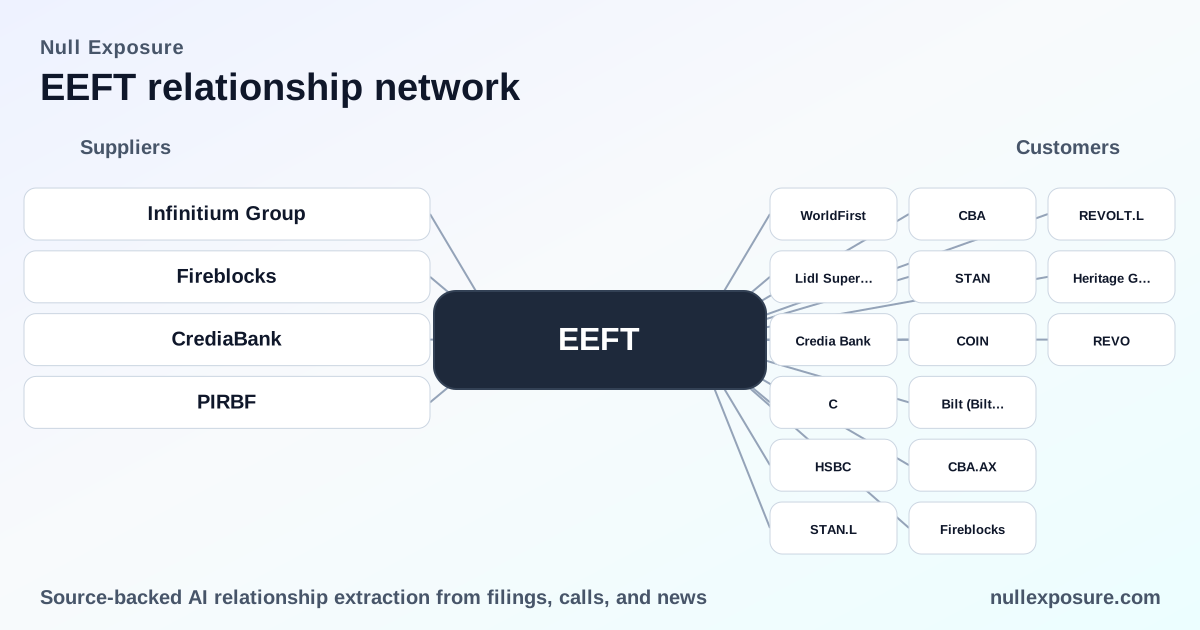
Euronet’s disclosed relationships over the past two fiscal years reveal a two‑track strategy: buy capabilities and bolt on external technology where strategic urgency exists. That combination accelerates go‑to‑market but raises integration and third‑party dependency issues for partners. Below I cover each named relationship and what it contributes to Euronet’s commercial and operational posture.
Infinitium Group — regional authentication capability
Euronet acquired Infinitium Group on February 1, 2024, adding a regional solutions provider focused on payments authentication services, strengthening the company’s authentication and fraud‑mitigation stack for merchant and issuer clients. This was disclosed in Euronet’s FY2024 Form 10‑K filing. (Source: Euronet FY2024 10‑K.)
Fireblocks — technology partner for stablecoin rails
Management confirmed on the Q4 2025 earnings call that Euronet continues to work closely with Fireblocks and internal teams to launch a stablecoin strategy, indicating a partnership to access custodial and tokenization infrastructure for digital‑asset settlement. The earnings remarks were captured in the company’s Q4 2025 call and the transcript published in March 2026. (Source: Q4 2025 earnings call; transcript via InsiderMonkey, March 2026.)
CrediaBank — merchant acquiring bolt‑on (20,000 merchants)
A GlobeNewswire release dated February 2, 2026 announced Euronet signed an agreement to acquire CrediaBank’s merchant acquiring business, bringing roughly 20,000 merchants into Euronet’s acquiring footprint and expanding its merchant processing scale in targeted markets. This is an acquisition of merchant flows rather than a technology partnership. (Source: GlobeNewswire, February 2, 2026.)
Piraeus — previously acquired merchant acquiring business
Management referenced that Euronet purchased a merchant acquiring business from Piraeus during recent remarks, underscoring the company’s pattern of acquiring existing acquiring portfolios to boost merchant counts and processing volumes. That comment appears in the Q4 2025 earnings transcript published in March 2026. (Source: Q4 2025 earnings call transcript via InsiderMonkey, March 2026.)
Operating‑model constraints and what they signal for partners and investors
Euronet’s public disclosures include two consistent operational signals that shape supplier negotiation and risk:
-
Short‑term contracting posture: The company reports use of short‑duration foreign currency forward contracts—typically with maturities up to 14 days—and derivatives generally less than one year to hedge transactional FX exposures. This shows a transactional, high‑velocity hedging approach consistent with a business model that moves funds quickly rather than locking into long‑dated contracts. (Company-level signal: SEC disclosures on derivative contract duration.)
-
Reliance on third‑party service providers: Euronet states it subscribes to cyber intelligence and managed security services and relies on third‑party providers to support key portions of its operations, indicating operational criticality and dependency on external security and platform vendors. This raises supplier risk concentration and the need for robust SLAs and security assessments. (Company-level signal: disclosures on third‑party service reliance.)
Those constraints are company‑level characteristics and not tied to any single named supplier unless the source explicitly does so.
What investors and counterparties should focus on
Euronet’s approach combines acquisition of merchant portfolios with technology partnerships. That model produces rapid revenue scale but introduces integration and counterparty concentration risks.
-
Growth driver: Acquisitions such as CrediaBank’s 20,000 merchants and previous Piraeus portfolio purchases accelerate revenue growth by importing active processing flows into Euronet’s systems, reducing organic sales cycles and increasing fee income immediately. (Source: GlobeNewswire; earnings remarks.)
-
Capability builder: The Infinitium purchase adds authentication expertise, improving fraud controls and potentially increasing authorization success rates for merchant clients—an operational advantage that can lift margins. (Source: FY2024 10‑K.)
-
Technology dependency: The Fireblocks collaboration to launch a stablecoin strategy demonstrates a push into digital rails that require trusted custodial and token infrastructure, placing emphasis on third‑party resilience and regulatory compliance. (Source: Q4 2025 earnings call; InsiderMonkey transcript.)
-
Risk vectors: Short contracting horizons for hedges and explicit reliance on managed security vendors mean operational risk is concentrated around execution and counterparty reliability, not long-term contractual lock‑ins. Investors should price integration cost and vendor concentration into valuation and due diligence. (Company disclosures on derivative durations and third‑party services.)
Midway action step: for detailed monitoring of Euronet’s partner exposures and to track future supplier disclosures, visit https://nullexposure.com/.
Practical guidance for operators evaluating Euronet as a supplier or counterparty
When negotiating or underwriting relationships with Euronet, prioritize the following:
- Conduct a focused security and resiliency review of any technology tie‑in, especially where Euronet cites managed security or external custody providers.
- Require clear SLAs and transition plans for merchant portfolio migrations following acquisitions (CrediaBank, Piraeus), including data mapping and settlement cadence.
- Assess FX and settlement timing expectations given Euronet’s short‑duration hedging posture; ask for settlement windows and close‑out mechanics.
- For firms partnering on digital‑asset rails, demand regulatory, custody and reconciliation disclosures tied to any stablecoin initiative with Fireblocks.
Use these points to structure contractual protections and pricing that reflect integration and operational risk.
Bottom line — what to watch next
Euronet is executing a pragmatic mix of acquisitions and partnerships to broaden processing scale and extend capabilities into authentication and digital‑asset rails. The company is building scale quickly through acquired merchant flows while outsourcing specialized technology and security functions, which creates attractive revenue leverage but increases counterparty and integration risk. Key near‑term catalysts that will clarify durability are: successful integration of the CrediaBank merchant base, proof points from the Infinitium authentication stack in reduced fraud or improved authorization rates, and operational readiness for the Fireblocks‑enabled stablecoin initiative.
For investors and operators tracking supplier posture and counterparty risk, start with management’s next quarterly filings and the progress reports on these named relationships. If you want continuous tracking and deeper relationship analytics, explore the resources at https://nullexposure.com/.
Final CTA: for a concise dashboard of supplier relationships and filings tied to EEFT, visit https://nullexposure.com/.