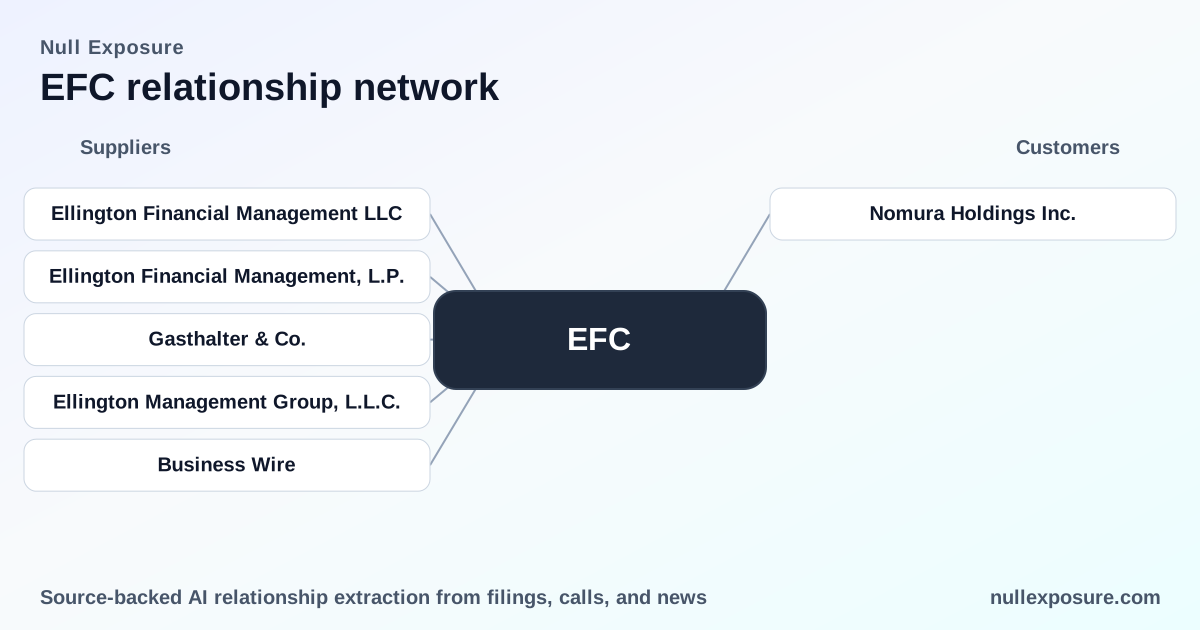
Ellington Financial Inc. (EFC): Supplier relationships that drive an externally managed mortgage REIT
Ellington Financial Inc. is an externally managed mortgage REIT that acquires and manages mortgage-related and other financial assets and monetizes via net interest spread, financing arbitrage (short-term repo/leverage), and management/incentive fee arrangements with its external manager. Its economics depend on asset yield capture, financing cost control through repurchase markets, and the operational execution of third-party servicers and managers. For deeper supplier mapping and vendor-risk signals, visit https://nullexposure.com/.
How Ellington runs the business and where suppliers matter
Ellington Financial operates as a capital-centric platform: it sources and holds mortgage assets (Agency RMBS, MSRs, reverse mortgages and credit portfolios), funds those assets primarily with short-term secured financing, and contracts out day-to-day asset management and many servicing functions. Revenue comes from asset yields and fee income paid to and from affiliated managers, while counterparty funding and servicer performance are direct drivers of balance-sheet stability.
This structure makes certain supplier relationships strategic rather than peripheral: the external manager executes investment decisions, large banks provide repo and settlement plumbing, and specialist servicers handle loan-level performance on mortgages that are economically material. If you manage or evaluate EFC exposure, focus on management alignment, repo counterparty concentration, and servicer continuity. For a consolidated view of supplier linkages, see https://nullexposure.com/.
Who EFC contracts with (what the public record shows)
Below I list each vendor relationship present in the public results and give the plain-English takeaway and source for verification.
Ellington Financial Management LLC
Ellington Financial is externally managed and advised by Ellington Financial Management LLC, an affiliate of Ellington Management Group that implements the company’s investment strategy and runs day-to-day operations under a long‑standing management agreement. This management link is repeated across company press releases and investor materials in 2023–2026. Source: Business Wire / Globe and Mail press releases and company announcements (FY2023–FY2026) — see https://www.theglobeandmail.com/investing/markets/markets-news/Business%20Wire/35648470/ellington-financial-announces-estimated-book-value-per-common-share-as-of-september-30-2025/ and related filings.
Ellington Financial Management, L.P.
Public commentary and analyst notes characterize Ellington Financial Management, L.P. as the external manager and a subsidiary within the Ellington group; that entity performs management and advisory functions for the REIT under contractual arrangements dating to the company’s formation. This is reported in market commentary and ratings updates in early 2026. Source: MarketBeat / industry coverage (March 2026): https://www.marketbeat.com/instant-alerts/ellington-financial-nyseefc-rating-lowered-to-sell-at-wall-street-zen-2026-03-07/
Ellington Management Group, L.L.C.
Ellington Management Group, L.L.C. is the parent alternative asset manager whose affiliates provide the investment-advisory infrastructure for Ellington Financial; public notices note that the manager is an affiliate of Ellington Management Group, which supplies personnel, investment process and back-office support. Source: Company disclosures published alongside offering and investor materials (FY2025) — see https://finance.yahoo.com/news/ellington-financial-announces-proposed-offering-120300529.html
Gasthalter & Co.
Gasthalter & Co. is the retained investor relations and media agency handling public communications for Ellington Financial, listed in multiple press releases as the media contact for investor outreach and press distribution. This reflects a standard PR/vendor relationship rather than investment operational dependency. Source: Press releases for earnings and investor presentations (FY2023–FY2026) — see https://markets.financialcontent.com/worldnow.ktul/article/bizwire-2023-5-1-ellington-financial-announces-release-date-of-first-quarter-2023-earnings-conference-call-and-investor-presentation
Business Wire
Business Wire is the distribution channel used for Ellington Financial’s investor releases, indicating the company’s choice of a broad wire service for regulated news dissemination. This is an operationally necessary communications vendor for timely market disclosures. Source: Representative press distribution in FY2023 — see the Business Wire posting cited in investor materials.
What the constraints tell investors about EFC’s vendor posture and risk profile
The company-level constraints derived from regulatory language and filings reveal a clear operating pattern:
- Short-term financing posture. Ellington’s leverage is predominantly short‑term repurchase agreements with maturities often up to 364 days; repo is the principal lever for funding Agency and credit portfolios. This creates recurring rollover risk and sensitivity to short-term rate moves and repo market liquidity.
- Large, institutional counterparties. Lenders and repo counterparties are primarily large global financial institutions; the firm’s funding and settlement rails depend on major bank participation.
- Government counterparty exposure. Portions of the business touch government-sponsored or government-backed programs (FHA, Ginnie Mae, HUD) particularly on reverse mortgage exposures, which introduces policy and regulatory dependency.
- Service-provider dependence and materiality. The company is externally managed and relies heavily on third-party mortgage servicers; failures of subservicers or master servicers for certain portfolios are identified as material to operations.
- Active, ongoing relationships. Management and servicing agreements have been in place since inception and are described as active, not one-off engagements.
- Concentrated operational spend. Financing lines and secured borrowings are substantial — public disclosures show billions of dollars of repo and other secured borrowings (e.g., ~$4.8bn as of December 31, 2024) — indicating a high spend band and counterparties that are mission‑critical.
These constraints create a business model where operational continuity with the external manager and servicers plus access to repo markets are the dominant counterparty risks investors should monitor.
What this means for counterparty evaluation and monitoring
- Prioritize counterparty analysis on funding banks and the external manager: service continuity, contract terms, fee mechanics, and amendment provisions matter as much as credit lines.
- Track concentrated exposures: the firm’s repo funding and servicing reliance make a small set of counterparties capable of producing outsized operational shocks.
- Watch policy/regulatory risk where government programs feed underlying asset performance; changes to FHA/Ginnie practices can be immediate value levers.
If you want supplier-level risk scoring and a vendor map built from filings and public releases, start your due diligence with our supplier intelligence platform at https://nullexposure.com/.
Bottom line and next steps for investors
Ellington Financial’s model is capital-intensive and outsourcing-heavy: the firm monetizes asset yield and financing spread while depending on an external management platform and third‑party servicers to execute. That structure concentrates counterparty and operational risk into a manageable number of relationships — the external manager, major repo counterparties, and servicers — and makes monitoring those suppliers essential to assessing equity and credit risk.
For a practitioner-ready supplier roster and continuous monitoring feed, learn more at https://nullexposure.com/.
Key takeaway: monitor the manager agreement, repo counterparty composition, and servicer contracts — those three supplier vectors determine whether the REIT’s financing and execution can withstand rate and liquidity stress.