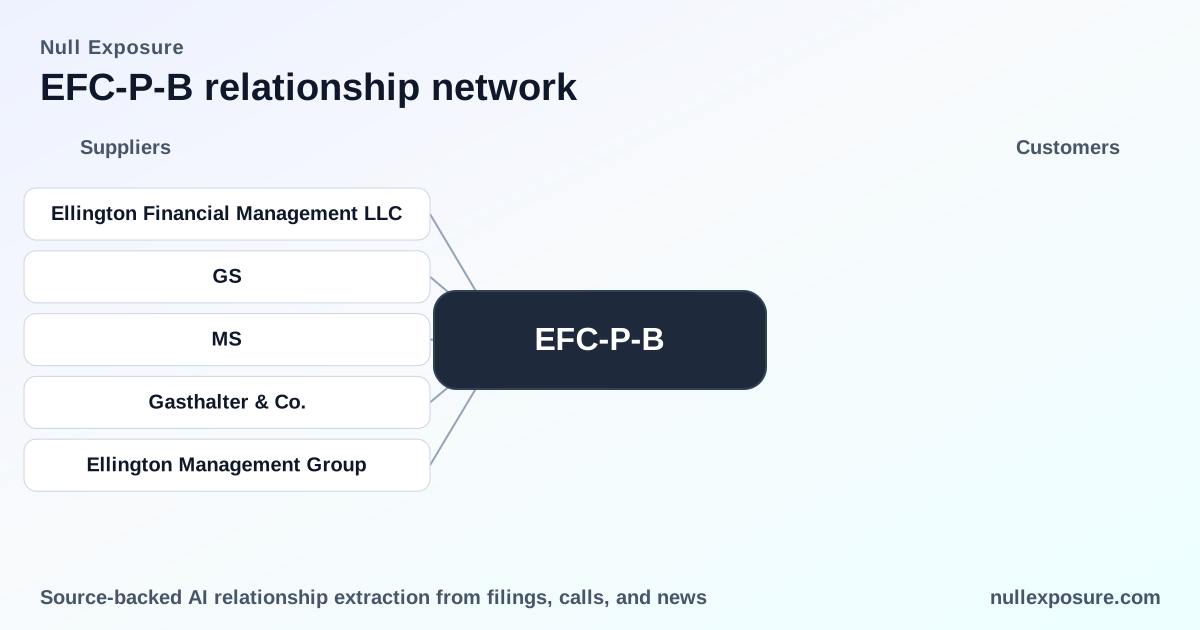
Ellington Financial (EFC-P-B): supplier relationships that shape preferred-holder risk and return
Ellington Financial Inc.’s preferred class EFC-P-B sits atop an mREIT business that monetizes a portfolio of agency and non‑agency mortgage-backed securities by generating interest income and distributing cash to holders; the company is externally managed and uses capital markets partners to execute equity and debt transactions that preserve liquidity and manage capital structure. For investors and counterparties, the critical question is how those supplier relationships — management, underwriters, and communications advisors — affect stability of distributions, access to capital, and operational continuity. For a concise map of counterparties and practical implications, visit https://nullexposure.com/.
Why the supplier map matters for a preferred investor
Ellington Financial’s operating model is management- and markets-driven: portfolio performance creates distributable cash, but access to capital and governance are mediated by external providers. That structure concentrates operational dependency on a small set of firms that perform three roles: ongoing portfolio management (fiduciary/operational), capital markets execution (underwriting and liquidity), and investor communications (market-facing disclosure and PR). The health of these supplier relationships directly influences redemption outcomes, refinancing costs, and the credibility of distribution guidance.
- External management is a single point of operational control and therefore a material supplier relationship for preferred-holders.
- Top-tier underwriters provide liquidity optionality during capital raises, but their participation also signals the market’s willingness to take risk exposure to Ellington at a given valuation.
- Outsourced media and investor-relations support shapes market perception and the transmission of book‑value and distribution information to investors.
Explore a structured view of these counterparties and their near-term activity at https://nullexposure.com/.
Supplier relationships and what they mean for investors
Ellington Financial Management LLC — the external manager
Ellington Financial is externally managed and advised by Ellington Financial Management LLC, an affiliate of Ellington Management Group, which executes the day‑to‑day investment strategy and risk controls that determine distributable earnings. According to a Marketscreener report on Ellington’s year‑end book value announcement in early March 2026, the company reiterates its external management relationship. https://www.marketscreener.com/news/ellington-financial-estimates-book-value-per-share-of-13-16-as-of-december-31-2025-ce7e5bd2db81f521
Ellington Management Group — group affiliation and brand
Ellington Financial operates under the broader umbrella of Ellington Management Group, a firm with roots in structured credit and mortgage markets; this affiliation supplies scale, models, and trading access that underpin portfolio construction. Finviz and The Globe and Mail press reporting in March 2026 describe Ellington Financial’s operating guidance coming from Ellington Management Group. https://finviz.com/news/323279/ellington-financial-nyse-efc-misses-q4-cy2025-sales-expectations https://www.theglobeandmail.com/investing/markets/stocks/EFC/pressreleases/441993/ellington-financial-nyseefc-misses-q4-cy2025-sales-expectations/
Goldman Sachs — joint book‑running underwriter and liquidity partner
Goldman Sachs served as a joint book‑running manager on a public offering in early 2026, participating in placement and sale activity that raised capital used for preferred redemptions and balance sheet management. TradingView and other March 2026 coverage noted Goldman's role in selling shares and helping raise roughly $118.5 million in the transaction. https://www.tradingview.com/news/tradingview:f3feec35141a5:0-key-facts-goldman-sachs-raises-gold-and-aluminum-price-forecasts-aids-ellington-financial/
Morgan Stanley — co‑lead underwriter and syndication partner
Morgan Stanley joined Goldman Sachs as a joint book‑runner for the same equity offering, providing syndication capability and distribution reach that materially improved execution terms and market access for Ellington Financial. The underwriting selection was reported in early March 2026 coverage of the public offering. https://intellectia.ai/news/stock/ellington-financial-prices-public-offering-to-raise-1185-million
Gasthalter & Co. — media and investor-relations contact
Ellington uses specialized communications support to distribute estimated book value and press materials; Gasthalter & Co. is listed as the media contact on Ellington’s March 2026 estimated book value announcement, underscoring the company’s reliance on an external PR channel to shape investor messaging. Yahoo Finance carried the press release that identified the firm and contact details. https://ca.finance.yahoo.com/news/ellington-financial-announces-estimated-book-211500322.html
What these relationships imply for operating posture and business model constraints
There are no explicit constraint statements packaged with the supplier data, but the relationship map provides clear company‑level signals investors should treat as operational constraints:
- Contracting posture: External management creates a vendor relationship with clear fee and oversight mechanics; governance and alignment depend on contractual terms between Ellington Financial and Ellington Financial Management LLC rather than in‑house management. That posture centralizes execution risk but also leverages specialist capability.
- Concentration and criticality: The management function is concentrated — loss or disruption of Ellington Financial Management LLC would be immediately material to operations and distributions. Similarly, reliance on a small set of elite underwriters (Goldman Sachs, Morgan Stanley) speaks to concentrated capital‑markets channels that are critical for timely refinancings and preferred redemptions.
- Access to capital and market maturity: Active engagement of large bulge‑bracket banks for equity placements signals mature capital-market relationships; this reduces transaction friction but ties pricing to market conditions and underwriter appetite at the point of sale.
- Market communications and perception control: Outsourced PR through Gasthalter & Co. indicates a formalized investor-relations process, which helps stabilize market expectations but also centralizes narrative control outside the corporate treasury.
These are company-level operational signals derived from the supplier roster rather than discrete constraints reported by the firm.
Key takeaways for investors and operators
- External management is the single largest operational dependency for EFC-P-B holders; governance and fee alignment should be checked in any due diligence.
- Underwriter relationships with Goldman Sachs and Morgan Stanley materially improve capital access, lowering execution risk for offerings and preferred redemptions but linking costs to market sentiment at issuance.
- Communications outsourcing reduces disclosure friction but concentrates reputational flow through a single PR conduit during sensitive announcements.
For a deeper, structured review of counterparties and how they affect preferred‑class exposures, visit https://nullexposure.com/ to see how supplier maps influence credit and market risk.
If you want a tailored supplier-risk memo or a quick benchmarking of EFC-P-B against peer mREIT preferred securities, start here: https://nullexposure.com/.