EFC-P-C: Income instrument, capital-market distribution, and what underwriters tell investors
Ellington Financial’s EFC-P-C is a series of preferred stock that monetizes the REIT’s balance sheet by selling fixed-dividend claims to income-focused investors. The issuance converts balance-sheet capacity into recurring cash return obligations while preserving common-equity upside for existing shareholders; Ellington extracts liquidity and funding flexibility through capital-market placements and leverages institutional distribution to reach large fixed-income buyers. For investors and counterparties, EFC-P-C is primarily a yield product whose performance is driven by interest-rate dynamics, Ellington’s credit management of mortgage assets, and the efficiency of capital-market execution.
If you want a structured view of counterparties and capital-market partners involved in this security, see full supplier coverage at https://nullexposure.com/.
Why EFC-P-C exists and how it behaves in a portfolio
EFC-P-C functions as a fixed-income-like claim issued by a mortgage REIT. Preferreds trade for income stability rather than equity appreciation: holders receive a contractual dividend priority ahead of common stock and behind senior debt. That priority structure and the fixed dividend make EFC-P-C attractive to institutional allocators seeking yield within real-estate exposure, while leaving management flexibility to transact mortgage assets as market conditions change.
Ellington’s corporate strategy—active management of mortgage-related assets combined with disciplined risk controls—supports the narrative that the preferred is a funding instrument rather than an operational line item. Liquidity and price are sensitive to interest-rate moves and to investor appetite for mortgage-REIT credit characteristics, not to day-to-day operational metrics.
Explore counterparties and underwriting history for EFC-P-C at https://nullexposure.com/.
Who ran the deal: the underwriting counterparties
This offering used major capital-market intermediaries to distribute the preferred. Each relationship below is described in plain terms with source attribution.
-
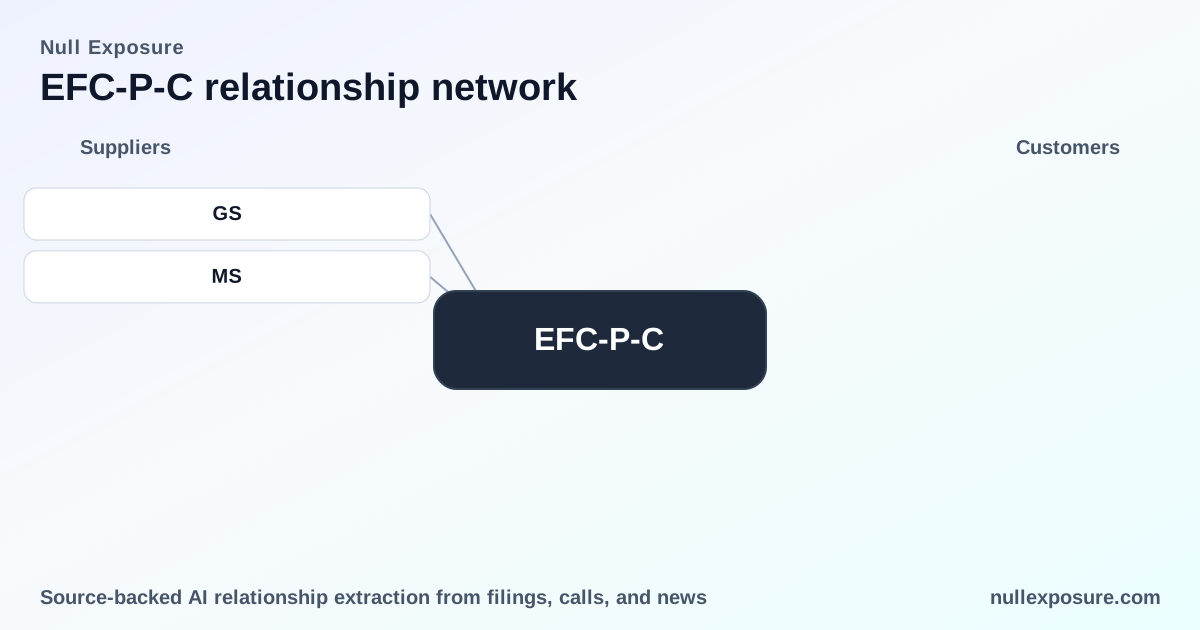
Goldman Sachs & Co. LLC — Goldman Sachs served as a joint book-running manager on the offering, providing underwriting capacity and distribution reach to institutional buyers. According to Intellectia’s coverage on March 9, 2026, Goldman Sachs acted alongside another global bank as a joint book-running manager for the issuance. (Source: Intellectia news coverage, March 9, 2026 — https://intellectia.ai/en/stock/EFC/news)
-
Morgan Stanley & Co. LLC — Morgan Stanley functioned as the co-joint book-running manager, sharing underwriting and placement responsibilities for the preferred issuance and accessing its institutional sales channels for distribution. Intellectia reported the bank’s joint book-running role on March 9, 2026. (Source: Intellectia news coverage, March 9, 2026 — https://intellectia.ai/en/stock/EFC/news)
These underwriting relationships indicate institutional placement intent and standard capital-market execution for a mortgage-REIT preferred issuance. Underwriting by two global banks supports broad distribution and efficient pricing at issuance, which directly affects early secondary-market liquidity.
Operational posture and company-level signals
The available data includes no explicit third-party constraints filed against EFC-P-C, which signals a conventional capital-market arrangement without disclosed long-term vendor lock-ins or operational covenants visible in external constraint reporting. From a business-model perspective, several company-level characteristics stand out:
- Contracting posture: transactional and market-driven. Preferred issuances use standard underwriting agreements; ongoing counterparty dependency is limited to capital-raising episodes rather than continuous vendor services.
- Concentration: episodic reliance on capital markets rather than a single technology or supplier; concentration risk is cyclical (market access) rather than supplier-specific.
- Criticality: The preferred is critical for funding and dividend strategy but not for day-to-day operational continuity of mortgage asset management.
- Maturity: Use of preferred issuance reflects a mature, institutionalized funding toolkit typical of mortgage REITs that access high-quality investment banks for distribution.
These signals should be read as company-level diagnostics rather than relationship-specific constraints, since no constraint excerpt explicitly links to any supplier.
Key risks and what to monitor
Investors and operators should focus on a concise set of drivers that govern EFC-P-C’s performance and counterparty implications:
- Interest-rate sensitivity: Preferred valuations and yield spreads reprice with rate moves; rising rates compress preferred prices absent offsetting credit improvements.
- Distribution and liquidity at issuance: Underwriting by Goldman Sachs and Morgan Stanley improves initial liquidity and market access, but secondary liquidity remains a function of market sentiment and REIT sector flows.
- Counterparty exposure during raises: Reliance on major banks for underwriting suggests predictable execution quality, but pricing and access are contingent on market windows.
- Dividend funding: The preferred’s dividend depends on Ellington’s ability to generate net income from mortgage assets and to preserve capital flexibility.
Monitor Ellington’s earnings releases, dividend notices, and capital-market activity for shifts in funding posture. For institutional diligence on underwriting and distribution, review placement terms and stabilization activity disclosed around the issuance.
Practical takeaways for investors and operators
- Investors: Treat EFC-P-C as a yield instrument with REIT-sector credit characteristics; prioritize trackable metrics—dividend announcements, sector spread movements, and issuance disclosure—to assess ongoing value.
- Operators and counterparties: Capital-market partners like Goldman Sachs and Morgan Stanley provide breadth of distribution and execution discipline; maintain alternative funding pathways to avoid single-window market dependency.
- Risk managers: Reconcile preferred dividend obligations with asset-liability management, and stress-test for widening mortgage spreads and rate shocks.
If you need a consolidated map of underwriting and supplier activity for this security, our platform curates these links and relationship profiles at https://nullexposure.com/.
Final assessment and next steps
EFC-P-C represents Ellington Financial’s use of preferred equity to secure durable funding and deliver fixed income to investors. The involvement of Goldman Sachs and Morgan Stanley as joint book-runners signals a standard institutional distribution strategy that supports issuance execution and initial liquidity. Absent explicit constraints in external reporting, the capital-market mechanics look conventional: market-dependent access, episodic reliance on underwriters, and a funding instrument tied to mortgage-REIT fundamentals.
For operators and investors seeking a deeper supplier map or historical underwriting footprints for Ellington’s securities, examine the full supplier dossier and relationship timelines at https://nullexposure.com/.