Energy Focus (EFOI) — supplier footprint and contractual risks investors should price in
Energy Focus designs, manufactures and sells energy‑efficient lighting systems and monetizes through product sales, specification contracts, and service offerings to commercial and institutional customers. Revenue is concentrated on hardware sales supported by in‑house production in Solon, Ohio and outsourced finished goods produced to the company’s specifications, with supplier economics determining gross margins and working capital volatility. For investors and operators evaluating supplier relationships, the critical themes are offshore concentration, related‑party exposure, single‑vendor dependency for specific materials, and small but active purchase commitments. Learn more about supplier risk intelligence at https://nullexposure.com/.
How Energy Focus runs its supply chain and where the economics live
Energy Focus is a hybrid manufacturer: some product lines are produced in‑house while others are outsourced to vendors who build to company specifications. That structure lets the company scale SKUs without duplicative factory investment, but it also creates supplier concentration risk where a small number of offshore partners drive both payable balances and procurement economics.
From a financial lens, the company reports modest trailing revenue ($3.86M TTM) and negative profitability metrics (negative EBITDA and EPS), so supplier terms and working capital are a direct lever on cash flow and near‑term solvency. High supplier concentration combined with related‑party exposure increases negotiation complexity and operational fragility, particularly given the company’s small market capitalization and limited institutional ownership.
Notable supplier and research mentions — what was found
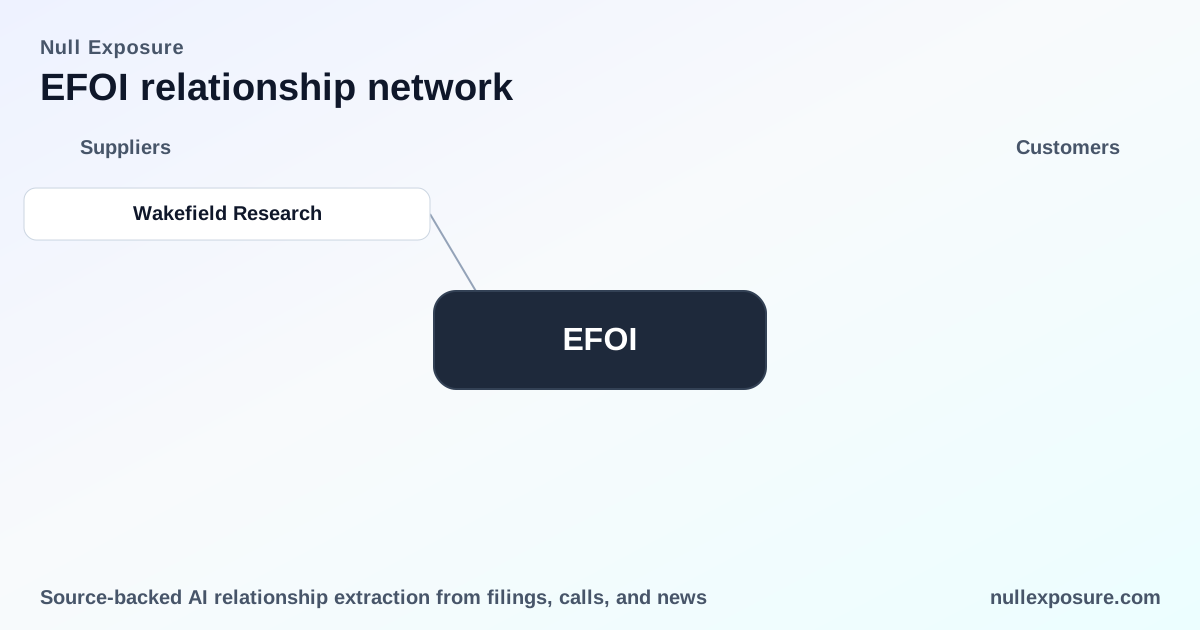
- Wakefield Research: A workplace healthiness survey conducted by Wakefield Research (fielded December 6–12, 2016 among 1,000 U.S. office workers) is cited in a Smart‑Lighting.es article referencing Energy Focus’ workplace study. The citation documents third‑party market research used in the company’s marketing and thought leadership. Source: Smart‑Lighting.es post referencing Wakefield Research (first seen March 9, 2026) at https://smart-lighting.es/new-human-health-study-fluorescent-flicker/.
This entry is the only explicitly recorded external relationship in the results set supplied; it is a marketing/research citation rather than a procurement counterparty. The company’s supplier posture is sourced elsewhere in filings and summarized below.
Operating constraints and what they imply for investors and operators
Several constraints from company disclosures together form a coherent picture of supplier risk:
-
Geographic concentration in APAC is a company signal. The company states “Our suppliers are primarily based in Asia,” which translates into exposure to APAC logistics, tariff regimes, and regional geopolitical risk. This is a governance and sourcing issue as much as a cost line item.
-
Supplier concentration is material and critical. Company filings disclose that two offshore suppliers accounted for approximately 36% and 54% of trade accounts payable at December 31, 2024, and that one offshore supplier represented ~36% of total expenditures for the 12 months ending December 31, 2024. That level of concentration is critical to operations and therefore to cash‑flow stability and procurement leverage. These excerpts also reference one supplier as a related party, introducing governance and related‑party transaction scrutiny.
-
Purchasing posture mixes in‑house manufacturing with outsourced finished goods. The firm explicitly manufactures at its Solon, Ohio facility while also outsourcing finished goods produced to specification. That hybrid model supports flexibility but increases the number of contractual relationships to manage, each with different maturity and performance profiles.
-
Single‑vendor dependency for specific materials. The company states that “with specific materials, all of our purchases are from a single vendor,” indicating supplier lock‑in for critical inputs and potential re‑qualification costs to switch vendors.
-
Supplier relationships are active and near‑term committed. Deposits and outstanding purchase commitments ($0.3M as of December 31, 2024, with most expected to ship in Q1 2025) show active procurement cycles at modest nominal dollar size, consistent with the reported spend band of $100k–$1M.
Collectively, these constraints imply an operating model that is concentrated, operationally critical, and partially outsourced, with supplier bargaining power tilted toward a few APAC firms and one notable related‑party supplier. That combination creates amplified supply risk for a small, cash‑constrained company.
Investment implications — what to watch and price
-
Counterparty concentration is the primary operational risk. With two offshore suppliers representing the majority of payables, a disruption (quality, logistics, or governance) would have immediate margin and working‑capital consequences. Price this into downside scenarios.
-
Related‑party procurement elevates governance risk. Investors should demand disclosure on the related party’s terms, transfer pricing, and any off‑market arrangements disclosed in Note 12 of the 2024 Form 10‑K.
-
Margin recovery requires supply‑chain stability. Given negative operating margins and limited gross profit dollars, improving supplier terms, diversifying vendors, or reshoring higher‑value subassemblies are levers that management must execute to restore consistent profitability.
-
Small purchase commitments reduce near‑term CAPEX shock but not strategic exposure. Outstanding commitments (~$0.3M) keep short‑term capital outlay manageable, but they do not eliminate medium‑term concentration risk.
If you want a concise supplier risk dossier or a PT/earnings sensitivity that models supplier shocks, start here: https://nullexposure.com/.
Practical recommendations for operators and procurement teams
-
Prioritize vendor diversification for the two largest offshore suppliers. Secure secondary sources for the specific materials currently supplied by a single vendor and build re‑qualification paths in 6–12 months.
-
Strengthen governance around related‑party transactions. Require independent pricing verification and board oversight for any large awards to related entities.
-
Convert payment terms into contingency protections. Where possible, negotiate performance milestones, holdbacks, or letters of credit to protect working capital and quality.
-
Monitor APAC logistics indicators and tariff regimes. Given the APAC supplier base, maintain scenario plans for lead‑time shocks and incremental freight costs.
Bottom line and next steps
Energy Focus operates a lean production model that depends heavily on a small number of offshore suppliers, including a related‑party counterparty, creating critical concentration risk that directly impacts margin and liquidity. For investors, the valuation and downside scenarios must reflect supplier fragility and the company’s limited scale. For operators, immediate priorities are governance over related‑party deals and supplier diversification to remove single‑vendor dependencies.
For a tailored supplier risk brief or to commission a deeper supplier‑counterparty map, visit https://nullexposure.com/ for service options and engagement details.