EFSC supplier relationships: what the First Interstate branch deal and advisor roster reveal about operational risk and growth optionality
Enterprise Financial Services Corp (EFSC) operates as the holding company for Enterprise Bank & Trust, monetizing through traditional regional banking channels—net interest margin on commercial and consumer lending, fee income from wealth management, and deposit gathering via branches and acquisitions. With roughly $673.7M in revenue TTM, a trailing P/E of 10.0 and a price-to-book near 1.0, the company balances a conservative capital profile with active inorganic growth through targeted branch purchases. Investors should view recent supplier and advisor relationships as execution levers that expand deposit access while simultaneously concentrating operational dependence on third-party providers and contractual arrangements. For a consolidated view of EFSC’s supplier exposures and deal counterparties, visit https://nullexposure.com/.
A straightforward acquisition: Enterprise buys 12 branches from First Interstate
- Enterprise Bank & Trust has signed a purchase-and-assumption agreement to acquire twelve branches from First Interstate Bank, a unit of First Interstate BancSystem, Inc. This transaction is a classic regional-bank footprint extension designed to accelerate deposit gathering and client relationships without building branches organically. According to an Advfn news item published March 9, 2026, Enterprise will acquire these branches from First Interstate Bank (First Interstate BancSystem) as part of the deal announcement.
- Retail Banker International also reported the same March 9, 2026 transaction, noting the 12-branch transfer and situating the move as part of Enterprise’s strategic branch expansion.
Who advised the deal — the advisor and counsel roster
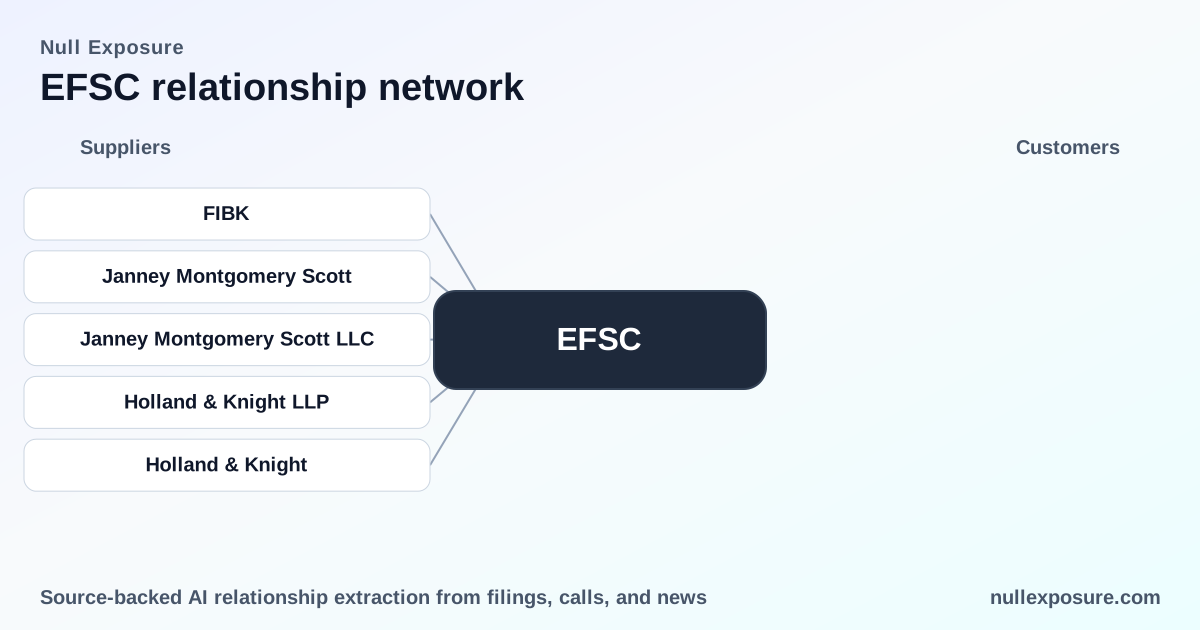
- Janney Montgomery Scott served as Enterprise’s financial advisor on the transaction, with Holland & Knight providing legal counsel to Enterprise. An Advfn press report on March 9, 2026 names Janney Montgomery Scott LLC and Holland & Knight LLP in their respective advisory roles.
- Retail Banker International also noted that Keefe, Bruyette & Woods, Inc. and Luse Gorman provided financial and legal advice to First Interstate on the same deal, respectively, giving both sides institutional advisor coverage in the announced purchase (Retail Banker International, March 9, 2026).
Relationship-by-relationship rundown (one-sentence takeaways, with sources)
- First Interstate Bank — Enterprise will acquire twelve First Interstate Bank branches in a purchase-and-assumption agreement, expanding Enterprise’s retail footprint and deposit base (Advfn, March 9, 2026).
- First Interstate BancSystem, Inc. — The parent of First Interstate Bank, First Interstate BancSystem is the counterparty in the disclosed transaction structure; the announcement lists both Enterprise Financial Services and First Interstate BancSystem (Advfn, March 9, 2026).
- Janney Montgomery Scott — Acted as Enterprise’s financial advisor on the branch acquisition, providing transaction structuring and M&A advisory services (Retail Banker International, March 9, 2026).
- Janney Montgomery Scott LLC — Cited specifically in the Advfn report as Enterprise’s financial advisor, reflecting use of established broker-dealer advisory resources for execution (Advfn, March 9, 2026).
- Holland & Knight LLP — Identified as Enterprise’s legal advisor on the transaction, supporting regulatory, contract and closing mechanics (Advfn, March 9, 2026).
- Holland & Knight — Reported by Retail Banker International as Enterprise’s legal counsel in the deal announcement, reinforcing the firm’s role on the buy-side legal team (Retail Banker International, March 9, 2026).
What the constraints and supplier signals tell investors about EFSC’s operating model
The company disclosures and excerpts for EFSC show a hybrid contracting posture and a reliance on third-party infrastructure:
- Contracting posture: mixed-term exposure. EFSC reports a combination of long-term operating leases (many expiring 2025–2029, with renewals and some extending to 2034) alongside short-term customer-transacted agreements used as overnight investment/borrowing instruments. This signals capital allocation that balances fixed-location commitments with highly liquid, short-dated funding.
- Operational criticality is high. Company statements explicitly recognize that third-party failures could materially affect service delivery, positioning vendors as critical to day-to-day operations.
- Role and segment: outsourced infrastructure. EFSC relies on third-party service providers for core banking technology (relationship management, mobile banking, general ledger, loan servicing and origination systems), and the information services team augments those relationships rather than replaces them—an active, managed dependency.
- Relationship stage: active and ongoing. The evidence shows active use of external vendors for extended coverage rather than one-off project relationships.
These signals combine into a practical investor framework: acquisitions drive deposit growth and revenue leverage, but service-provider concentration and long-term facility commitments create integration and operational risk that is material to execution.
For a more complete map of EFSC’s supplier exposures and how counterparties influence financial performance, see https://nullexposure.com/.
Implications for risk, returns and monitoring
- Upside: Branch acquisitions accelerate deposit growth and client cross-sell, directly supporting the bank’s fee and interest-income engines. Given EFSC’s reported ROE (~10.4%) and profit margin (~29.9%), accretive branch deals can lift earnings-per-share if integration is executed cleanly.
- Downside: Dependence on third-party systems and leased infrastructure creates execution risk (service interruptions, vendor transitions, SLA failures). The company explicitly states third-party issues could materially impair service delivery, making vendor management an investment return driver as much as an operational necessity.
- Valuation context: EFSC trades at a trailing P/E of 10.0, forward P/E ~13.3, and near book value—a profile that rewards successful integration and penalizes operational missteps quickly.
Actionable investor checklist
- Monitor deposit and transaction metrics in the quarters following the branch close to confirm deposit retention and cost-to-acquire behavior.
- Track vendor concentration disclosures and any new material contracts; evaluate SLAs for critical systems such as mobile banking and loan servicing.
- Watch lease maturity schedules and renewal terms as part of the bank’s cost structure and branch rationalization planning.
- Review regulatory filings for integration costs, one-time charges for the acquisition, and any changes in provisioning or credit mix tied to the new branches.
For continued coverage of EFSC counterparties and real-time supplier risk signals, visit https://nullexposure.com/. Investors who want a consolidated supplier risk report for EFSC and peer banks can start at https://nullexposure.com/.
Bottom line
The disclosed relationships around the First Interstate branch purchase are textbook regional-bank expansion: targeted footprint growth financed through an established advisor and counsel network. The strategic benefit—faster deposit access and cross-sell potential—is clear; the execution risk—rooted in vendor dependence, lease commitments and integration complexity—is material and quantifiable through regular filings and vendor disclosures. Investors should treat advisor and supplier relationships as first-order inputs into EFSC’s ability to convert acquisitions into durable earnings gains.