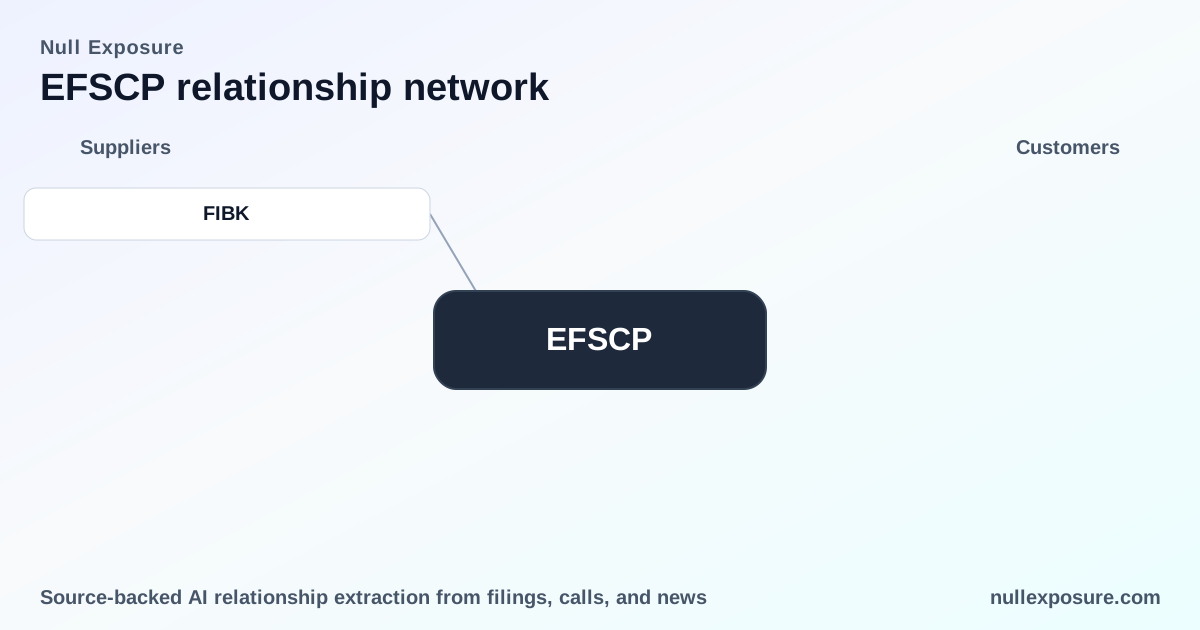
Enterprise Financial Services (EFSCP): supplier relationships, branch roll-up, and operational constraints investors should price in
Enterprise Financial Services monetizes core banking through net interest income, fee income from commercial and consumer services, and selective branch acquisitions to accelerate deposit growth; the EFSCP depositary shares represent a 1/40th interest in a 5% fixed-rate perpetual preferred that benefits from the parent’s stable earnings and capital management. The company runs a traditional regional-bank model enhanced by targeted branch purchases and outsized reliance on third‑party infrastructure and government liquidity channels — a profile that supports predictable income but creates concentrated operational counterparty risk.
Explore detailed supplier and counterparty risk profiles at NullExposure.
Branch expansion is the current growth lever — and an operational inflection
Enterprise’s most visible supplier/partner activity in FY2026 was a discrete, inorganic expansion: the acquisition of 12 branches from First Interstate Bank, located in Arizona and Kansas City. That move accelerates deposit gathering and local commercial relationships without the lead time of greenfield buildouts, improving short‑term funding flexibility and branching density in strategic markets.
According to the company’s SEC filing summarized on TradingView, the branch acquisition closed in 2025 and is presented as part of the company’s growth plan to deepen market share in those regions (TradingView, March 2026). The strategic bet is straightforward: buy scale in core markets rather than grow organically.
What the filings reveal about supplier and counterparty posture
Enterprise’s filings and public disclosures give a clear picture of how it sources liquidity and runs its day‑to‑day technology and operations:
-
Government and correspondent liquidity are core funding channels. The company explicitly relies on lines of credit with the FHLB, access to the Federal Reserve, and correspondent banks to provide liquidity and to support brokered deposits and secondary loan sales. This produces a contracting posture that is strongly tied to government‑backed and regulated counterparties — a structural funding advantage in stress but also a concentration lever investors must monitor.
-
Third‑party providers are critical to operations. Enterprise relies heavily on vendors for relationship management, mobile banking, general ledger, loan servicing, origination systems, and other bank‑critical software and infrastructure. This is not peripheral outsourcing — it is the backbone of the bank’s customer delivery and controls framework, and the company acknowledges that service interruptions could materially affect its business.
-
Vendor spend and contract maturity are modest but meaningful. Operating lease payments were reported at roughly $5.6 million for the twelve months ended December 31, 2024, which aligns with a vendor spend band in the $1–10 million range; that scale suggests multiple mid‑sized, long‑dated vendor contracts rather than an army of small suppliers.
-
Software and infrastructure are primary segments of reliance. The disclosures single out communications, information, and financial control systems technology as third‑party dependencies; investors should treat these contracts as strategically critical and expect enhanced third‑party risk management controls to be economically material.
Taken together, these signals create a business model profile where liquidity and vendor continuity are top risk drivers; counterparty concentration (government funding channels) and concentration of critical technology services both warrant active monitoring by investors and counterparties.
Explore supplier risk scoring and counterparty mapping at NullExposure.
The contracting and maturity picture investors should price
Enterprise’s reliance on government liquidity channels and mid‑single‑digit millions of annual lease/vendor spend implies a contracting posture dominated by long‑dated, institutionally negotiated agreements rather than spot transactions. Maturity is skewed toward established relationships with FHLB/Reserve corridors and a small set of software/infrastructure vendors, which increases criticality but gives the bank negotiating leverage — provided vendor performance remains stable.
Relationship ledger — every declared link in the record
Enterprise’s relationship dataset lists the same supplier counterparty across multiple reporting venues; below are each of the recorded mentions with a concise, plain‑English summary and source.
- Enterprise acquired 12 branches from First Interstate Bank in Arizona and Kansas City during 2025, a move disclosed in the company’s SEC report and summarized on TradingView (TradingView, March 9, 2026).
- A SimplyWall.St article also highlights that Enterprise’s FY2026 activity included the acquisition of 12 First Interstate Bank branches in Arizona and Kansas City, framing it as a strategic footprint expansion (SimplyWall.St, March 2026).
- The AMP version of the SimplyWall.St report reiterates the same factual disclosure: 12 branches purchased from First Interstate Bank in Arizona and Kansas City as part of Enterprise’s expansion (SimplyWall.St AMP, March 2026).
- An analysis published by Sahm Capital likewise documents the transaction and discusses how the 12‑branch acquisition from First Interstate Bank supports Enterprise’s branch expansion and capital allocation narrative (Sahm Capital, March 3, 2026).
Each source references the same corporate action; collectively they confirm a consistent and reported branch‑level acquisition strategy.
Investment implications and a practical risk checklist
Enterprise’s financial profile — Revenue TTM ~$673.7M, Return on Equity ~10.4%, and operating margin ~40.6% (latest quarter end 2025) — supports steady cash flow that underpins the EFSCP depositary preferred distribution. Strategic branch buys accelerate deposit growth and local lending pipelines, which is positive for liquidity and NII. However, investors must price several non‑market risks into valuation and capital allocation decisions:
- Vendor concentration risk: core banking and control systems are outsourced; any outage or contract dispute would be materially disruptive.
- Liquidity concentration: significant reliance on FHLB, Federal Reserve, and correspondent lines creates a positive funding advantage but also a concentration exposure under stress.
- Integration and operational risk from acquisitions: branch purchases are execution‑intensive; integration costs and customer attrition can pressure near‑term earnings.
- Contractual cash commitments: operating leases (~$5.6M annually) indicate recurring fixed obligations that reduce free cash flow flexibility.
For an investor focused on preferred securities such as EFSCP, the headline is clear: stable earnings and authoritative funding channels support preferred distributions, but operational and counterparty concentrations are primary downside vectors.
Bottom line and next steps
Enterprise is executing a classic regional‑bank playbook — buy branches to scale deposits, lean on government liquidity and correspondent markets, and outsource expensive technology to specialist vendors. That combination fosters predictable income but concentrates operational and counterparty risk. Institutional investors evaluating EFSCP should balance the attractive yield profile against these structural dependencies.
For a deeper supplier and counterparty risk analysis, visit NullExposure.
If you need a tailored counterparty report or continuous monitoring for EFSCP, start here: https://nullexposure.com/.
Key takeaway: the branch acquisition accelerates growth and deposit access, but third‑party infrastructure and government funding reliance are the two levers that underwrite — and could stress — Enterprise’s preferred security economics.