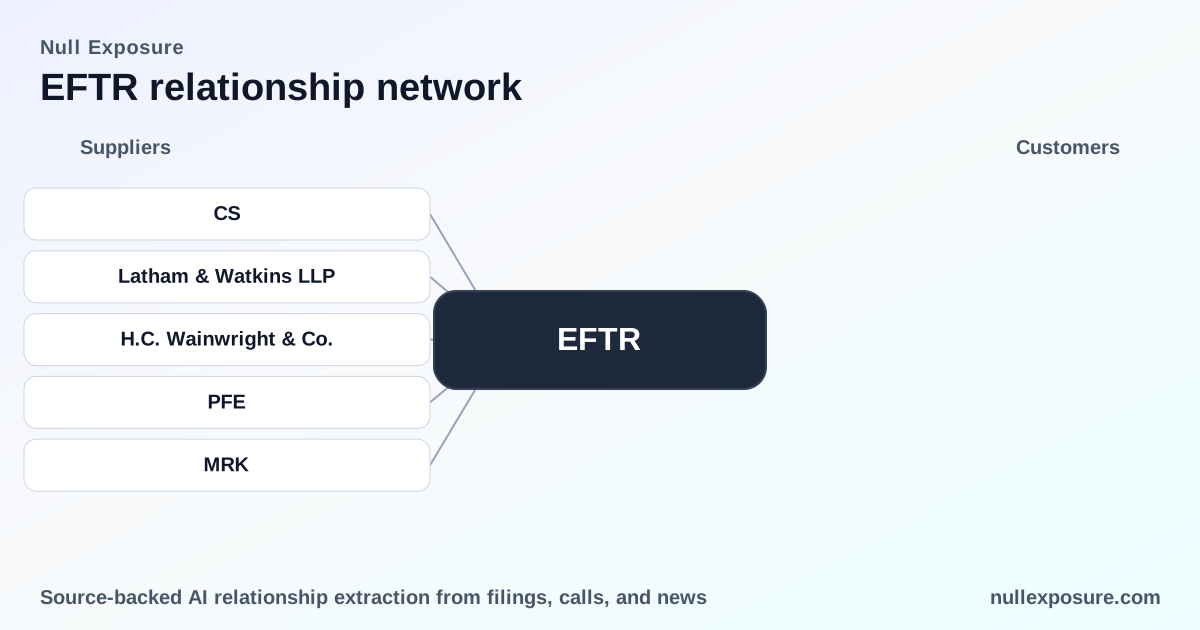
EFTR Supplier Map: Who Fuels Effector Therapeutics' Clinical Push
Effector Therapeutics (EFTR) is a clinical‑stage biotechnology company that commercializes its science through strategic partnerships and capital‑markets transactions rather than product sales. The company advances small‑molecule modulators of RNA translation through clinical trials, funds operations with registered offerings and private placements, and monetizes through collaboration agreements and future license or milestone payments tied to successful clinical development. For investors evaluating supplier and counterparty exposure, the commercial model is collaboration‑driven, capital‑dependent, and outcome‑sensitive. Explore more context and supplier mapping at https://nullexposure.com/.
How Effector’s operating model translates into investor outcomes
Effector runs a classic development‑stage bioeconomy playbook: scientific assets are advanced internally to key inflection points, then value is unlocked via pharma collaborations or licensing, while ongoing cash needs are satisfied through equity placements. Recent financials show minimal recurring revenue (Revenue TTM: $675,000) and meaningful negative operating performance (EBITDA: -32,593,000), so counterparty choices — placement agents, legal counsel and strategic pharma partners — are central to the company’s ability to sustain trials and reach value‑creating milestones.
- Contracting posture: Effector engages external placement agents and legal counsel routinely for capital raises, indicating an outsized reliance on capital markets expertise rather than internal origination of funding.
- Concentration: A small number of strategic pharma partners and placement agents carries outsized influence on liquidity and validation.
- Criticality: Collaborations that enable clinical combinations (for example with Merck’s Keytruda) are near‑term value drivers and therefore operationally critical.
- Maturity: Clinical‑stage with limited commercial revenue; counterparty relationships are predominantly transactional and milestone/clinical‑execution oriented.
If you evaluate supplier risk for portfolio construction, this is a company where financial intermediaries and a handful of Big Pharma collaborators materially shape execution risk. Track the partnership and financing cadence at https://nullexposure.com/.
Who Effector works with: concise, source‑backed relationship map
Below are every supplier and counterparty mentioned in the available reporting, each summarized in plain English with the cited source.
-
Credit Suisse — Credit Suisse acted as a lead placement agent for the PIPE tied to Effector’s business combination and also served as capital markets advisor. According to coverage in Yahoo Finance reporting on the company’s public debut (March 2026), Credit Suisse was a primary execution partner on the financing behind the transaction (https://finance.yahoo.com/news/effector-therapeutics-debuts-publicly-traded-231800361.html).
-
Latham & Watkins LLP — Latham & Watkins provided legal counsel to Effector in connection with the same business combination and public listing. The Yahoo Finance account of the transaction lists Latham & Watkins LLP as legal counsel (March 2026; https://finance.yahoo.com/news/effector-therapeutics-debuts-publicly-traded-231800361.html).
-
H.C. Wainwright & Co. — H.C. Wainwright acted as the exclusive placement agent for a registered direct offering that closed for $15 million, priced at the market. The company announced the closing in a GlobeNewswire release dated January 29, 2024 (https://www.globenewswire.com/news-release/2024/01/29/2819427/0/en/eFFECTOR-Therapeutics-Announces-Closing-of-15-Million-Registered-Direct-Offering-Priced-At-The-Market-Under-Nasdaq-Rules.html).
-
Pfizer — Effector has a global collaboration with Pfizer to develop inhibitors targeting eIF4E, expanding the company’s translational oncology footprint. The GlobeNewswire corporate release (January 29, 2024) details the collaboration as part of Effector’s strategic development partnerships (https://www.globenewswire.com/news-release/2024/01/29/2819427/0/en/eFFECTOR-Therapeutics-Announces-Closing-of-15-Million-Registered-Direct-Offering-Priced-At-The-Market-Under-Nasdaq-Rules.html).
-
Merck & Co., Inc. — Effector is running a randomized Phase II study (KICKSTART) testing tomivosertib in combination with Merck’s Keytruda (pembrolizumab) versus placebo plus Keytruda for frontline NSCLC with PD‑L1 ≥50%. Yahoo Finance reporting covering a subsequent stock move referenced the trial and the Keytruda combination (March 2026; https://finance.yahoo.com/news/effector-therapeutics-eftr-plunges-82-165800294.html).
What these partnerships mean for execution and valuation
The relationship map explains Effector’s two central operational levers: clinical progress with pharma partners and capital‑markets execution through placement agents.
- Clinical validation and asymmetric value: Collaborations with Pfizer and the combination trial with Merck’s Keytruda are primary routes to value creation; positive readouts will convert research into licensing leverage or acquisition interest. Conversely, trial setbacks create binary downside given the company’s limited revenue base.
- Financing as a strategic supplier function: Placement agents such as Credit Suisse and H.C. Wainwright are not peripheral vendors — they are primary enablers of runway. The company’s dependence on market channels to fund operations increases sensitivity to capital markets conditions.
- Legal and execution risk: Engagements with large law firms (Latham & Watkins) reflect standard diligence and transaction complexity; legal capability reduces regulatory and transactional friction but does not eliminate clinical or market risk.
If you need a deeper counterparty exposure report or ongoing monitoring of partner announcements, see our supplier intelligence hub at https://nullexposure.com/ for subscription options.
Operational constraints and risk checklist for operators and investors
At a company level, the following constraints and signals define how supplier relationships function:
- Capital dependence: Cash runway is driven by equity placements and the ability of placement agents to place stock; fluctuations in capital markets directly constrain R&D cadence.
- Concentration risk: A small set of pharma collaborators and capital markets counterparties represents concentrated operational exposure; loss of a single partner could materially delay programs.
- Execution criticality: Clinical trials (e.g., tomivosertib + Keytruda) are single‑point execution events that determine near‑term strategic options.
- Maturity limitations: As a clinical‑stage company with negligible product revenue, counterparty relationships skew toward transactional, milestone, and advisory engagements rather than long‑term supply contracts.
Key risk factors to monitor: clinical readouts, upcoming financing notices, placement agent mandates, and any changes to collaboration terms with Pfizer or clinical supply/combination arrangements involving Merck.
Investment takeaway and recommended next steps
Effector Therapeutics is a partnership‑centric, capital markets‑funded clinical developer: its supplier map shows a mix of top-tier placement agents, established legal counsel, and strategic pharma collaborators that together enable both financing and clinical execution. For investors, the thesis is straightforward — value comes from successful trials or an out‑license; downside is driven by funding friction and clinical failure. Monitor the KICKSTART trial results, any new financing announcements, and formal updates to the Pfizer collaboration as primary catalysts.
If your model needs rolling counterparty exposure updates or a tailored supplier‑risk brief, start here: https://nullexposure.com/. For deeper situational monitoring and to subscribe to partner‑level alerts, visit https://nullexposure.com/ and request a briefing.