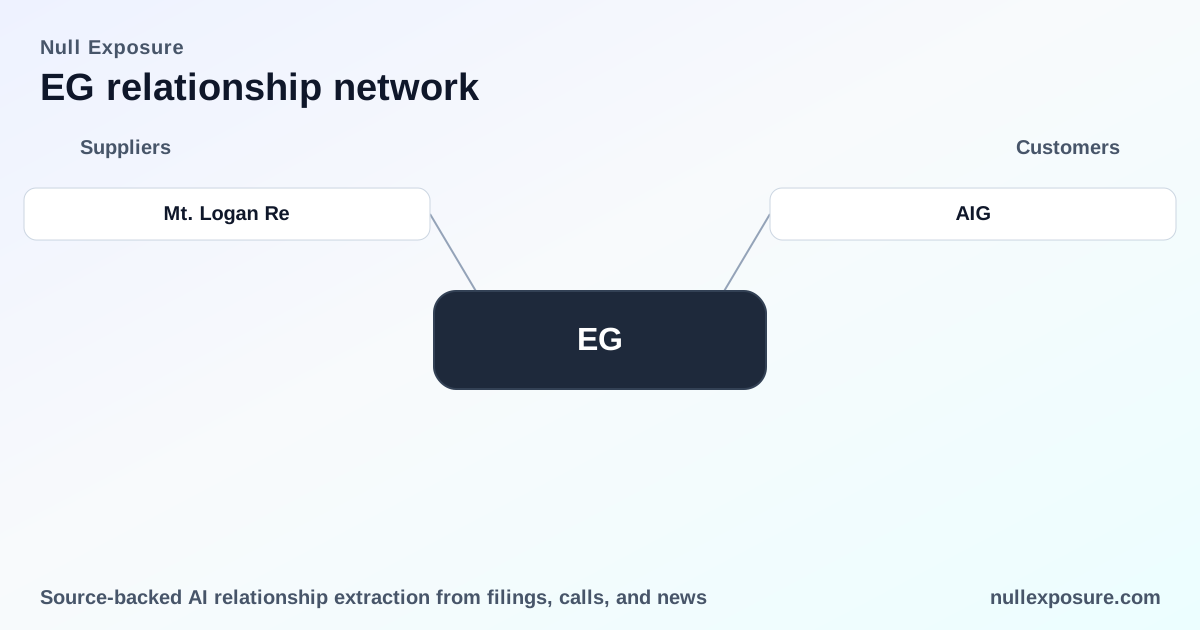
Everest Group Ltd (EG) — supplier relationships and operational constraints investors should price in
Everest Group Ltd underwrites reinsurance and insurance business globally and monetizes through underwriting margins, investment income, and retrocession management; the firm generates revenue by accepting ceded premiums from cedents and brokers, investing float, and recovering portions of large losses through reinsurance arrangements. Everest’s economics are concentrated around broker-led reinsurance placements and active capital management, so supplier and counterparty relationships are a direct driver of underwriting scale and volatility. Learn how these supplier connections influence exposure and operational posture at https://nullexposure.com/.
A quick operational summary for investors
Everest writes business through the broker reinsurance market, direct reinsurance and insurance channels, and leverages third‑party vendors for administrative and technological functions. The company trades with a Market Capitalization of roughly $12.9 billion, reported Revenue TTM of $17.54 billion, and a Price‑to‑Book under 1.0, signaling a capital‑intensive, asset‑heavy business where counterparties and capital facilities materially affect capacity and returns.
How supplier relationships translate into capital and underwriting outcomes
Everest does not merely buy services — it forms the plumbing of risk transfer. Brokers source and place the risk; reinsurers and retrocessionaires share losses; and capital providers (credit facilities, LOCs) back statutory and collateral needs. That web determines Everest’s ability to scale new business, absorb catastrophe hits, and manage returns on equity. Company disclosures show large committed credit lines and borrowings that underscore the scale of counterparty funding supporting underwriting.
- Concentration matters: the reinsurance segment’s ten largest brokers represented approximately 60.5% of gross written premiums in 2024, establishing a concentrated distribution footprint that creates both efficiency and concentration risk.
- Contracting posture: brokers source business but do not bind coverages without Everest’s acceptance; reinsurance placements remain subject to underwriting acceptance rather than automatic quota share commitments.
- Service dependency: Everest outsources several business, technological and administrative functions to third parties, making vendor management a non‑trivial operational risk.
- Capital support: Everest maintains multiple letter of credit facilities with total commitments up to $1.7 billion and had $1.0 billion of borrowings outstanding as of Dec 31, 2024 — a scale that places counterparty financing squarely in the critical path of capacity.
Read more on supplier mappings and operational exposure at https://nullexposure.com/.
The supplier relationships you need on your radar
Below I cover each relationship flagged in the reviewed results — concise, plain‑English takeaways with source references.
Mt. Logan Re — reinsurance cessions and premium flows
Everest ceded $357 million of written premiums to Mt. Logan Re in 2025, down from $433 million in 2024 but up from $246 million in 2023, indicating a volatile but non‑trivial bilateral reinsurance flow between the firms. According to an Artemis news report from March 2026, the movement in ceded premium suggests active portfolio re‑allocation and episodic use of Mt. Logan Re for risk placement in recent years. (Artemis, March 9, 2026 — https://www.artemis.bm/news/everest-earned-35m-dividend-and-7m-investment-income-from-mt-logan-re-in-2025/)
What these relationships imply about operational risk and concentration
The relationship evidence and company disclosures collectively paint an operational profile investors must price:
- Concentration of distribution: With the top ten brokers accounting for ~60.5% of reinsurance GWP in 2024, Everest’s premium flows are materially driven by a small set of intermediaries. That concentration accelerates revenue when brokers deliver, but it also concentrates counterparty bargaining power and renewal risk.
- Buyer and distributor roles: Everest functions both as a buyer of retrocession and reinsurance capacity and as a distributor of risk through broker channels; these dual roles mean counterparties are simultaneously commercial partners and capital providers, which compresses traditional supplier vs. customer distinctions.
- Criticality of capital counterparties: The existence of large committed credit facilities and material borrowings is a signal that financing arrangements are part of the company’s operating backbone — disruptions in credit or letter‑of‑credit capacity would directly constrain underwriting capacity.
- Service provider dependency: Outsourcing of core administrative and technological functions creates operational dependency that investors should monitor through vendor concentration and SLA robustness.
Investment takeaway: supplier relationships translate into both capacity and vulnerability — concentrated broker relationships and large credit commitments increase leverage to counterparties while improving distribution efficiency.
Risk drivers to watch next quarter
- Renewal negotiations with the largest brokers — any deterioration in broker access or fee economics will move GWP quickly given concentration.
- Movements in committed credit lines or collateral requirements — changes to LOC availability will affect statutory capacity and retentions.
- Vendor continuity and IT resilience — outsourced functions underpin underwriting and claims processing; service disruption would materially affect operations.
For a practitioner-grade supplier risk view that overlays these drivers with counterparty specifics, visit https://nullexposure.com/ to see supplier mappings and exposure analytics.
How operators should think about mitigation and monitoring
Operators should incorporate supplier clauses and performance KPIs into renewals with large brokers and capital providers. Specific steps:
- Negotiate multi‑year arrangements with staggered notice provisions to dampen renewal volatility.
- Stress‑test liquidity and LOC replacement scenarios to ensure underwriting continuity.
- Audit third‑party vendor contracts and contingency plans annually to keep recovery timelines within acceptable limits.
Final verdict for investors
Everest’s supplier relationships are fundamental to its ability to write and retain business; broker concentration and significant capital commitments are the two dominant structural features that will determine underwriting scale and margin volatility going forward. For active investors, the path to alpha runs through monitoring broker renewals, counterparty capital strength, and vendor resilience.
If you want a deeper look at how these supplier connections map to portfolio risk and liquidity scenarios, start here: https://nullexposure.com/. For bespoke exposure reports and ongoing monitoring, explore subscription options at https://nullexposure.com/ — the data will change how you underwrite counterparty risk.