Eagle Bancorp (EGBN) — supplier map and strategic implications for investors
Eagle Bancorp operates as the holding company for EagleBank, a regional commercial and consumer lender headquartered in Bethesda, Maryland. The company monetizes through traditional bank economics: net interest income generated by lending and investment spreads, deposit intermediation, and fee income tied to commercial banking services. Its supplier footprint is compact and centered on liquidity conduits and transaction agents rather than broad third‑party outsourcing, which concentrates operational leverage where counterparty credit and infrastructure stability matter most. For a consolidated view of supplier exposure and traceable source documents, visit https://nullexposure.com/.
High‑level takeaway: liquidity and transaction support, not broad outsourcing
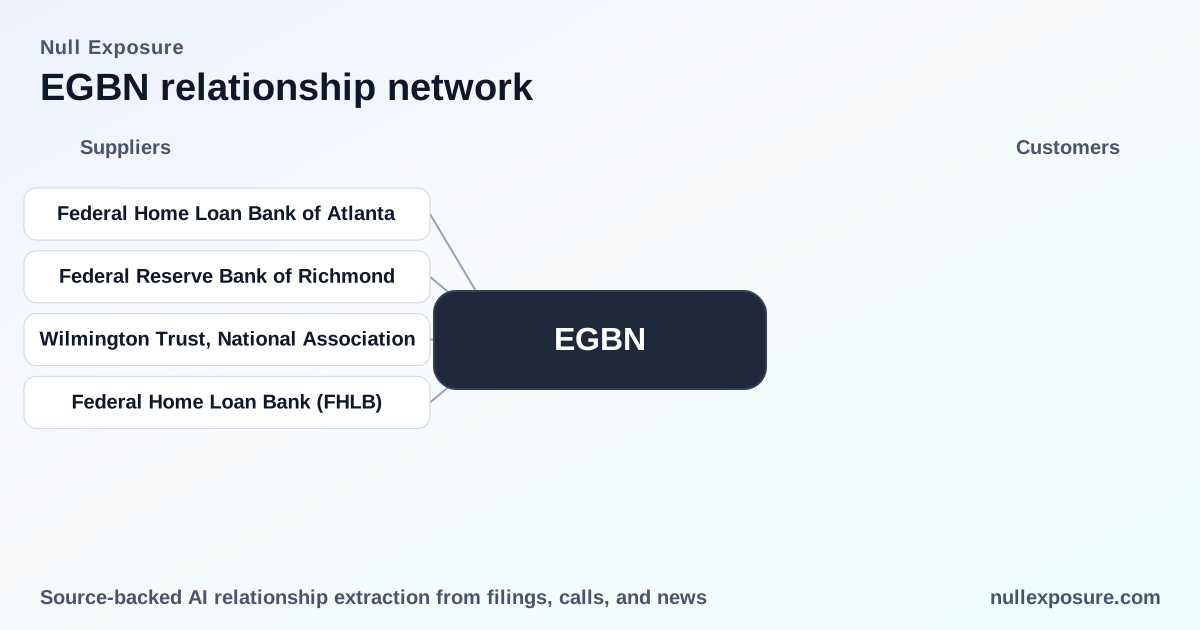
EagleBank’s supplier relationships reveal a clear operating emphasis: use of central liquidity providers and a transactional trust agent for capital markets activity, plus limited externalization of specialized security operations. The bank holds interest‑bearing balances at the Federal Home Loan Bank and the Federal Reserve and has used FHLB borrowings as a short‑term funding tool; Wilmington Trust has been engaged as an exchange agent for a securities exchange offer. These ties support balance‑sheet management and discrete capital transactions rather than recurring vendorized services.
Detailed supplier relationships and what they mean
Federal Home Loan Bank of Atlanta
EagleBank maintains interest‑bearing balances with the Federal Home Loan Bank of Atlanta, a staple funding and collateral counterparty for regional banks. According to the company’s FY2024 Form 10‑K, these balances are used alongside correspondent bank accounts to cover costs for services provided to the bank. (FY2024 10‑K)
Federal Reserve Bank of Richmond
EagleBank keeps large average daily balances at the Federal Reserve, which the bank reports earn interest; the FY2024 10‑K records average daily balances of $1.8 billion in 2024 and $1.1 billion in 2023, underscoring a material placement of liquidity at the central bank as part of cash management and regulatory reserve posture. (FY2024 10‑K)
Wilmington Trust, National Association
Wilmington Trust acted as Exchange Agent in a securities exchange offer tied to EagleBank’s 10.00% Senior Notes due 2029, a discrete capital markets engagement that is transactional in nature and critical to that restructuring. The role and appointment were disclosed in news coverage of the exchange offer in March 2026. (QuiverQuant news, March 9, 2026)
Federal Home Loan Bank (FHLB) — short‑term borrowings history
EagleBank has used FHLB borrowings as a short‑term funding source, but recent reporting shows those borrowings were repaid with excess cash from deposit growth and asset sales; a Q3 2025 earnings release reported FHLB borrowings reduced to zero after being $50.0 million in Q2 2025. This demonstrates active liquidity management and the capacity to deleverage contingent short‑term facilities when deposit inflows permit. (ManilaTimes/GlobeNewswire, Oct 23, 2025)
What the supplier footprint says about EagleBank’s operating model
- Contracting posture: The bank relies on highly standardized, relationship‑level counterparties (Federal Reserve, FHLB, trust banks) rather than a broad vendor base, indicating a contracting posture focused on core financial infrastructure rather than outsourcing non‑core operations. The company concurrently discloses using third parties for certain security operations and information security infrastructure, signaling targeted outsourcing of specialized technical functions rather than wholesale operational offload. (Company disclosures)
- Concentration: Liquidity concentration is evident — large placements at the Federal Reserve and conditional reliance on FHLB facilities mean funding risk is concentrated in a small number of counterparties that are systemically important but operationally essential. This reduces counterparty credit risk but increases the bank’s sensitivity to provider policy and access changes.
- Criticality: Relationships with the Federal Reserve and FHLB are mission‑critical for day‑to‑day liquidity and contingency funding; Wilmington Trust’s role is event‑critical for capital structure actions but not part of ongoing operations.
- Maturity: These are mature, low‑complexity relationships rooted in established banking plumbing; operational friction is more likely around transaction execution and contingency funding timing than vendor performance variability.
Note on third‑party security operations: the company-level disclosure that EagleBank “utilize[s] third parties to conduct certain security operations and maintain certain information security infrastructure” is a material signal about targeted outsourcing of security functions and associated operational risk, but the disclosure does not tie those services to any named supplier. Treat this as a company-level outsourcing indicator, not a relationship-level attribution. (Company filings)
For a full supplier risk assessment and access to original filings and press coverage, consult the source index at https://nullexposure.com/.
Investor implications — risks and actionable checklist
- Liquidity management is a core risk vector. Large Federal Reserve balances improve resilience but concentrate cash in central channels; changes in reserve remuneration or access could affect short‑term liquidity deployment. (FY2024 10‑K)
- FHLB facilities provide contingent capacity. Repayment of FHLB borrowing in Q3 2025 reduced leverage risk but also signals reliance on deposit growth and securities sales to self‑fund operations when available. (Q3 2025 release)
- Capital markets transactions are executed through established trust agents. Wilmington Trust’s role in the 2026 exchange offer shows the bank uses standard custodial/trust relationships for complex securities transactions; this mitigates execution risk for discrete debt events. (QuiverQuant news, March 2026)
- Targeted security outsourcing creates operational concentration risk. Outsourcing of security operations and infrastructure is efficient but elevates the importance of vendor governance, SLAs, and incident response readiness. (Company disclosures)
Use this checklist when evaluating counterparty risk and operational continuity: verify FHLB access commitments, monitor Federal Reserve balance trends and compensation, review trust agent engagement terms for capital transactions, and obtain vendor security controls documentation where possible.
If you want structured supplier exposure reports and original source links for EGBN, start here: https://nullexposure.com/.
Final synthesis and next steps
EagleBank’s supplier relationships reflect a compact, banking‑centric operating model: central bank placements and FHLB access for liquidity, transactional engagement with a trust agent for securities actions, and limited outsourcing of security operations. For investors, the key question is not the breadth of suppliers but the resilience and governance around those few, high‑impact counterparties.
To explore the underlying filings and news items referenced in this analysis and to build a supplier risk profile for EGBN or peer institutions, visit https://nullexposure.com/.