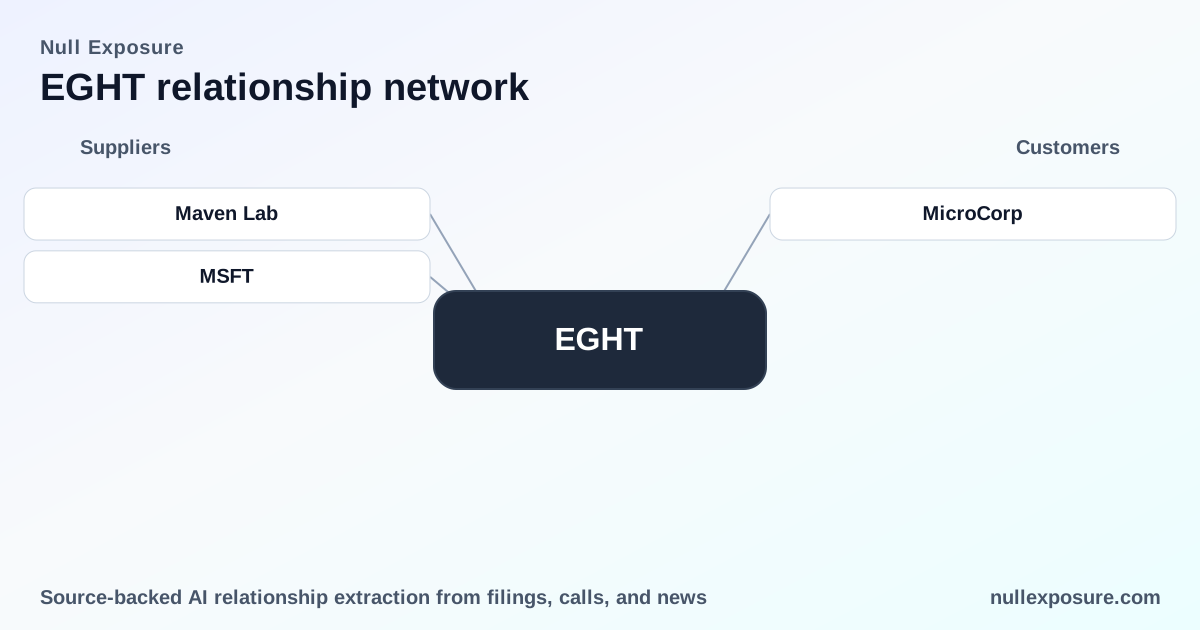
8x8 (EGHT) — what its supplier footprint tells investors about resilience and execution
8x8 is a cloud communications and contact-center software provider that monetizes primarily through recurring SaaS subscriptions and paid contact-center services, supplemented by hardware endpoint sales and professional services. The company layers voice, video, chat and contact-center APIs into recurring bundles sold to SMBs and enterprises; supplier choices — data-center co‑location, third‑party service providers and endpoint vendors — materially shape cost, uptime and go‑to‑market speed for those offerings. If you evaluate EGHT as a supplier relationship, focus on how these external partners affect continuity, regional coverage and margin leverage.
Visit https://nullexposure.com/ for the full profile and sourcing.
What the available supplier signals reveal about 8x8’s operating model
8x8 runs a hybrid, partner-dependent infrastructure: it relies on third‑party co‑location data centers across North America, EMEA and APAC, leverages third‑party service providers for implementation and support, and sources IP phones and some endpoints from external vendors. These are company-level signals derived from public disclosures and reporting rather than relationship-specific claims.
- Contracting posture: The company uses co‑location agreements and third‑party service providers rather than owning a global data-center footprint. That posture reduces fixed capital intensity but increases operational dependency on supplier SLAs and geographic partners.
- Concentration and coverage: Geographic reach is broad — North America, Europe, Asia Pacific — with at least one South America location noted, indicating geographic diversification but potential local concentration in specific markets.
- Criticality and single points of failure: Third‑party hosting, implementation partners and hardware vendors are critical to uptime, deployment speed and customer experience. These suppliers are operationally material: any degradation in partner performance translates quickly to customer impact.
- Maturity and commoditization: Reliance on external IP‑phone vendors and service‑provider partners signals commoditized hardware and implemented services, while the company retains control of software IP and customer billing relationships.
These structural choices shape negotiating leverage, cost of service, and the speed at which 8x8 can localize products. For investors, supplier risk is an operational exposure that sits alongside product and competitive risk.
Visit https://nullexposure.com/ to see supplier signal breakdowns and underlying evidence.
Named relationships in public reporting — what to know, fast
Below are the named partner relationships that appear in the collected results, with concise takeaways and source references.
Maven Lab — regional capability through acquisition
8x8 acquired Singapore‑based Maven Lab to strengthen its regional execution and product delivery in Asia Pacific, positioning the company as a stronger regional player with local engineering and integration capacity (CRN Asia, March 9, 2026: https://www.crnasia.com/news/2026/software/8x8-aiming-to-be-stronger-regional-player-with-maven-lab-acquisition). This is an ownership move that reduces reliance on third‑party local integrators by internalizing certain capabilities.
Microsoft — integration partner for enterprise reach
Market commentary highlights the strategic importance of integrations with Microsoft Teams and the broader Microsoft ecosystem as a distribution and competitive axis for enterprise communications, a relationship that supports solution differentiation and route-to-market for joint customers (Ad‑Hoc News, March 9, 2026; coverage of FY2026 earnings expectations and go‑to‑market strategy: https://www.ad-hoc-news.de/boerse/news/ueberblick/8-8-earnings-report-to-test-ai-strategy-against-market-pressures/68545346). Integration depth with Microsoft materially affects competitive dynamics with unified-communications incumbents.
How these supplier links change the investment thesis
- Operational risk is externalized but manageable. By using co‑location and third‑party service providers, 8x8 keeps capital requirements lower and can scale regionally, but it also trades capital flexibility for supplier dependence — uptime, SLAs and local partner competency become core procurement priorities.
- Acquisitions are being used to de‑risk regional execution. The Maven Lab acquisition signals a strategic choice to internalize certain capabilities rather than rely entirely on local integrators; that reduces delivery friction in APAC and improves control over customer implementations.
- Platform partnerships matter for growth and defensibility. Microsoft Teams integration is a growth lever: it expands addressable market through embedded workflows and channel reach, while also exposing 8x8 to competitive pressure from platform owners and large ecosystems.
Key takeaway: supplier economics and strategic integrations are central to 8x8’s ability to convert product innovation into stable ARR.
Practical implications for operators, procurement and investors
Assess 8x8 supplier strength along four dimensions: contractual terms, geographic redundancy, supplier concentration and integration depth.
- Contractual terms and SLAs: confirm co‑location contracts include robust uptime guarantees, change‑management procedures and penalties for performance shortfalls.
- Redundancy across regions: validate that co‑location footprints and service‑provider partners provide true failover across NA/EMEA/APAC rather than shared single points of failure.
- Vendor concentration: quantify exposure to a small set of hardware vendors for endpoints and the degree to which those manufacturers control pricing or supply.
- Integration and go‑to‑market: evaluate the depth of the Microsoft relationship and any channel or co‑selling arrangements that materially affect sales velocity.
A short due-diligence checklist:
- Ask for a supplier map showing co‑location sites, primary and backup POPs, and ownership of network transit.
- Request copies of key service‑provider SLAs and escalation paths.
- Confirm the contractual status and integration level with Microsoft Teams and any cross-license or revenue‑share arrangements.
- Review the impact of the Maven Lab acquisition on local billing, delivery timelines and headcount.
Final judgment and next steps
8x8’s strategy combines a software‑centric revenue model with a partner-first operating architecture that lowers fixed capital and accelerates geographic reach. That structure delivers scale but concentrates operational risk in a handful of external relationships — hosting providers, implementation partners and endpoint vendors — while targeted acquisitions like Maven Lab reduce that exposure in priority markets. For investors and operators, the question is not whether these supplier relationships exist, but whether contractual protections and redundancy are adequate to support ARR stability and margin improvement.
Explore the full supplier evidence, timelines and constraint summaries at https://nullexposure.com/ to deepen your diligence and track future supplier changes. If you manage vendor risk or run procurement for a buyer considering 8x8, prioritize SLA reviews, redundancy verification and integration audits as the next steps; the supplier posture will determine whether 8x8’s revenue growth translates into durable cash flow. Visit https://nullexposure.com/ for detailed supplier intelligence and source links.