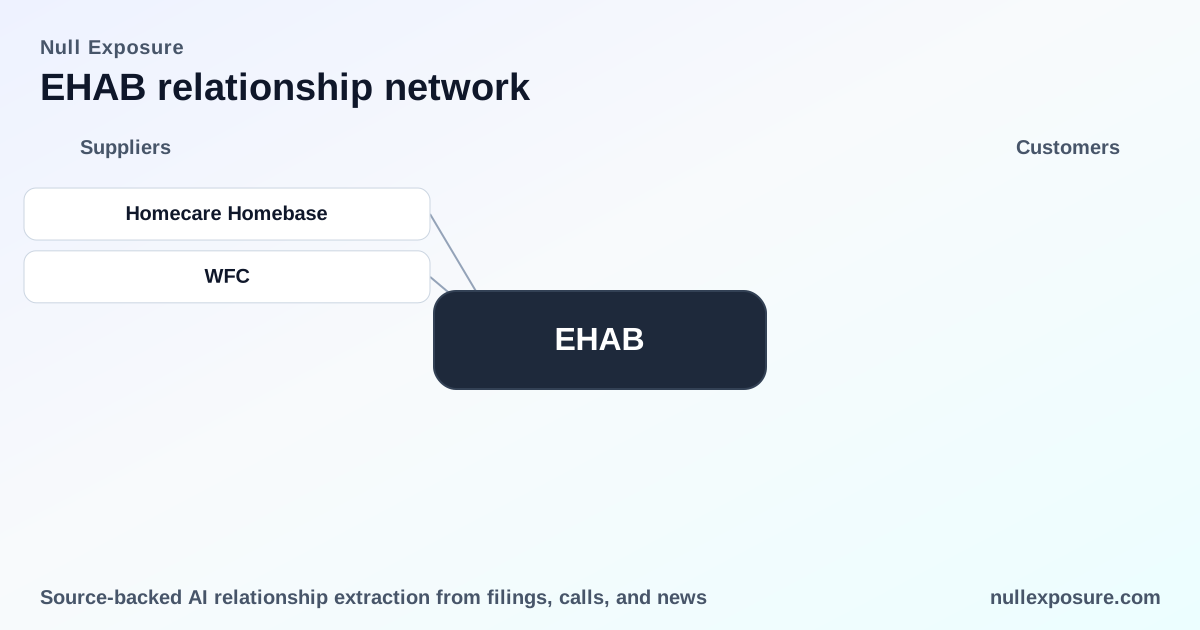
Enhabit (EHAB) — supplier map and what it signals for investors
Enhabit operates and monetizes by delivering home health and hospice clinical services to payers and patients across the United States, generating revenue through billed care episodes and ancillary services; the company reports roughly $1.06 billion in trailing twelve‑month revenue and positive operating margins while managing cash and leverage through institutional credit facilities. For investors, supplier relationships matter because clinical operations depend on software, analytics, and capital partners; disruptions or cost shifts in those relationships translate directly into operating leverage and margin risk.
Explore more supplier intelligence at https://nullexposure.com/.
One-line investment thesis
Enhabit is a revenue‑driven provider of home health and hospice services whose operating economics are tightly coupled to a small number of critical third‑party providers: electronic medical records and clinical analytics vendors that touch clinical workflow, plus bank-led credit facilities that underpin balance-sheet flexibility. The company’s growth and margin sustainability depend on continuity of licensed software, predictable vendor spend, and stable bank financing.
How Enhabit pays to run care (and why suppliers matter)
Enhabit’s model is fundamentally people-and-data intensive: clinicians deliver care while licensed software and analytics platforms enable scheduling, clinical documentation, and utilization management. Software licensing and analytics are operationally critical rather than discretionary, because they affect documentation quality, billing accuracy, and clinician productivity. Separately, bank financing shapes capital structure and the company’s ability to invest in growth or manage seasonality, so the identity and terms of lenders are material to credit and operational risk.
- The company reports $1.06 billion in revenue TTM and a positive operating margin, indicating scale, but the reliance on third‑party platforms concentrates operational exposure.
- Vendor spend signals show mid-single‑digit millions of dollars annually on analytics platforms, which is meaningful relative to margins.
If you want a concise supplier dossier and risk scoring, visit https://nullexposure.com/ for deeper supplier maps.
Supplier relationships on the record
Below are the supplier relationships identified in Enhabit’s public filings and news coverage. Each relationship summary is precise and sourced.
Homecare Homebase — licensed EMR provider
Enhabit discloses that it licenses an electronic medical records system under an agreement with Homecare Homebase, indicating an outsourced EMR arrangement that supports clinical documentation and billing workflows. According to Enhabit’s 2024 Form 10‑K, “We use an electronic medical records system that we license under an agreement with Homecare Homebase.” This is an operationally critical software relationship (FY2024 filing).
Wells Fargo Bank — administrative agent on credit facilities
Wells Fargo Bank serves as administrative agent for a five‑year, $475 million credit facility that Enhabit secured, positioning Wells Fargo as the lead lender and operational partner for the company’s liquidity and capital needs. A March 2026 news report on TradingView noted Enhabit “secures $475 million five‑year credit facilities led by Wells Fargo,” with Wells Fargo identified as the administrative agent (TradingView, March 2026).
Contracting posture, maturity and concentration — company-level signals
Enhabit’s public disclosures and constraint signals paint a clear operating posture:
- Contract type: licensing. The company operates with licensed software relationships for its EMR and related platforms; these are traditional vendor licensing arrangements rather than owned systems. This is a company‑level signal drawn from public filings.
- Contract type: short‑term/transition services. Enhabit previously relied on transition services provided by a former parent (Encompass) on a temporary basis, which indicates short‑term contractual backstops while standalone systems and processes scale. The company described temporary Transition Services Agreements in its filings.
- Relationship role: service provider dependency. Historically, Encompass provided core corporate functions on a service basis (treasury, legal, IT, HR), which indicates early maturity stage operational outsourcing and the need to internalize or replace those services post‑separation.
- Segment signal: software. Multiple disclosures highlight software (EMR, analytics) as a distinct vendor segment that is central to operations.
- Spend band: $1m–$10m with analytics vendor (Medalogix). According to Enhabit’s 2024 Form 10‑K, the company incurred approximately $4.9 million in 2024 (and roughly $4.5–$4.6 million in prior years) for usage of Medalogix’s analytics platforms — consistent with a mid‑range vendor spend band.
These signals together define an operating profile of high criticality for a small set of software vendors, moderate vendor concentration, and a mix of short‑term and multi‑year contracts that require active supplier management.
Investment implications — what to watch next
- Operational risk: The EMR license is critical; any interruption or adverse re‑pricing would degrade bill capture and clinician productivity. Investors should monitor contract renewal terms and integration progress of alternative systems if the company transitions away from temporary service arrangements.
- Margin sensitivity: Mid‑single‑million dollar analytics spend is operationally material relative to margins; productivity improvements tied to analytics are a net positive, but rising fees without commensurate efficiency gains compress margins.
- Balance‑sheet risk: The Wells Fargo‑led credit facilities provide liquidity headroom but also introduce covenant and refinancing dynamics that investors must watch through earnings cycles and interest rate shifts.
- Concentration and maturity: A small number of critical suppliers plus legacy transition relationships indicate that supplier concentration is meaningful and that the company remains in a phase of operational build‑out and vendor stabilization.
For a structured supplier risk briefing and continuous monitoring of these relationships, see https://nullexposure.com/.
Bottom line and actionable signals
Enhabit operates a capital‑intensive, software‑enabled home health/hospice platform where a handful of suppliers have outsized influence on operations and financial flexibility. Key investor signals: the EMR license, multi‑million analytics spend, and bank‑led credit facilities are the primary supplier vectors that determine near‑term margin and liquidity risk. Monitor filing disclosures for contract renewal language, vendor concentration metrics, and covenant mechanics on the Wells Fargo facility.
If you want a tailored supplier risk memo or periodic alerts on Enhabit’s vendor and lender changes, start with the supplier hub at https://nullexposure.com/ and request a briefing.