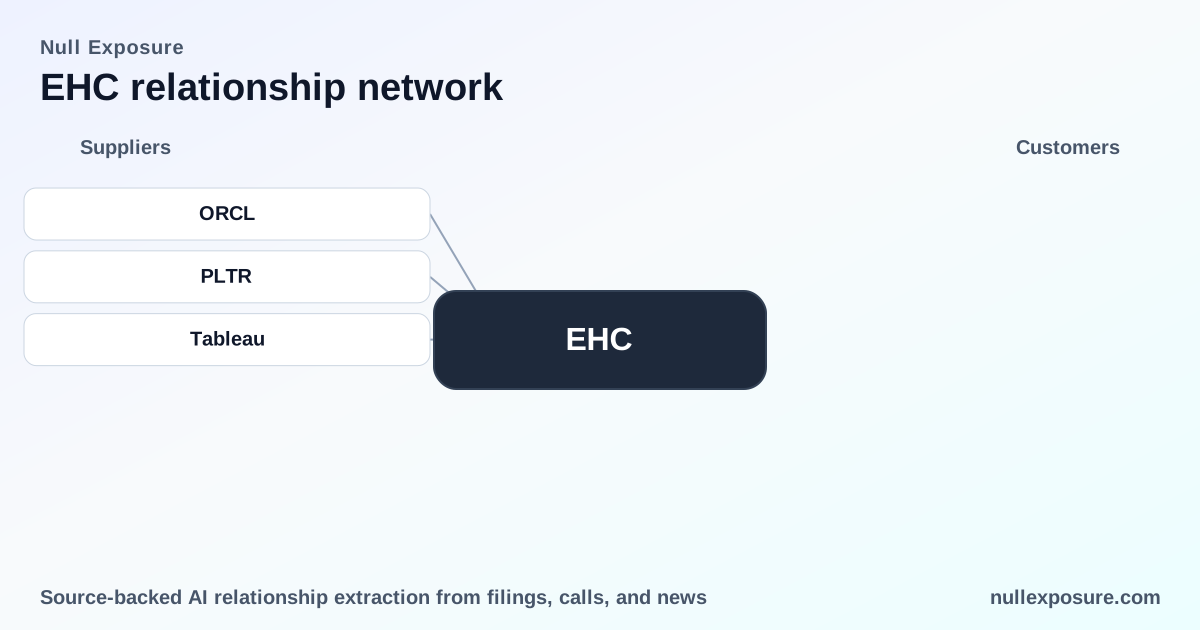
Encompass Health (EHC): Supplier relationships that shape operations and margin
Encompass Health operates and monetizes a two‑legged post‑acute healthcare platform: a national network of inpatient rehabilitation hospitals and a growing in‑home services business that together bill payors for high‑margin rehabilitation and post‑acute care. Revenue converts to cash through fee‑for‑service and contract reimbursement, while operating leverage comes from standardized clinical systems, data analytics and consolidated back‑office platforms that compress cost per discharged patient. Supplier relationships for enterprise clinical software, ERP and analytics are direct drivers of operating efficiency, regulatory compliance and margin stability. Learn more at https://nullexposure.com/.
How Encompass buys technology and services — what the vendor posture tells investors
Encompass Health contracts for a mix of licensed software, hosted services, and third‑party clinical service provision. The company discloses a licensed, hosted relationship for its enterprise clinical information system (ACE‑IT) and has moved its ERP to Oracle Fusion, indicating a preference for large‑vendor solutions that combine licensing with cloud hosting and managed support. That posture signals vendor consolidation and potential lock‑in, balanced by lower integration risk from mature incumbents.
Company constraints reveal four operating characteristics relevant to supplier diligence:
- Contracting posture — licensing and hosting. Encompass uses licensed clinical systems with implementation and hosting agreements, which creates multi‑year commercial exposure and renewal risk tied to ACE‑IT licensing.
- Criticality — mission‑critical infrastructure. Clinical and billing systems are central to operations and revenue capture; third‑party outages or breaches directly affect patient care and cash flow.
- Concentration — focused on a small set of enterprise vendors. Use of enterprise ERP and analytics platforms implies concentration risk with a few strategic suppliers.
- Maturity — enterprise, not bespoke. Encompass favors mature, widely adopted vendors, reducing early‑stage execution risk but increasing migration and licensing costs.
These are company‑level signals drawn from Encompass public disclosures; where a constraint explicitly names a vendor, the connection is noted below.
Vendor map: Oracle, Palantir, Tableau — what each relationship delivers
Oracle
Encompass completed a conversion of its ERP to Oracle Fusion in October (FY2026) and reported the transition occurred without significant disruption to operations, showing Oracle’s role in the company’s core finance and back‑office stack. According to the Q4 2025 earnings call transcript published by InsiderMonkey on March 9, 2026, the ERP conversion is complete and stable. Key takeaway: Oracle is a strategic infrastructure vendor underpinning financial and operational workflows. (InsiderMonkey, FY2026 earnings call transcript, 9 Mar 2026)
Palantir
Encompass has extended and expanded its agreement with Palantir, positioning the company to leverage Palantir’s analytics and data‑integration tools across clinical and operational use cases; analysts probed for quantifiable benefits during the Q4 call. The extension was disclosed in the Q4 2025 earnings call transcript (InsiderMonkey, 9 Mar 2026) and was questioned by analysts in a Finviz summary of the same call (Finviz, 9 Mar 2026). Key takeaway: Palantir is a strategic analytics partner intended to drive measurable operational improvements and scale analytics across the portfolio.
Tableau
Encompass reports investment in Tableau as a visualization layer covering roughly 70% of its hospitals, with the platform enabling capacity planning and utilization analysis that can double volume under current utilization assumptions. This deployment was described during the Q4 2025 earnings call transcript (InsiderMonkey, 9 Mar 2026). Key takeaway: Tableau supports clinical and operational decision‑making and amplifies the value of the company’s data platform.
What these relationships mean for margin and operational risk
The vendor mix is coherent with a playbook that prioritizes standardized, enterprise solutions to drive scale. ERP stability and analytics expansion are positive margin levers: Oracle Fusion standardizes finance and procurement; Palantir and Tableau extract value from operational data and improve throughput and length‑of‑stay decisions. The combination supports Encompass’s historical operating margins and return on equity metrics.
Risks are concentrated and quantifiable:
- Licensing and hosting terms create renewal and cost inflation risk, especially where clinical systems are licensed and hosted by vendors. Encompass explicitly states ACE‑IT is subject to a licensing, implementation, hosting and support agreement with Oracle Cerner Corporation, signaling material contractual dependence on clinical software licensing.
- Third‑party intermediaries matter to revenue capture. Encompass disclosed reliance on intermediaries for claims processing and noted a prior cybersecurity incident involving Change Healthcare (a UnitedHealth subsidiary) that affected payment claim processing; this highlights operations‑to‑cash exposure from external partners.
- Data governance and uptime are mission critical. Clinical platform availability and analytics integrity drive patient throughput and payer billing; vendor outages or integration failures have direct financial consequences.
For investors, these are not speculative weaknesses but operational levers to track in quarterly filings and earnings calls: contract durations and renewal cadence with Oracle/Oracle Cerner, scope and KPIs tied to the Palantir extension, and Tableau penetration across the hospital footprint.
Learn more about supplier exposure analysis at https://nullexposure.com/.
A short checklist for supplier diligence before underwriting exposure
- Contract terms: Review license duration, renewal triggers, and exit costs for ACE‑IT and ERP contracts.
- Service levels and runbooks: Confirm SLAs for hosting, backup, and incident response on clinical systems.
- Data access and analytics KPIs: Validate the measurable outcomes tied to the Palantir engagement and Tableau roll‑out.
- Claims‑processing contingency: Assess vendor redundancy for third‑party claim intermediaries and historical incident response (note the Change Healthcare incident called out in filings).
- Consolidation risk: Evaluate the balance between single‑vendor efficiencies and supplier concentration that can compress negotiation leverage.
Bottom line — what investors should watch next
Encompass Health has moved decisively toward enterprise vendors that reduce integration fragility while concentrating commercial exposure. Oracle underpins finance operations, Palantir is the analytics multiplier, and Tableau operationalizes insights across most hospitals. Monitor contract renewals, disclosed KPIs from the Palantir program, ACE‑IT licensing language, and any further commentary on claims‑processing resilience. For a deeper supplier risk profile and ongoing alerts, visit https://nullexposure.com/.
This supplier map is an operational lens on EHC’s margin mechanics; track these relationships in the coming quarters to anticipate cost pressures and margin upside tied to analytics‑driven throughput.