eHealth (EHTH): Supplier and financing counterparties that reshape short-term liquidity and vendor risk
eHealth operates an online private health insurance exchange that connects individuals, families and small employers with health plans and agents, monetizing through commissions and fees on policy sales and ancillary services. Recent financing and supplier activity recasts the company’s near-term balance sheet and highlights a vendor-dependent operating model: new secured working capital from an ABL, parallel amendments with a private investor, and a reset of prior lender arrangements materially change counterparty exposures for operators and procurement teams.
If you evaluate supplier relationships or underwriting counterparty risk, start here: learn how these counterparties interact with eHealth’s capital structure and day-to-day operations at https://nullexposure.com/.
Why these moves matter to investors and operators
eHealth’s business is operationally lean but contract-reliant — distribution technology and third-party networks are core inputs. The company’s decision to draw a full $125 million asset-based revolving credit facility replaces prior debt and provides immediate liquidity to support operations, which reduces near-term refinancing risk but increases secured-creditor priority on pledged assets. Simultaneously, amendments with an investor vehicle controlled by H.I.G. Capital introduce governance and liquidity covenants that constrain cash flow policy and dividend rights.
- Immediate effect: liquidity buffer increased; prior Blue Torch facility repaid and terminated.
- Contracting posture: heavier use of secured financing and investor governance tools implies tighter covenants and reduced financial optionality for management.
- Supplier implications: service and licensing relationships remain operationally important; secured lenders now stand ahead of unsecured suppliers on collateral claims.
For more detailed counterparty intelligence and supplier impact analysis, visit https://nullexposure.com/.
Who the counterparties are and what they did
Below are the relationships surfaced in recent public disclosures and press reports. Each entry is a plain-English takeaway and the public source.
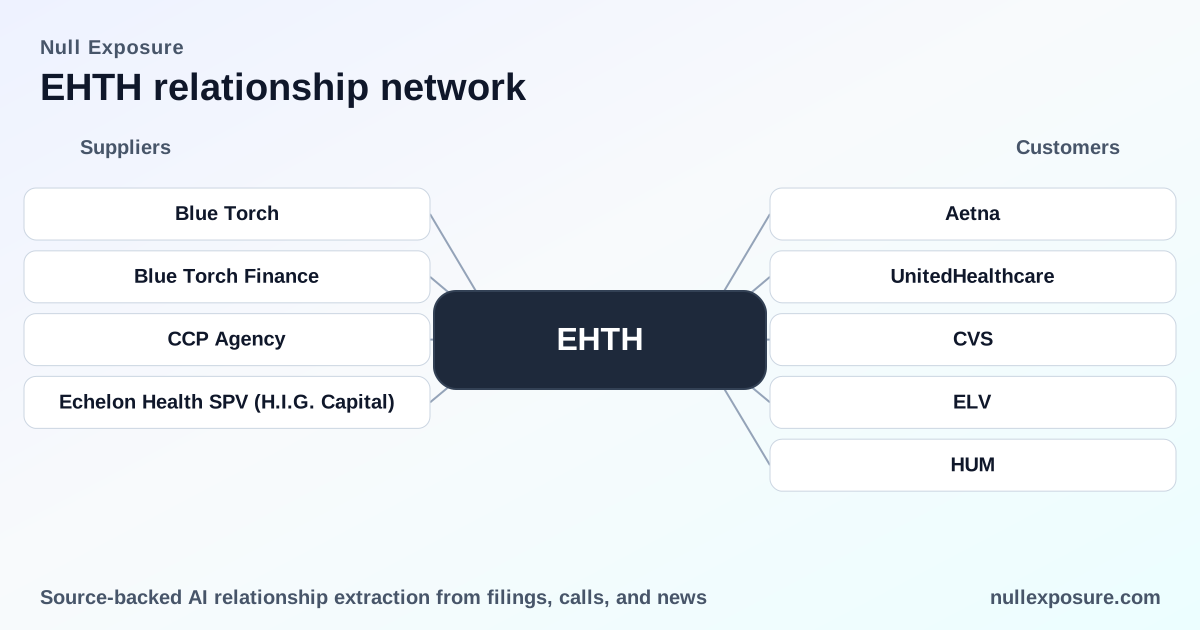
Blue Torch
eHealth announced an extension of a Blue Torch term loan, signaling an active negotiation lifecycle with that lender before the company ultimately repaid and terminated the prior Blue Torch credit agreement. According to a PR Newswire release cited through Finviz on March 9, 2026, the extension was publicly recorded before the subsequent refinancing.
Blue Torch Finance
In connection with its financing actions, eHealth repaid and terminated its prior Blue Torch credit agreement as part of a broader restructuring of its capital stack. TradingView reported on March 9, 2026 that the company executed multiple material agreements, including the retirement of the earlier Blue Torch facility to simplify lender relationships.
CCP Agency
eHealth entered a new $125.0 million asset-based revolving credit facility led by CCP Agency, drew the full amount to refinance prior debt, and will have the facility mature in December 2028; this converts unsecured or different-priority obligations into a secured, asset-backed structure. TradingView’s March 9, 2026 coverage details the size, purpose, and full initial draw of the facility.
Echelon Health SPV (H.I.G. Capital)
eHealth amended an investment agreement with Echelon Health SPV (an H.I.G. Capital vehicle) to permit the CCP-led facility, add a liquidity covenant with a dividend-adjustment remedy, and establish specific governance rights for the investor. TradingView’s March 9, 2026 reporting highlights these covenant and governance changes as part of the package of material agreements.
What the supplier constraints tell you about eHealth’s operating model
Company-level disclosures indicate service and licensing agreements are material inputs: eHealth contracts third parties for network access, equipment maintenance and software licensing. Those contract types show the company runs an externally integrated tech stack and relies on third-party service providers for core functions.
- Contract type and role signal: Licensing and service-provider arrangements are confirmed company-level characteristics, indicating a recurring operational dependence on external vendors rather than fully insourced infrastructure.
- Concentration and criticality: Given the business is an online exchange, vendor failures or adverse renegotiations could interrupt sales flow, customer onboarding, or claims-facing systems, raising operational risk that is asymmetric relative to the secured-creditors’ claims.
- Maturity and contracting posture: The presence of licensing agreements suggests standardized vendor contracts with renewal risk, while the new secured financing and investor covenants imply management will prioritize cash conservation over discretionary vendor spend.
Note: the contract-type constraints above are company-level signals drawn from eHealth’s disclosures and are not tied to a specific counterparty unless the disclosure explicitly named that party.
Risk profile and implications for supplier and underwriting decisions
- Priority shift: the ABL led by CCP Agency establishes a secured creditor ahead of general unsecured suppliers; procurement and service providers should assume tightened remediation options in insolvency scenarios.
- Governance pressure: H.I.G.’s governance and liquidity covenants mean management has reduced flexibility on dividends and large discretionary payments, which increases the likelihood that operational vendors receive prioritized payments only when covenant tests permit.
- Counterparty concentration: eHealth’s reliance on licensing and third-party service providers creates concentration risk; counterparties that provide unique network access or bespoke integrations are de facto critical suppliers and should price contractual protection accordingly.
Investor takeaways and action items
- For credit analysts: reassess counterparty recovery assumptions in light of the new CCP Agency ABL; secured exposure reduces recovery prospects for unsecured claims. Review covenants introduced by H.I.G. for triggers that could force a deleveraging or asset sale.
- For operations and procurement teams: renegotiate SLAs and introduce stronger termination and cure rights where feasible, given elevated secured-lender priority and tighter cash governance.
- For equity investors: the financing package reduces near-term liquidity risk but transfers economic value to secured lenders and private equity governance, meaning upside from operational improvement is now shared with creditor and investor counterparties.
If you need a tailored supplier-risk memo or counterparty exposure map for EHTH, get a focused profile at https://nullexposure.com/.
Final judgment
eHealth’s financing and investor amendments are decisive, not cosmetic: the full draw of a $125 million ABL and contractual amendments with an H.I.G. vehicle materially alter the company’s creditor hierarchy and internal capital allocation mechanics. For anyone underwriting supplier risk or conducting operational due diligence, the two-fold takeaway is clear: liquidity improved but contractual flexibility decreased, and third-party service and licensing relationships are strategically important under the new creditor landscape.
For ongoing monitoring of material supplier and financing relationships at eHealth, consult https://nullexposure.com/ for updated counterparty intelligence and workflow-ready summaries.