Eagle Point Income Company (EIC): Supplier Relationships and Operational Signals for Investors
Eagle Point Income Company (EIC) generates current income by investing principally in the equity tranches of collateralized loan obligations (CLOs) and is externally managed and advised, collecting returns through portfolio cash flows and distributing yield to shareholders. The firm monetizes via income generation from CLO equities, dividend distribution policy, and NAV appreciation, while operational control and day-to-day portfolio execution rest with its external adviser. Learn more about supplier intelligence and counterparty risk at https://nullexposure.com/.
How EIC’s operating model converts market advantage into shareholder yield
EIC’s value proposition is straightforward: capture spread and equity upside in CLO capital structures while outsourcing portfolio management to a specialist adviser. This structure produces a predictable revenue stream when credit markets are stable and allows the firm to scale strategy without heavy internal investment in portfolio infrastructure. Key balance-sheet and market signals include a modest market capitalization (~$251m), negative reported EPS in the latest TTM, and a dividend policy that targets current income over capital appreciation. These features make EIC a yield-focused vehicle where advisor capability and access to CLO inventory are core economic drivers.
The core supplier relationships you need to know
Below are the supplier and service relationships surfaced in recent public items. Each relationship is summarized in plain English with a direct source reference.
-
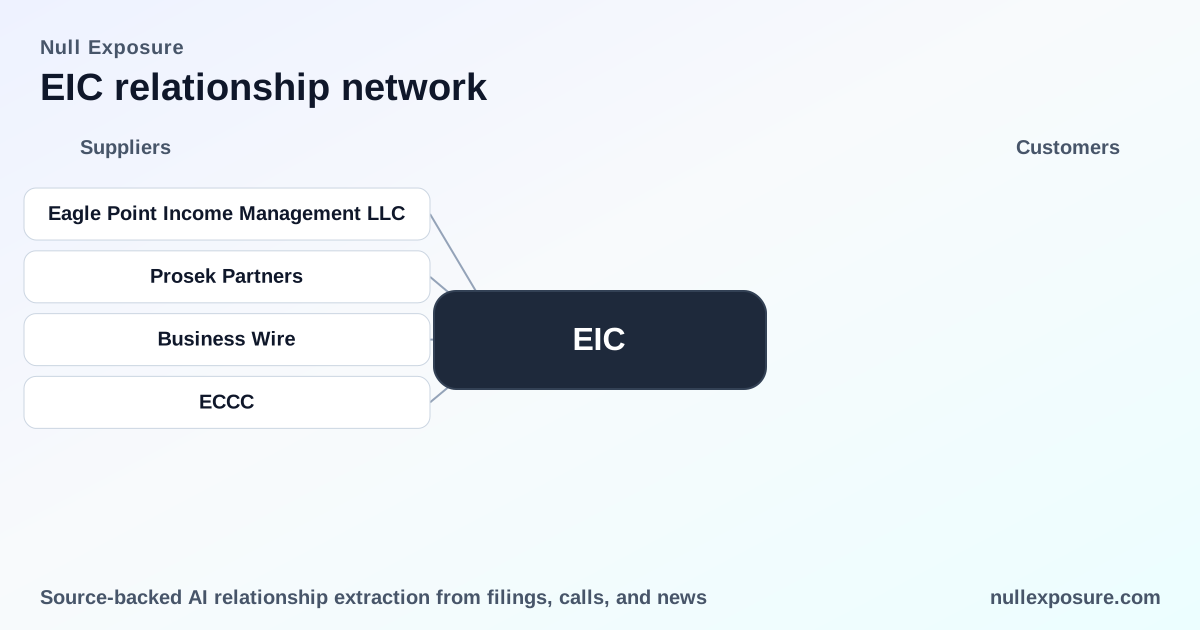
Eagle Point Income Management LLC — external manager and adviser. Eagle Point Income Management LLC serves as EIC’s external investment adviser and manager, responsible for portfolio construction, CLO sourcing, and NAV estimates. According to the company’s press release distributed via Business Wire on October 30, 2025, “The Company is externally managed and advised by Eagle Point Income Management LLC.” (Business Wire / Markets FinancialContent, Oct 30, 2025).
-
Prosek Partners — investor and media relations firm. Prosek Partners is listed as EIC’s investor- and media-relations contact, handling communications and IR inquiries for the company; contact information and IR routing are published in EIC press materials. (Markets FinancialContent via Business Wire, Oct 30, 2025; Yahoo Finance press release distribution, FY2026).
-
Business Wire — press distribution channel. EIC uses Business Wire to distribute official corporate announcements and earnings-release scheduling, indicating a centralized, professional approach to market communications. (Business Wire distribution noted in company press release, Oct 30, 2025).
-
Eagle Point (branded adviser) — institutional scale and adviser positioning. Company remarks in an earnings call transcript emphasize that the scale and experience of Eagle Point are presented as a competitive advantage in sourcing CLO opportunities and navigating market dislocations. (Earnings call transcript coverage in InsiderMonkey, Q4 2025).
What these relationships imply about EIC’s contracting posture and operational concentration
With an externally managed structure and a single adviser named repeatedly in public releases, EIC’s vendor posture is clearly concentrated and adviser-centric. That concentration delivers operational leverage—a small company can access scale and expertise without internalizing the cost of an investment platform—but it also creates a single point of commercial and operational dependency:
-
Contracting posture: EIC is outsourced for investment execution and portfolio management, giving the adviser significant influence over portfolio positioning and timing.
-
Concentration: The adviser relationship is material and central to EIC’s ability to execute its CLO equity strategy; supplier diversification at the advisory level is limited.
-
Criticality: The adviser is operationally critical — any disruption to adviser services would directly affect NAV calculation, CLO access, and distribution strategy.
-
Maturity: Public filings and press practice (use of professional PR and IR firms) indicate an established governance and communications layer, appropriate for an externally managed closed-end investment vehicle.
Because no formal constraints were listed in the relationship data, these signals are presented as company-level attributes rather than tied to any specific contractual clause.
Commercial and risk implications for investors and counterparties
EIC’s supplier map generates clear commercial levers and risk considerations for counterparties and investors alike:
-
Concentration Risk: The external-manager model concentrates operational risk with Eagle Point Income Management LLC; investors should treat the adviser as a primary counterparty when assessing operational resilience and continuity planning.
-
Negotiation Leverage: Proximity to an experienced adviser with market relationships is a commercial asset, but it also implies limited negotiating leverage for EIC over advisory fees relative to internally managed peers.
-
Information Flow and Market Signaling: Use of professional PR distribution and retained IR indicates disciplined market communications, which benefits liquidity and transparency; however, it does not substitute for direct disclosure on fee schedules or adviser contracts.
-
Performance Dependence: Equity tranche returns are sensitive to credit cycles; adviser skill in sourcing, trimming, and hedging positions is the dominant performance driver.
For active investors, incorporate adviser track record, contract terms (where available), and NAV reporting cadence into any valuation or engagement framework. For counterparties and vendors, prioritize contract clarity on service levels, termination rights, and continuity plans.
Explore supplier and counterparty profiles for other names at https://nullexposure.com/ — use the site to prioritize due diligence across managers and service providers.
Quick take — recommended actions for investors and operators
- Demand access to adviser-level disclosures: obtain the adviser’s track record on CLO equity performance, fee schedules, and written continuity plans.
- Treat the adviser as the primary counterparty: perform operational due diligence on Eagle Point Income Management LLC before increasing exposure.
- Monitor NAV and distribution cadence closely: NAV volatility will drive total return more than headline dividend yield.
For a targeted review of supplier risk and relationship exposure across alternative asset firms, visit https://nullexposure.com/ to schedule deeper supplier intelligence or to download tailored reports.
Final assessment
EIC is a yield-first closed-end vehicle whose investment alpha is delivered through an externally managed CLO-equity strategy. The firm’s supplier architecture — a single, named external adviser plus professional PR/IR support — is efficient and market-appropriate but creates concentrated operational dependency that investors must underwrite explicitly. For investors focused on income with a tolerance for adviser-driven execution risk, EIC offers a clear trade-off; for risk-averse allocators, adviser concentration elevates governance and counterparty diligence to first-order considerations. Learn more about mapping supplier concentration and operational dependencies at https://nullexposure.com/.