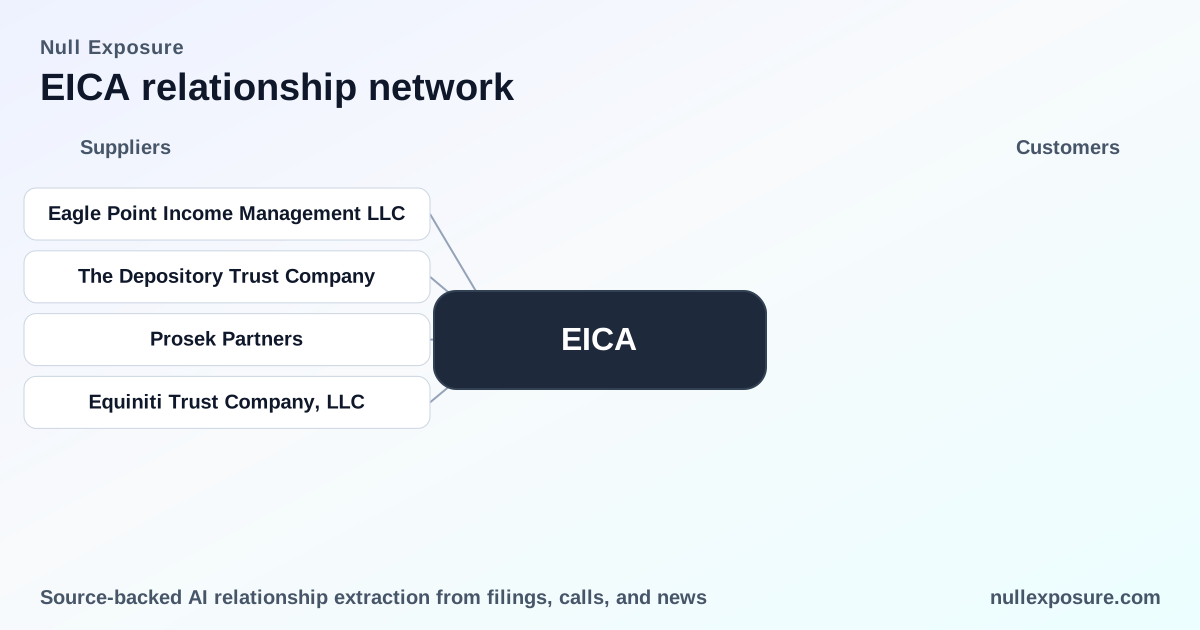
Eagle Point Income Company Inc. (EICA) — Supply-chain map and investor implications
Eagle Point Income Company Inc. Preferred Series A (EICA) is a closed-end management investment company that monetizes through income-generating credit positions—chiefly private debt and CLO-related instruments—while outsourcing portfolio management and several investor services. The company collects yield from its invested capital and funnels cash to preferred shareholders while depending on third-party providers for advisory, custody/clearing, redemption processing and investor communications. For a focused supplier-risk briefing, see https://nullexposure.com/.
Snapshot thesis for investors
EICA’s operating model is externally managed and service-dependent: investment returns and dividend stability hinge not only on portfolio selection but on the continuity and integrity of a handful of outsourced providers that execute portfolio advisory, share custody and investor communications. That structural reliance concentrates operational risk even as it enables an asset-light operating profile that can scale returns if the advisor continues to generate attractive credit income.
For deeper supplier risk profiles and monitoring tools, visit https://nullexposure.com/.
The supplier map — who does the work for EICA
Below I cover every supplier relationship surfaced in public filings and press notices. Each entry includes a concise plain-English description and a source reference so investors can follow the original disclosure.
Eagle Point Income Management LLC
Eagle Point Income Management LLC is the company’s external investment advisor and manager; it handles portfolio construction, credit selection and day‑to‑day investment decisions that determine EICA’s earnings and NAV movements. According to press materials and NAV estimates published in FY2025–FY2026, the company is explicitly externally managed and advised by Eagle Point Income Management LLC (see press releases and MarketScreener notes in late 2025–early 2026).
Source: press release scheduling Q3 2025 results (Globe and Mail, Nov 13, 2025) and MarketScreener/Yahoo Finance disclosures referencing FY2025–FY2026 management arrangements.
The Depository Trust Company (DTC)
All preferred shares referenced in recent notices are held in book‑entry form at The Depository Trust Company, which provides the clearing and settlement infrastructure that enables transfer, redemption and secondary trading liquidity for shareholders. A company notice in FY2025 explains that Series B term preferred stock shares are held through DTC and will be redeemed pursuant to DTC procedures.
Source: company redemption notice published via Yahoo Finance (FY2025).
Equiniti Trust Company, LLC
Equiniti Trust Company, LLC is named as the redemption agent responsible for executing payments to DTC for redeemed shares; this places Equiniti in a critical cash‑processing and shareholder‑servicing role during capital actions. A FY2025 notice states that payment to DTC for Series B term preferred stock will be made by Equiniti Trust Company, LLC.
Source: company redemption notice published via Yahoo Finance (FY2025).
Prosek Partners
Prosek Partners is listed as the investor and media relations contact for EICA, handling IR communications and inquiries that shape market perception and buy‑side access to corporate statements. FY2025–FY2026 press materials identify Prosek Partners with a contact line and email for investor and media relations.
Source: investor and media relations contact details published in company press releases on Yahoo Finance and related FY2025–FY2026 notices.
What these relationships imply about EICA’s operating model
Investors should translate the supplier map into actionable signals about EICA’s business model and operational constraints:
- Contracting posture — vendor-dependent and externally governed. EICA is externally managed, which means key investment decisions are delegated to its advisor rather than executed in-house; this reduces fixed overhead but increases dependency on contractual continuity and advisor performance.
- Concentration — few critical counterparties. The supplier list reveals a compact set of high‑leverage vendors (investment manager, clearing/custody, redemption agent, IR firm). A small number of suppliers control functions that are material to NAV, dividends and shareholder liquidity.
- Criticality — operational suppliers have direct financial impact. The advisor determines portfolio returns; DTC/Equiniti control settlement and redemption mechanics; IR influences market liquidity and investor sentiment. Each supplier’s failure or disruption can directly affect distributions and secondary-market pricing.
- Maturity — asset‑management model with standard institutional vendors. Relationships are with established industry players (a management firm, DTC, a trust company, and a specialized communications firm), indicating mature outsourcing practices rather than bespoke or nascent vendor arrangements.
These are company‑level signals drawn from published vendor roles and corporate notices; they describe EICA’s structural risks and operational posture rather than the health of any specific counterparty.
Investment implications and risk checklist
- Performance risk is concentrated in the advisor. Financial returns and preferred dividend stability depend on Eagle Point Income Management LLC’s ability to source and manage CLO and private credit exposure. Monitor advisor commentary, personnel continuity, and performance attribution.
- Operational liquidity hinges on custody and redemption mechanics. DTC’s role means secondary trading and redemptions are subject to standard market plumbing; Equiniti’s role as redemption agent is the operational fulcrum during any capital return events.
- Reputational and communications risk is centralized. Prosek Partners manages investor-facing narratives; poor communications during NAV shocks or redemptions can exacerbate market dislocations.
- Concentration risk requires active monitoring. Given the compact supplier list, investors should track contract renewals, any announced transitions, and public filings for changes to service providers.
Practical next steps for investors
- Review the advisor’s published investment commentary and performance attribution on a rolling quarterly basis.
- Watch corporate press releases for any changes to DTC custody arrangements or redemption agent assignments.
- Keep a log of IR contact activity during distribution or redemption events to evaluate the quality of external communications.
For an ongoing supplier-risk dashboard and deeper company supplier profiles, explore https://nullexposure.com/.
Closing assessment
EICA operates an asset‑light, yield‑oriented model that depends on a small set of institutional suppliers to deliver returns, liquidity and investor communications. That structure delivers scalability and focused management expertise but concentrates operational risk in the advisor, clearing/custody and redemption channels. Investors should therefore weight exposure not only to credit performance but to vendor continuity and the firm’s track record of outsourcing governance.
For detailed supplier due diligence and monitoring tools tailored to closed-end funds, visit https://nullexposure.com/.