Employers Holdings (EIG): Supplier Relationships, Operational Constraints, and Investment Implications
Employers Holdings (EIG) underwrites specialty commercial property and casualty, monetizing through premium income, risk selection retained on its balance sheet, reinsurance programs that manage volatility, and investment returns on float. Its operating model combines captive-style underwriting at the subsidiary level with centralized capital and liquidity management at the holding company, producing revenue from underwriting margin and investment income while using reinsurance and bank facilities to preserve capital and meet regulatory needs. For a structured supplier-risk view and vendor intelligence, visit https://nullexposure.com/ for additional sourcing and context.
How the supplier map fits into the business model
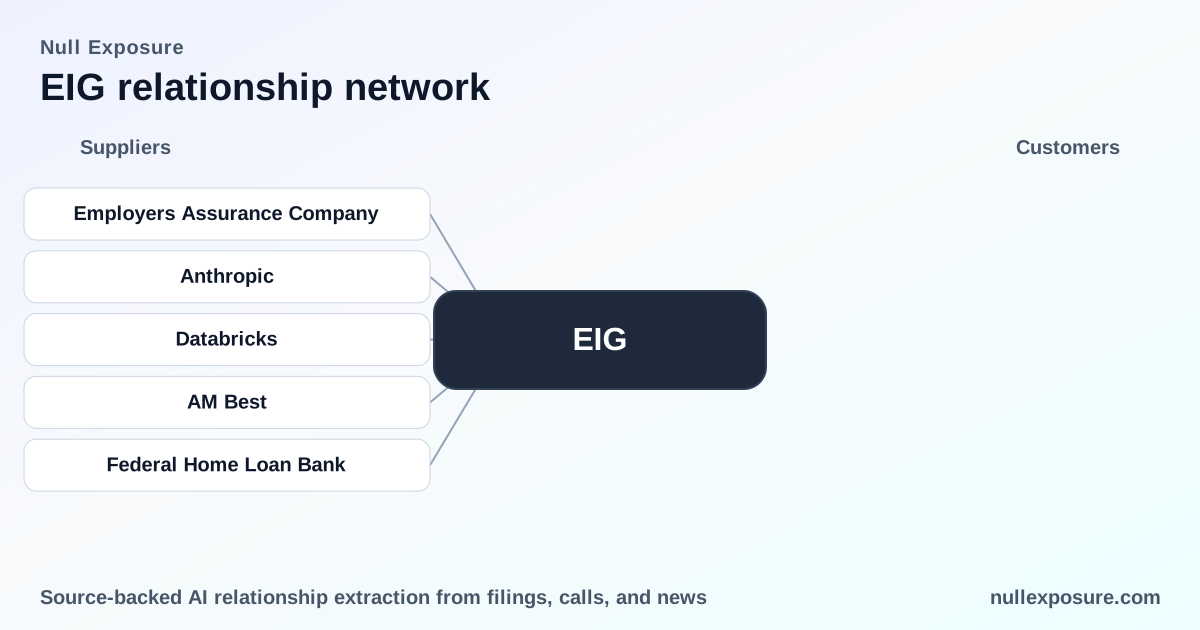
EIG runs a layered supplier footprint that reflects two concurrent priorities: short-term liquidity and claims protection through bank advances and annual reinsurance, and longer-term operational modernization through third-party technology and advisory services. These relationships execute distinct functions—capital access, reinsurance protection, ratings validation, and enterprise technology—so investors should treat counterparty exposure as operationally critical rather than discretionary. AM Best’s rating affirmation and the company’s access to the Federal Home Loan Bank are material credit supports; technology partnerships (Anthropic, Databricks) signal a deliberate modernization program that influences loss-ratio control and administrative efficiency.
Who EIG is working with and what each relationship does
Employers Assurance Company
Employers Assurance Company is the underwriting entity for new excess workers’ compensation programs and carries an A (Excellent) rating from A.M. Best. This relationship is the internal underwriting engine referenced in EIG press coverage about new product launches (news release, March 2026; CarrierManagement, Feb 2026).
Anthropic
EIG has rolled out Anthropic’s Claude across the organization as part of its AI implementation, indicating enterprise-wide adoption of a generative AI assistant for internal workflows. The disclosure comes from the Q4 2025 earnings call transcript and shows a strategic move to embed AI in operations (The Globe and Mail, Q4 2025 earnings call transcript).
Databricks
EIG implemented an AI roadmap in 2025 and is consolidating its data platform into Databricks to centralize analytics and model development, positioning analytics as a core capability for underwriting and claims. Management discussed this data migration and roadmap on the Q4 2025 earnings call (The Globe and Mail, Q4 2025 earnings call transcript).
AM Best
AM Best affirmed the Financial Strength Rating (A, Excellent) for Employers’ operating insurance subsidiaries and affirmed long-term issuer credit ratings including an indicative rating for the holding company, reinforcing the group’s capital and claims-paying assessments. The rating action was published in a January 2026 release and is a key third-party validation of the group’s balance sheet and reinsurance structure (Business Wire / FinancialContent, Jan 2026).
Federal Home Loan Bank
EIG’s insurance subsidiaries have access to collateralized advances from the Federal Home Loan Bank and have used FHLB advances in past years as a source of liquidity; management notes these advances as part of planned recapitalization funding. This funding channel was described in the company’s third-quarter 2025 press release on recapitalization planning (GlobeNewswire, Q3 2025).
Constraints and what they signal about operating posture
EIG’s documented constraints present a hybrid contracting posture: both long-term fixtures and short-term, flexible arrangements.
- Long-term elements: The company has enduring legacy agreements—an LPT arrangement instituted in 1999 that remains in force until claims close or commutation—signaling structural obligations that stretch actuarial time horizons and constrain capital allocation. EIG also maintains a committed multi-year revolving credit facility used for working capital and liquidity management.
- Short-term elements: Management uses annually procured reinsurance programs and FHLB advances that are callable or repayable on short notice, which provides liquidity flexibility but creates renewal and counterparty exposure each year.
- Service provider posture: EIG contracts investment managers and external advisory services to implement portfolio targets and to manage reinsurance purchases, indicating reliance on external asset management and reinsurance brokerage expertise.
- Spend and criticality: Reinsurance capacity in force (e.g., $190 million excess of $10 million retention on a per-occurrence basis) signals large-dollar, high-criticality spend. These are not peripheral contracts but capital-protection arrangements that materially affect solvency and earnings volatility.
- Maturity and activity: The company’s supplier relationships are active and evolve—evidenced by the July 2024 reinsurance program effective through mid-2025 and ongoing AI/data-platform investments—so counterparties oscillate between stable structural partners and annual market-dependent providers.
Taken together, these constraints indicate a business that is capital-intensive, reliant on market-based reinsurance renewal cycles, and simultaneously investing in technology to lower operating cost and underwriting friction.
Why investors should care: strategic implications and risk checklist
- Capital and liquidity: Access to FHLB advances and a revolving credit facility provide tactical liquidity; AM Best affirmation supports solvency confidence. These facts reduce near-term refinancing risk but do not eliminate renewal risk on reinsurance.
- Counterparty concentration: Large, concentrated reinsurance placements and a handful of critical technology vendors create exposure to counterparties whose failure would transmit quickly to underwriting performance.
- Operational modernization: Adoption of Anthropic’s Claude and migration to Databricks are positive structural investments that improve analytics and day-to-day operations, reducing error rates and improving loss selection over time.
- Regulatory and rating sensitivity: Rating affirmations preserve market access and capital efficiency; any change in reinsurance pricing or collateral demands would directly stress loss-reserve adequacy and cost of capital.
If you want deeper supplier-risk scoring or a downloadable relationship map, explore our platform for tailored exposure analysis at https://nullexposure.com/.
Bottom line and recommended actions for investors
EIG runs a hybrid supplier model: a mix of enduring structural contracts (legacy LPTs, committed credit lines) and short-duration, market-priced protections (annual reinsurance, FHLB advances). AM Best’s affirmation and active liquidity channels are credit positives, while concentrated reinsurance exposure and reliance on third-party technology and investment managers are the primary operational risks. Monitor reinsurance renewal terms, collateral demands, and the pace of AI/data-platform integration as the next three catalysts for earnings volatility and margin improvement.
For a tactical review of how these supplier relationships map to solvency and earnings sensitivity, request a supplier-risk briefing at https://nullexposure.com/. For ongoing alerts and supplier-level change monitoring, visit https://nullexposure.com/ to subscribe to updates.