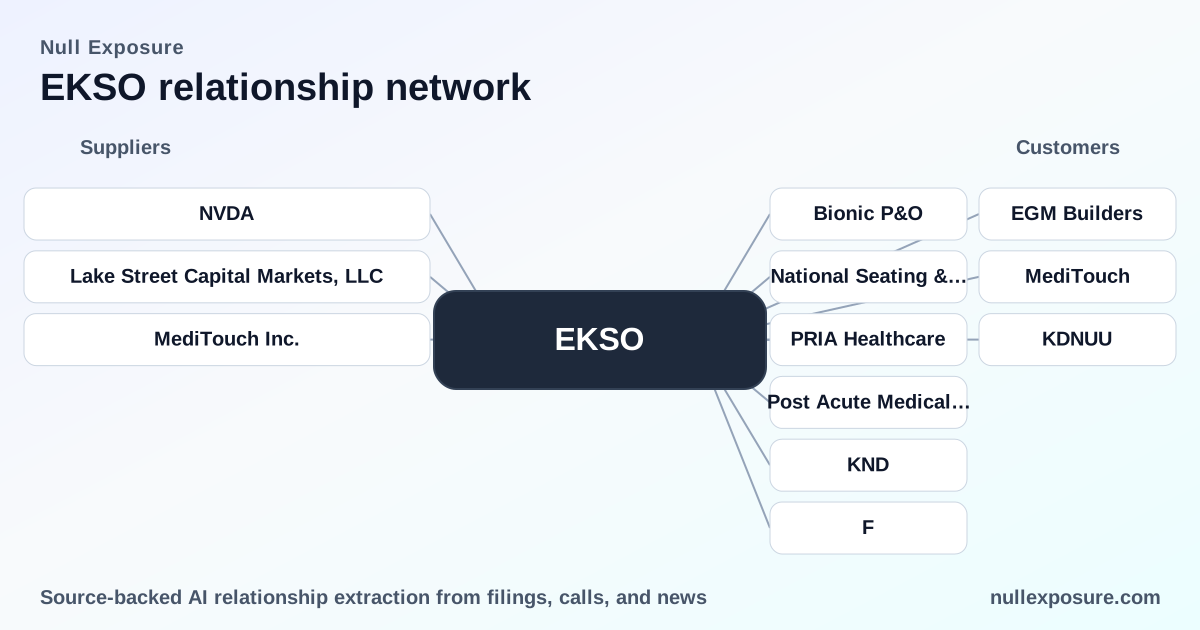
Ekso Bionics: the supplier map investors need to price operational risk
Ekso Bionics designs, sells and rents clinical and industrial exoskeletons and captures revenue through device sales, recurring rental/service contracts, and distribution agreements that extend product reach. The business combines product revenue with capital raises and placement-driven financing, so supplier and partner durability materially influences delivery, margins and capital efficiency. For a fast operational read, see the supplier relationships below and the company-level constraints that drive contracting posture and concentration.
Discover more supplier intelligence at https://nullexposure.com/.
How Ekso makes money and why suppliers matter
Ekso monetizes primarily through three streams: device sales, therapy and rental contracts, and distribution/authorization agreements that expand market access without large incremental capex. Gross margins are positive but operating metrics show losses: Ekso reported roughly $12.8 million in trailing twelve‑month revenue and negative operating margins in its latest filings, which creates sensitivity to supplier terms and placement financing. Suppliers who provide manufacturing, licensing or distribution capabilities are therefore critical for product delivery, time to revenue, and capital conservation.
The partners and suppliers that show up in public records
Below I cover every relationship surfaced in the public record for supplier scope; each entry includes a plain-English summary and a compact source note.
NVIDIA — selective technology partnership
Ekso joined the NVIDIA Connect program in mid‑May as part of a selective cohort of medical device companies, indicating a strategic technology or software collaboration channel for advanced compute or AI-enabled features. According to Ekso’s 2025 Q2 earnings call, the company announced membership in the NVIDIA Connect program in mid‑May 2025.
Lake Street Capital Markets, LLC — exclusive placement agent for multiple raises
Lake Street acted as the exclusive placement agent for both an at‑the‑market registered direct offering in October 2025 and a subsequent private placement in late 2025/early 2026, running the company’s capital raises. GlobeNewswire reported the Oct 29, 2025 registered‑direct offering naming Lake Street as exclusive placement agent, and follow‑on reporting in January 2026 (Manila Times quoting GlobeNewswire and a QuiverQuant notice) confirms Lake Street’s role on private placement activity.
MediTouch Inc. — exclusive U.S. distributor for BalanceTutor
Ekso executed an exclusive authorized‑sales agent and distribution agreement with Israel‑based MediTouch to distribute the BalanceTutor rehabilitation system across the United States, broadening its clinical product portfolio and route to market. This agreement was announced via GlobeNewswire on December 4, 2025.
What the disclosed constraints say about Ekso’s operating model
The filings and excerpts reveal consistent themes about Ekso’s contracting posture, supply chain footprint, and maturity profile. These are company‑level signals unless a constraint explicitly names a third party.
-
Long‑term licensing posture (relationship maturity): Ekso holds long‑dated license commitments related to university IP, with terms extending decades (license terms running into 2038 and 2041 in disclosed agreements). The company explicitly documents minimum annual royalties and multi‑decade duration, which signals a mature IP position but also long‑dated cash commitments. (Evidence: license agreement excerpts in company notes.)
-
Contract manufacturing and geographic spread (criticality and concentration): Ekso uses third‑party contract manufacturers; the EVO product line is manufactured in Malaysia, and production transfers for Indego lines were planned to a U.S. contract manufacturer by early 2025. This dual‑site contract manufacturing approach reduces single‑site risk but creates operational dependence on external manufacturers in APAC and the U.S. (Evidence: manufacturing excerpts citing Malaysia and planned U.S. transfer.)
-
Supplier role mix (contracting posture): The company is both a licensee of university technologies and a buyer of components and contract manufacturing services. That combination increases the complexity of supplier contracting: royalty and IP obligations sit alongside outsourced production agreements. The Vanderbilt license language in company filings confirms exclusive rights managed through license agreements.
-
Spend magnitude and near‑term obligations (maturity/concentration): Purchase obligations disclosed were modest in absolute terms — approximately $1.263 million of near‑term purchase obligations as of December 31, 2024 — suggesting operational spend with suppliers is material to execution but not outsized relative to revenue. These obligations point to predictable working‑capital cash outflows tied to inventory and manufacturing services. (Evidence: notes to consolidated financial statements.)
Why these relationships matter to investors and operators
-
Capital structure reliance on placement agents: Lake Street’s recurring role as exclusive placement agent underlines Ekso’s reliance on capital markets for liquidity and growth funding, elevating execution risk if market access tightens. Investors should price the cost and cadence of capital raises into valuation.
-
Technology partnerships can lift differentiation: Participation in NVIDIA’s Connect program positions Ekso to integrate advanced compute or software enhancements that can support higher‑value therapy features and recurring service revenue. Strategic tech partners can expand addressable market without heavy capex.
-
Distribution agreements extend commercialization without manufacturing scale: The MediTouch distribution deal is a low‑capex path to expand clinical offerings, useful for improving utilization of sales channels and increasing recurring therapy revenue.
-
Outsourced manufacturing limits fixed capital but raises supplier dependency: Contract manufacturing in APAC and planned U.S. transfers reduce Ekso’s factory capex but also create operational reliance on third parties for quality and delivery. Operational continuity depends on contract terms, quality control and alternative sourcing options.
For operators conducting vendor due diligence, prioritize:
- verified contingency plans for contract manufacturers,
- clarity on royalty escalation and minimums in license documents,
- and the financial terms under which placement agents execute raises.
If you want a structured supplier risk brief for Ekso — including contract expiration overlays and counterparty concentration — start here: https://nullexposure.com/.
Bottom line: how to weight Ekso’s supplier risk in a thesis
Ekso shows a hybrid model: asset‑light manufacturing via partners, long‑dated IP licensing obligations, and market financing executed through dedicated placement agents. That mix supports capital efficiency and product breadth, but creates leverage to third‑party manufacturing and capital markets. For investors, the primary questions are whether Ekso can convert distribution deals into repeatable revenue and whether capital raises (managed by Lake Street) remain available on acceptable terms.
For operators, key actions are contingency sourcing for APAC production lines and rigorous monitoring of royalty and license payment schedules. Ekso’s public disclosures give enough visibility to quantify these risks; investors should incorporate supplier continuity and placement capacity into near‑term liquidity stress tests.
Explore more supplier and counterparty intelligence at https://nullexposure.com/ — get tailored briefings, counterparty timelines, and obligation roll‑ups to support investment and operational decisions.