Estee Lauder: supplier posture, competitive set, and what it means for investors
Estee Lauder Companies Inc. operates a global portfolio of prestige skincare, makeup, fragrance and haircare brands and monetizes through wholesale retail distribution and direct-to-consumer digital channels. The business drives margin capture from brand strength and channel mix: FY-TTM revenue of $14.67B and gross profit of $10.90B, supported by a market capitalization around $32.1B. For investors and operators evaluating supplier exposure, the critical questions are payment terms, spend concentration and how named competitors and partners influence sourcing and distribution strategies. For an integrated view of counterparties and their implications, see the full platform at https://nullexposure.com/.
How Estee Lauder buys and pays: short contracts and mid-range obligations
Estee Lauder discloses supplier program mechanics that reveal a short-term contracting posture: supplier invoices confirmed under its programs require payment in full within 90 days of invoice date, which enforces a transactional, working-capital driven relationship with product and service vendors. The company also reports confirmed obligations outstanding of $82 in the context of a spend band placed between $10m–$100m, signaling a set of supplier relationships that are material at the program level but not concentrated at the single-vendor mega-supplier scale.
Those two signals produce a clear operating model profile:
- Contracting posture: short-term, invoice-driven arrangements that are optimized for cash conversion rather than long-term supplier lock-ins. This reduces supplier dependency but increases the importance of reliable logistics and timely payments.
- Spend concentration: the spend band points to mid-sized commitments rather than large single-source contracts; procurement leverage exists but is dispersed across many counterparties.
- Criticality and maturity: supplier relationships are operationally critical (finished goods and packaging) but structurally mature and transactional rather than partnership-driven — vendors are important for execution but not usually strategic co-innovators.
These company-level signals are drawn directly from the FY2025 Form 10‑K disclosures and accompanying program descriptions; use them as a framework when assessing supplier risk, working capital volatility, and renegotiation potential. If you want an interactive map of counterparties and exposure analytics, visit https://nullexposure.com/ for the supplier dossier.
Competitors and partners investors should track
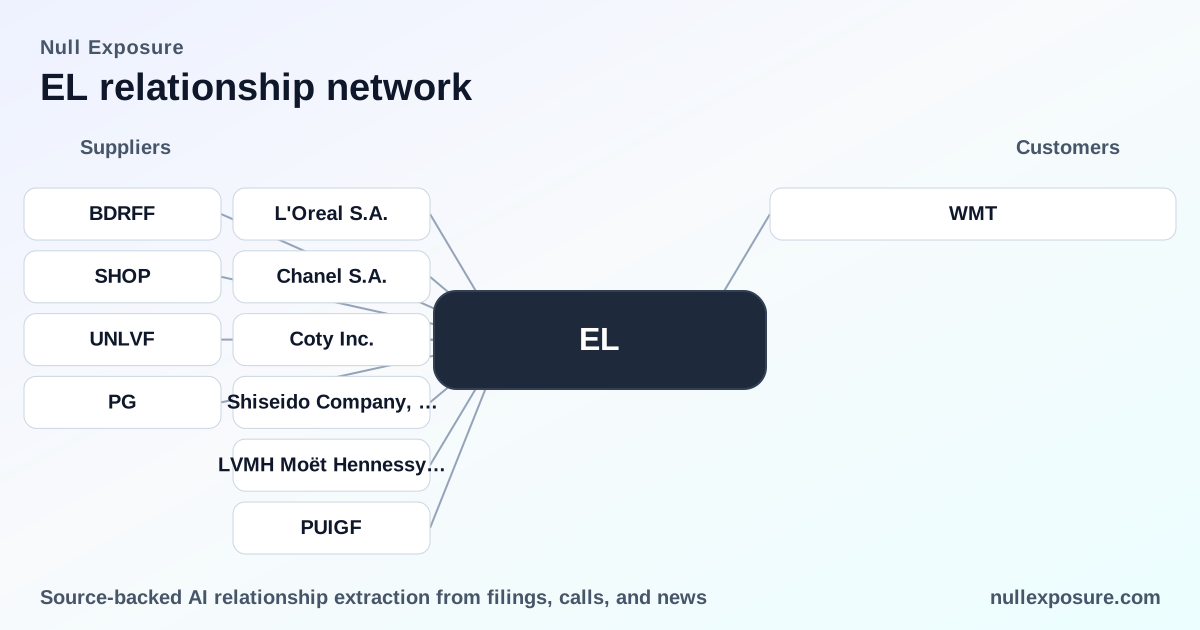
Below I list every relationship called out in the public results set and what each relationship implies for procurement, pricing power and market positioning.
-
L’Oreal S.A. — Estee Lauder identifies L’Oreal as a principal competitor in prestige beauty, which pressures pricing, marketing spend and shelf placement dynamics in global retail channels. According to Estee Lauder’s FY2025 Form 10‑K, L’Oreal is explicitly listed among the company’s competitors (FY2025 10‑K).
-
Chanel S.A. — Chanel is named as a competitor in luxury fragrance and skincare, reinforcing premium positioning battles and selective retail placements that affect distribution agreements and trade promotions. Estee Lauder lists Chanel in its FY2025 10‑K competitive overview (FY2025 10‑K).
-
Coty Inc. — Coty is called out among peers in fragrance and color cosmetics, which influences co-op marketing demands and category-level trade terms with department stores and specialty retailers. The FY2025 10‑K includes Coty in the company’s competitor roster (FY2025 10‑K).
-
Shiseido Company, Ltd. — Shiseido’s inclusion highlights competition in Asia‑Pacific and premium skincare, areas that drive supply-chain localization and ingredient sourcing strategies. Estee Lauder names Shiseido in the FY2025 10‑K (FY2025 10‑K).
-
LVMH Moët Hennessy Louis Vuitton — LVMH’s beauty brands are direct competitors at the luxury end; this intensifies requirements for premium packaging supply and exclusive retail deals. Estee Lauder identifies LVMH in its FY2025 10‑K competitor list (FY2025 10‑K).
-
Puig (PUIGF) — Puig is cited among competitors and is relevant for regional fragrance market share and distribution partnerships; the filing includes Puig by name and the record links an inferred ticker (PUIGF) in the relationship extraction (FY2025 10‑K).
-
Beiersdorf (BDRFF) — Beiersdorf’s mention signals competition in skincare at certain price points and reinforces the importance of ingredient sourcing and contract manufacturing. The FY2025 10‑K lists Beiersdorf among competitors and an inferred symbol appears in the relationship data (FY2025 10‑K).
-
Shopify (SHOP) — A news report connects Estee Lauder to a new Shopify partnership supporting digital distribution and social commerce; this shifts supplier focus toward digital-service providers and logistics partners that support direct-to-consumer growth. A TradingView news note (March 9, 2026) highlighted the new Shopify partnership as a driver for digital expansion (TradingView news, Mar 2026).
-
Unilever (UNLVF) — Unilever’s inclusion reflects competition on global distribution platforms and multi-brand shelf strategies; Unilever’s scale pressures trade terms and promotional allowances across supermarket and drug channels. Estee Lauder names Unilever in the FY2025 10‑K (FY2025 10‑K).
-
Procter & Gamble (PG) — P&G’s presence among competitors points to competition for mass-market and premium channels where scale and supply-chain efficiency determine margin outcomes. The FY2025 10‑K lists Procter & Gamble in the competitor set (FY2025 10‑K).
Each of these relationships is stated explicitly in the company’s FY2025 disclosure or in contemporaneous market reporting; together they frame where procurement pressure will come from—channel competition, premium packaging needs, and digital distribution services.
For an inventory-level view of these counterparties and to correlate them with contract terms, check https://nullexposure.com/.
What investors should infer and actions to take
The combination of short payment terms and mid-sized confirmed obligations produces a supplier profile that favors operational agility over strategic vendor lock-in. From an investor and operator perspective:
- Risk: Working-capital swings are the primary supplier risk. Short payment windows reduce long-term vendor exposure but increase the sensitivity of cost-of-goods to payment timing and cash management.
- Negotiation leverage: Estee Lauder retains negotiating power because spend is dispersed across many competitors and suppliers; procurement should focus on volume bundling for packaging and logistics to compress unit costs.
- Opportunity: The Shopify partnership pushes more revenue through direct channels, which allows the company to bypass some wholesale trade promotions and reclaim margin; that shifts supplier spend toward digital services and fulfillment partners.
Bold takeaway: Estee Lauder runs a transactional, mid-sized supplier footprint with tight payment discipline; procurement upside lies in consolidating packaging and logistics vendors while monitoring margin benefits from digital DTC expansion.
If you want tailored supplier-risk scenarios or a counterparty heatmap for diligence, start here: https://nullexposure.com/.
Bottom line
Estee Lauder’s FY2025 disclosures reveal a business that monetizes premium brands across retail and digital channels while managing suppliers through short-term, mid-sized contractual commitments. Investors should treat supplier exposure as an operational lever—one that affects working capital volatility and margin capture—rather than a systemic concentration risk. For a deeper supplier-by-supplier analysis and to map how each named competitor and partner ties back to procurement and distribution, visit https://nullexposure.com/.