Envela Corp (ELA) — Supplier relationships and what they mean for investors and operators
Envela operates a vertically integrated retail and wholesale jewelry business that monetizes by buying physical precious metals and jewelry from individuals and wholesalers, refurbishing or re‑setting inventory through its DGSE and Four Nines retail channels, and reselling across domestic retail and institutional channels. The company converts trade‑ins, buybacks, closeouts and bullion purchases into gross margin while capturing value through downstream retail distribution and liquidation. For a direct look at supplier posture and sourcing activity, visit https://nullexposure.com/.
Why supplier relationships matter for Envela’s model
Envela’s P&L is driven by inventory turn and the spread between acquisition cost and retail resale. Supplier relationships are the operational lifeblood — they determine inventory quality, cost of goods sold, and the speed at which DGSE and Four Nines can replenish shelves. The company’s most useful signals for counterparties and buyers are these firm-level sourcing behaviors:
- Counterparty composition: Envela sources heavily from individuals through in‑store buying programs and transaction-level buys, which brings a high volume of SKUs and variable quality but also strong margin capture on unique pieces.
- Geographic footprint: All product sourcing and sales are domestic, limiting cross‑border supply chain risk and simplifying regulatory compliance.
- Relationship posture: Envela functions primarily as a buyer in the supply chain — it does not depend on a narrow set of upstream manufacturers; rather, it aggregates heterogeneous supply from consumers, closeouts and secondary markets.
- Role criticality: Sourcing is a core product activity and is actively managed across the company’s retail footprint.
These characteristics produce an operating profile where inventory acquisition agility and retail distribution density are the primary levers of growth and risk management, rather than long‑term supplier contracts or large OEM dependencies. For more on supplier risk and disclosure-driven exposure, see https://nullexposure.com/.
The Kretchmer deal: what was announced and why it matters
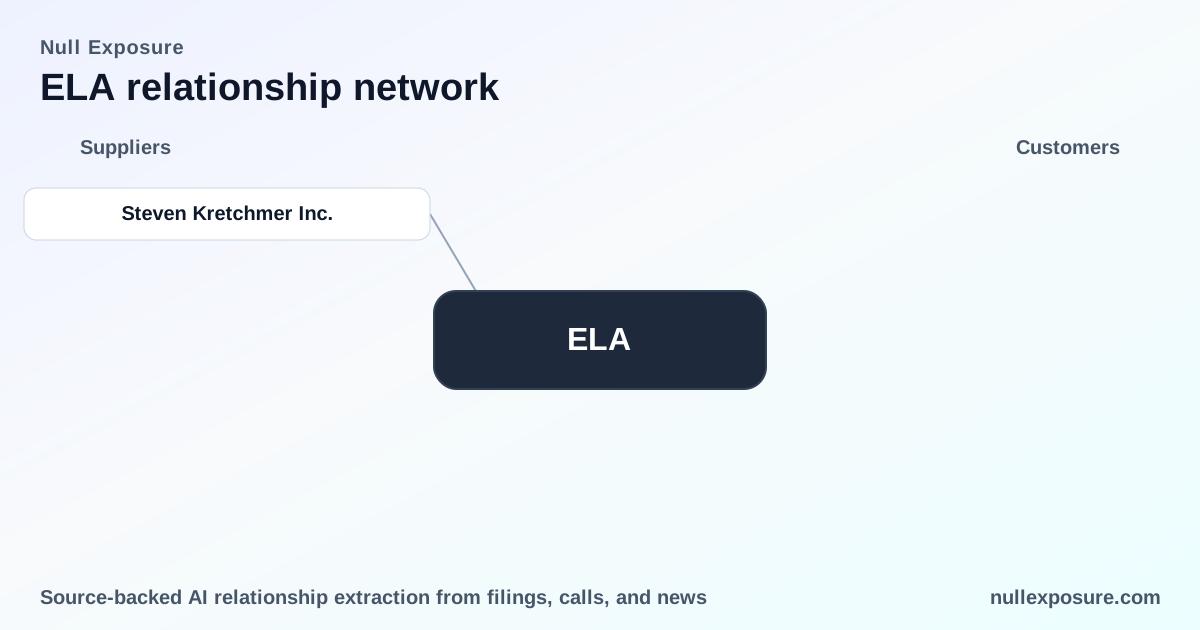
Steven Kretchmer Inc. — Following Envela’s acquisition of Steven Kretchmer Inc., the company’s DGSE subsidiary plans to distribute Kretchmer product through its Four Nines retail chain, integrating Kretchmer’s designs into Envela’s retail assortment. According to JCK Online (March 2026), DGSE intends to sell Kretchmer product at Four Nines as part of the acquisition integration.
This relationship is a simple, high‑visibility roll‑out of acquired inventory into existing retail channels, designed to accelerate monetization of acquired intellectual property and finished goods while expanding Four Nines’ product offering to higher‑end or designer SKUs.
Source: JCK Online editorial coverage of the transaction and integration plans (March 2026).
What each disclosed relationship implies for investors and operators
The Kretchmer transaction illustrates Envela’s playbook: acquire niche inventory or brand assets, and convert them quickly into retail sales using owned distribution. That strategy emphasizes speed to market and retail margin capture rather than long‑term supplier lock‑ins.
Operational and financial signals to consider:
- Concentration and insider ownership: With insiders controlling a large share of stock, strategic decisions around acquisitions and channel allocation move quickly; that governance dynamic accelerates execution but concentrates decision risk.
- Margin mechanics: Envela’s revenue of $208.8M and gross profit of $48.6M show a retail operation with modest absolute scale but a need for continued inventory refresh to sustain gross margins (profit margin roughly 4.9% and operating margin 7.3%).
- Valuation context: The company trades at an EV/EBITDA of ~20x, implying the market prices consistent execution and growth from retail channels or persistent margin expansion.
- Sourcing maturity: The combination of in‑store buybacks, trade‑ins and secondary market purchases indicates a mature, repeatable sourcing engine with predictable flow characteristics rather than one‑off supplier negotiations.
These elements create a supplier posture that is active, domestically oriented, buyer‑led and core to the business model. For investors focused on supply risk, this translates into lower geopolitical risk but higher operational dependence on retail traffic, appraisal accuracy, and inventory markdown control.
Practical takeaways for counterparty managers and procurement teams
For operators structuring supplier and acquisition strategies, the Envela profile suggests these tactical priorities:
- Prioritize domestic logistics and appraisal workflows to preserve margin between acquisition and resale.
- Build fast integration plans for acquired brands or inventories so that DGSE/Four Nines can monetize stock in existing retail windows.
- Monitor inventory aging metrics and SKU profitability closely; the business converts acquisitions into cash only if retail turn is sustained.
If you’re tracking buyer-led commodity flows or need a supplier intelligence vantage into how retail rollouts affect pricing and retail mix, examine current channel utilization and the speed of acquired product placement at point of sale. To explore structured supplier exposure analysis, go to https://nullexposure.com/.
Compliance, sourcing quality and operational risks
Envela’s domestic sourcing model reduces cross‑jurisdictional compliance burdens but elevates operational execution risk: appraisal accuracy, refurbishment throughput, and retail markdown discipline determine gross margin. The company’s buyer role and heavy use of in‑store buying programs increase exposure to variable product quality that must be managed through tight inspection and reconditioning workflows. That operational focus is consistent with the company’s classification of core product sourcing as active and central to revenue generation.
Financially, the firm’s modest profit margins and a relatively elevated EV/EBITDA multiple mean that sustained improvement in inventory yield or expansion of higher‑margin product lines (for example, integrated brands like Kretchmer) will directly affect valuation outcomes.
Bottom line and action items
Envela’s supplier posture is domestic, buyer‑centric, and operationally integrated with its retail platform. The Kretchmer acquisition is a representative case: Envela acquires product/brand assets and routes them through DGSE and Four Nines to capture retail margin and accelerate cash conversion. For investors and operators, the core monitoring signals are retail turn, inventory yield per acquisition dollar, and the company’s ability to scale proprietary brand placements without diluting margins.
If your mandate includes counterparty risk or supplier strategy in retail jewelry and bullion, review Envela’s sourcing cadence, integration playbooks and retail sell‑through metrics. For further supplier exposure and relationship intelligence, visit https://nullexposure.com/.
Bold takeaway: Envela’s value proposition is execution‑driven — it converts dispersed inventory sources into retail margin; governance concentration and operational execution speed are the primary investment levers.