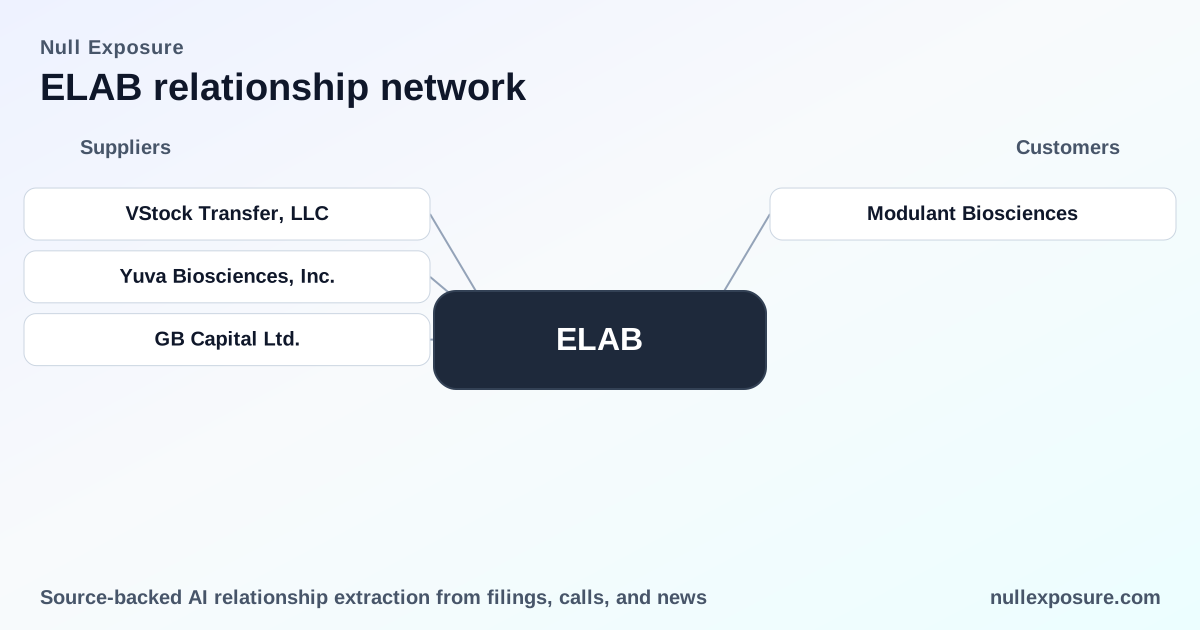
Elevai Labs (ELAB) — supplier map and what it means for investors
Elevai Labs, traded as ELAB, operates at the intersection of AI and life sciences by licensing AI-enabled discovery platforms and partnering with biotech and engineering service providers to commercialize assets. The company monetizes through licensing deals, strategic acquisitions, advisory engagements and by contracting third-party manufacturers and service providers to scale product candidates — a capital-light model that translates intellectual property and partnerships into revenue while outsourcing manufacturing and certain operational functions.
For a concise, investor-focused supplier risk report and ongoing monitoring, visit https://nullexposure.com/.
How the supplier set shapes ELAB’s operating posture
ELAB’s supplier footprint signals a hybrid operating model: intellectual-property centric and heavily dependent on third-party execution. Public filings and news releases show multiple long-tenor license agreements and short leases for facilities, indicating a mix of durable IP commitments and flexible operational leases. The company discloses explicit reliance on outside manufacturers, CROs and consultants for R&D and commercialization, which makes supplier performance directly material to clinical and go‑to‑market timelines.
- Contracting posture: A combination of long-term IP licenses (multi-year, often 10-year) alongside short-term facility leases creates both stickiness in technology access and operational flexibility in physical footprint.
- Concentration and criticality: The business model delegates manufacturing and development to partners; those providers are mission‑critical for clinical progress and commercial readiness.
- Maturity and spend: Evidence of seven‑figure license consideration and IPR&D purchase prices places certain supplier engagements in the $1M–$10M spend band, which is meaningful versus ELAB’s modest market capitalization.
These signals are company-level and govern counterparty diligence for any investor or operator evaluating supplier exposure.
Supplier and partner roster investors need to know
VStock Transfer, LLC
VStock Transfer serves as ELAB’s transfer agent and is the designated intermediary for shareholders holding physical certificates, including exchanges tied to corporate actions such as the reverse stock split announced in early 2026. According to company communications and press releases related to the reverse split, shareholders were instructed to exchange certificates through VStock Transfer (see a GlobeNewswire release, 2026-01-06: https://www.globenewswire.com/news-release/2026/01/06/3213298/0/en/PMGC-Holdings-Inc-Announces-Reverse-Stock-Split-Effective-January-6-2026.html and related notices cited on Bitget and SahmCapital in March 2026).
Yuva Biosciences, Inc.
Yuva Biosciences is a development partner under a Development and License Agreement with a PMGC Holdings subsidiary (NorthStrive Biosciences) to progress ELAB’s AI-driven drug discovery program into Phase III. The collaboration is framed as a licensed development path for multiple potential drug compounds and was announced in December 2025 (GlobeNewswire, 2025-12-17: https://www.globenewswire.com/news-release/2025/12/17/3206902/0/en/NorthStrive-Biosciences-Advances-to-Phase-III-of-AI-Driven-Drug-Discovery-Program-Toward-Validation-of-Multiple-Potential-Drug-Compounds-Discoveries.html).
GB Capital Ltd.
GB Capital acted as a strategic finance and advisory co-advisor to ELAB in connection with the acquisition of SVM Machining, a precision CNC machining company; the advisory role supported a strategic acquisition that expands operational capabilities related to manufacturing or services (ManilaTimes/GlobeNewswire coverage, February 2026: https://www.manilatimes.net/2026/02/13/tmt-newswire/globenewswire/gb-capital-ltd-co-advises-on-the-acquisition-of-svm-machining-inc/2277614).
What these relationships imply for credit, operations and underwriting
- Transfer agent relationship (VStock) is operational but administrative — critical for shareholder servicing and corporate actions. Confirm operational continuity, disaster recovery and certificate-handling SLAs before underwriting equity-linked instruments.
- Licensed development partnerships (Yuva Biosciences) drive the value chain; long-term licensing creates revenue optionality but also concentrates program execution risk in counterparty performance and milestone timing. Confirm milestone definitions, commercial rights and termination triggers.
- Advisory and acquisition partners (GB Capital and acquired vendors like SVM) indicate a growth-through-acquisition posture that shifts ELAB’s vendor mix into capital and services procurement, elevating vendor diligence on supply chain certifications, especially when acquiring ISO-certified manufacturers.
Financial context intensifies these supplier risks: ELAB shows a small market capitalization (~$2.6M) with negative EBITDA and high revenue-per-share volatility, which raises the importance of supplier credit protections, milestone-driven payments and options to reassign or replace critical suppliers if cash constraints tighten.
For operational monitoring and supplier risk dashboards tailored to small-cap life‑science companies, see https://nullexposure.com/.
Practical next steps for investors and operators
- Contracting: Insist on performance milestones, escrow or milestone‑linked payments in licensing and development agreements to protect cash and create exit ramps.
- Supplier resilience: Verify third-party manufacturing certifications, capacity commitments and contingency plans, especially for ISO‑rated suppliers acquired through M&A.
- Shareholder servicing: Validate transfer agent SLAs and certificate reconciliation processes ahead of corporate actions to avoid post-split settlement friction.
- Monitoring: Build a watchlist for any supplier that sits in the $1M–$10M exposure band and is critical to regulatory milestones.
For bespoke supplier diligence and to subscribe to timely supplier relationship alerts, visit https://nullexposure.com/.
Final takeaways
ELAB’s model converts AI and IP into partner-driven execution — a capital-efficient approach that makes supplier agreements the practical levers of value creation. Investors must treat licenses, transfer agent operations and manufacturing/advisory engagements as first-order risks and require contractual, operational and financial mitigants given the company’s modest capitalization and negative profitability. For disciplined monitoring and supplier risk scoring aligned to small-cap biotech/AI companies, return to https://nullexposure.com/ for tools and reports.