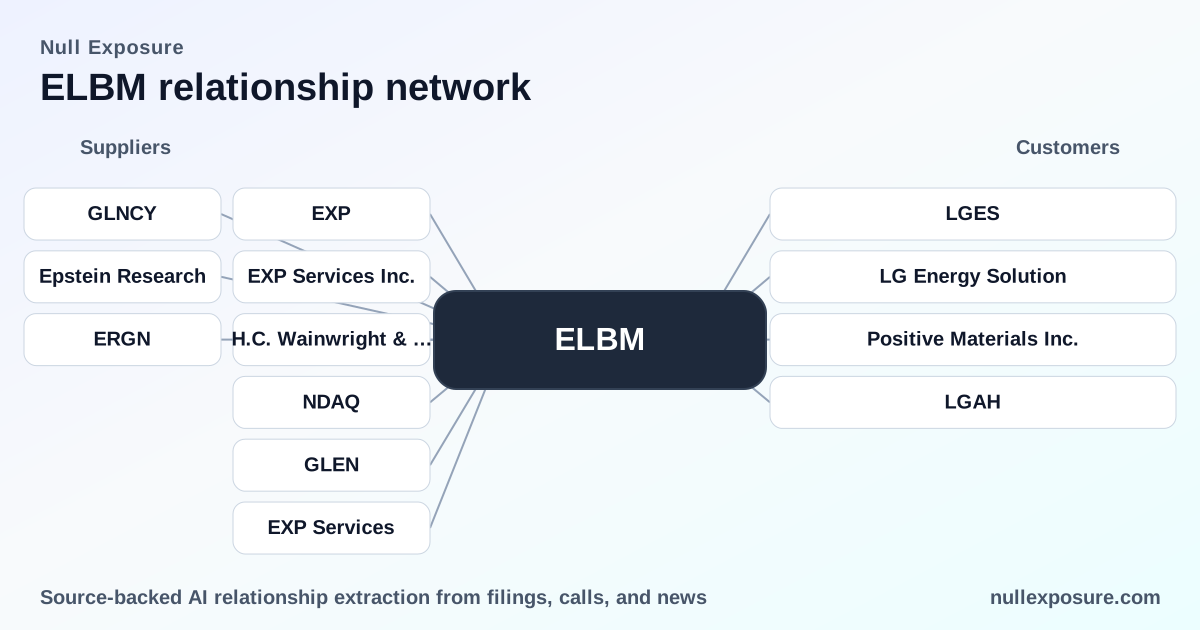
Electra Battery Materials (ELBM): Supplier relationships that shape a North American cobalt refinery
Electra Battery Materials operates as a processor and developer of battery materials, building a cobalt sulfate refinery in Ontario and monetizing through processing fees and sales of refined cobalt sulfate and related battery chemicals once the plant reaches commercial operation. The company finances project delivery with equity programs and short-term contracts with engineering, feedstock and market-facing partners; its path to cash flow depends on execution of construction, securing feedstock, and managing dilution from capital raises. For deeper diligence on counterparties and supply-chain exposure, visit https://nullexposure.com/.
How Electra’s operating model translates into supplier dependence
Electra is a pure processor rather than an integrated miner‑refiner: it will buy concentrate from third-party producers, build refining capacity, and sell refined product. That model creates predictable supplier and contractor linkages:
- Contracting posture: Electra outsources core delivery functions—engineering, project management, and construction management—to external firms while maintaining an internal owner’s team, which concentrates execution risk in a few large vendor relationships.
- Supply concentration: Feedstock sourcing is anchored to established global traders and producers, which reduces sourcing friction but creates exposure to the commercial terms and geopolitical realities of large suppliers.
- Commercial criticality: Refinery throughput and margin capture depend on secured concentrate supply and a reliable construction schedule; delays or feedstock shortfalls directly impair revenue generation.
- Maturity signal: Electra reports zero revenue TTM and negative EBITDA, underlining that this is a construction‑stage processor where supplier commitments drive value realization.
These operating characteristics should guide how investors evaluate counterparties, contract terms and financing cadence. See more vendor intelligence at https://nullexposure.com/.
Who Electra is contracting with now — the full relationship map
Below are every counterparty mentioned in public reports and filings in our coverage window, each with a concise summary and a primary source reference.
EXP / EXP Services Inc. — engineering, project and construction management
Electra awarded EXP a US$6.1 million (C$8.3 million) contract for engineering, project management and construction management at the Ontario refinery and is running construction under a joint EPCM framework led by EXP in collaboration with Electra’s owner’s team. According to GlobeNewswire and company press releases (Feb 3 and Feb 17, 2026), EXP is the principal delivery partner for the construction phase.
H.C. Wainwright & Co., LLC — at‑the‑market equity placement agent
Electra established and later upsized an At‑The‑Market (ATM) equity program with H.C. Wainwright, which will distribute share sales on Electra’s behalf and receive a cash commission (reported as 3.0% on ATM proceeds). The arrangement and upsizing were announced in December 2025 and February 2026 filings and press releases, with The Globe and Mail and GlobeNewswire documenting the Form 6‑K and the expanded US$25 million program.
Nasdaq Stock Market LLC — trading venue for ATM placements
Sales under the prospectus are intended to be executed directly on or through the Nasdaq Stock Market as part of the ATM process, providing Electra with an on‑market execution channel for equity raises (SahmCapital / company communications, Dec 2025).
Glencore — feedstock supplier and trading counterparty
Electra has stated feedstock supply arrangements with Glencore among other major cobalt producers and traders, positioning Glencore as a key supplier/counterparty for concentrate that will feed the Ontario refinery (SahmCapital, Markets Business Insider and Finviz coverage of Electra’s February 2026 project update).
ERG — western concentrate relationship
Electra has also established relationships with ERG as a western concentrate supplier, reflecting an explicit commercial link to Western producers for cobalt feedstock (CruxInvestor reporting, FY2025 commentary).
Epstein Research — marketing and investor engagement services
Electra engaged Epstein Research for awareness and content services under a short-term paid agreement: a three‑month engagement beginning Feb 1, 2026 for US$7,500 in aggregate (US$2,500 per month), to support investor outreach and media content (GlobeNewswire and InvestingNews, Feb 2026).
Mid‑article note: actionable next steps
If you are evaluating supplier risk, prioritize review of the EXP contract scope, feedstock offtake letters with Glencore/ERG, and the ATM mechanics with H.C. Wainwright. For consolidated counterparty intelligence and contractual red‑flag screening, see https://nullexposure.com/.
Strategic implications and risk checklist for investors and operators
Electra’s relationships outline a clear set of strategic dependencies:
- Execution risk concentrated in a single EPCM lead (EXP). Construction delays or scope changes under the EXP framework will directly affect capital timing and ramp to revenue; monitor milestone payments and change orders reported in subsequent releases.
- Feedstock concentration with major traders (Glencore, ERG) creates commercial and geopolitical exposure; pricing, availability and treatment of concentrate grades will drive margin capture once the refinery is operational.
- Funding dependence on ATM equity increases dilution risk. Electra’s ATM with H.C. Wainwright and the Nasdaq execution pathway give management flexibility to raise capital, but that flexibility translates into equity issuance risk for existing holders.
- Early‑stage financial profile: Electra lists RevenueTTM = 0 and EBITDA = -$13.1M, and Market Capitalization ≈ $67.3M, underscoring that supplier relationships are the primary value drivers until commercial production begins.
Use these signals to stress‑test scenarios: contractor delay, feedstock price shocks, and equity dilution all map back to the relationships detailed above.
Bottom line for investors and operators
Electra’s commercial model is simple: build a North American refinery, secure concentrate from major traders, and sell refined product. The company’s value trajectory is tightly linked to three levers — execution under EXP, feedstock supply from Glencore/ERG, and financing via its ATM with H.C. Wainwright. Active monitoring of counterparties, advance offtake terms, and construction milestones will provide the clearest short‑term indicators of risk and reward. For ongoing supplier and counterparty monitoring tools tailored to deal teams, visit https://nullexposure.com/.
Key takeaway: Electra is a construction‑stage processor whose commercial outcome is determined more by supplier and contractor integrity than by market demand for refined cobalt; investors should underwrite counterparty exposures before sizing positions.