Ellomay Capital (ELLO): Supplier Map and What It Means for Investors
Ellomay Capital operates as a project developer and asset owner in renewable energy across Israel, Spain and the Netherlands, monetizing through controlling equity stakes in special-purpose vehicles (SPVs) that build, operate and sell clean power. Revenue flows come from asset-level electricity sales and ancillary contracts while capital events—project financings, strategic EPC and supply contracts, and asset commissioning—drive value realization. For investors and operators, the critical lens is straightforward: Ellomay is a project-centric owner that outsources engineering, construction and critical equipment to tier-one vendors, then captures long-term cashflow through ownership and operational contracts.
Explore supplier risk and counterparty exposure across Ellomay’s portfolio at https://nullexposure.com/.
Company snapshot and financial posture every buyer should know
Ellomay is a small-cap utility player with a portfolio management profile rather than an integrator model. The firm reports market capitalization of about $352 million and trailing revenue of $41.1 million, with EBITDA of roughly $13.8 million. Profitability metrics show pressure—EPS is negative (-$0.07) and operating margin is nearly flat (about 1.18%)—consistent with a company that is mid-cycle in asset development and integration. Balance and capital structure details reflect a portfolio with project financings and outside investors in individual assets rather than a fully vertically integrated manufacturer or contractor.
Key takeaways for investors: Ellomay’s value is asset-driven and dependent on the performance of third-party constructors, module suppliers and O&M providers, not on proprietary manufacturing or long-term captive supply chains.
Who Ellomay is contracting with — the suppliers in public view
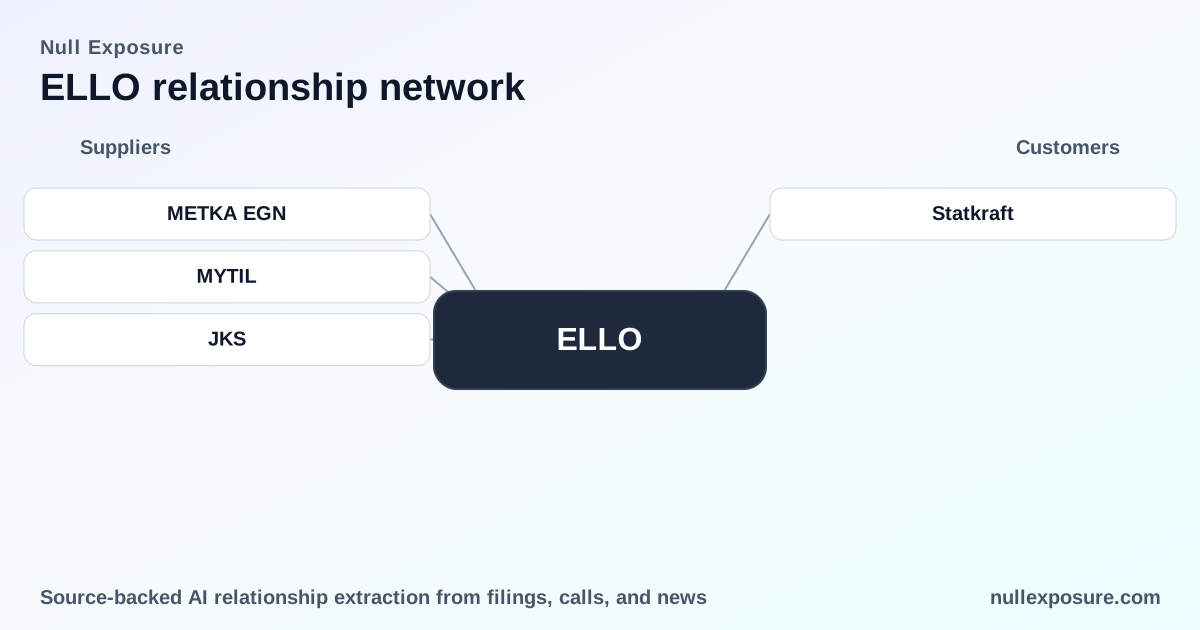
The public record identifies three supplier relationships that clarify how Ellomay executes projects and secures equipment and services.
-
METKA EGN: METKA EGN secured a notice to proceed on construction for the 300 MW Talasol PV project after financial close, and later achieved mechanical completion while being contracted to provide two years of operation and maintenance services for the plant. This is a classic EPC + short-term O&M engagement that shifts construction and early operations risk to a contractor. — TaiyangNews, March 2026.
-
Mytilineos: Ellomay Solar engaged Mytilineos’ Renewables and Storage Development unit to perform engineering, procurement and construction (EPC) for a 28 MW solar project in Spain, reflecting a pattern of awarding country-level EPC contracts to established regional constructors. — eKathimerini, March 2026.
-
JinkoSolar: Ellomay’s Talasol project deployed ultra‑high efficiency Cheetah modules supplied by JinkoSolar, confirming Ellomay’s reliance on large Tier‑1 module suppliers for megawatt-scale projects and the company's approach of combining international equipment vendors with regional EPCs. — TaiyangNews, March 2026.
Each relationship underscores Ellomay’s operating model: project ownership through SPVs, third-party EPCs to execute construction, and global module suppliers to meet scale and performance requirements.
What these partnerships say about Ellomay’s contracting posture and operational constraints
Ellomay’s public supplier footprint communicates a deliberate contracting posture: asset ownership with outsourced execution and near-term operational handoff. The company routinely uses SPVs (project companies) and secures financial closure before engaging EPCs and module vendors—an arrangement that reduces Ellomay’s direct construction workload while concentrating counterparty performance risk.
Company-level signals from the relationship set:
- Concentration: Supplier relationships are project-specific rather than enterprise-wide master-supplier arrangements; this reduces single-vendor concentration across the portfolio but increases transaction-level dependency on EPC and module performance.
- Criticality: EPCs and module suppliers are operationally critical—construction timelines, mechanical completion and O&M handoffs materially affect commissioning dates and cashflow generation.
- Maturity: The use of established contractors and Tier‑1 modules signals a mature procurement strategy for utility-scale projects, where bankability and supplier track record are prioritized.
- Contract posture: Short-term O&M windows (for example, two years with METKA EGN) indicate Ellomay prefers flexibility in long-term asset operations, likely shifting to specialized O&M providers or in-house teams after initial warranty periods.
These are company-level signals rather than constraints tied to any single supplier.
Risk profile for investors and operators
Ellomay’s model generates concentrated operational risk around a small set of supplier roles:
- Counterparty execution risk: Construction delays or missed guarantees from EPCs directly defer revenue and increase cost. Awarding EPCs like Mytilineos and METKA EGN demonstrates reliance on established contractors to mitigate that risk, but execution risk remains project-level critical.
- Equipment and warranty risk: Dependence on global module suppliers such as JinkoSolar reduces technology risk but ties asset performance to module quality and supply continuity.
- Contract maturity and replacement risk: Short O&M contracts can create transition risk once initial provider terms expire; operators must budget for handover and potential reprocurement.
- Geographic/regulatory exposure: Spain, Israel and the Netherlands have distinct permitting, grid and subsidy regimes; supplier performance must be viewed through local regulatory lenses.
For investors, the central question is whether project-level counterparty risk is priced into equity and whether management’s procurement choices preserve bankability while controlling lifecycle O&M costs.
How to convert supplier intelligence into investment decisions
Map each project to its contractor and equipment supplier, then stress-test cashflows against construction timeline slippage, warranty claims and O&M replacement costs. Use supplier track records (mechanical completion history, performance guarantees) to model downside scenarios and to size required liquidity buffers.
If you want an integrated supplier risk profile tied to Ellomay’s assets, run a counterparty exposure review through NullExposure’s supplier mapping and monitoring tools: https://nullexposure.com/. This is the quickest route to convert public supplier disclosures into investment-grade counterparty risk metrics.
Final synthesis and a clear investor action
Ellomay’s strategy is clear: own and operate renewable assets while outsourcing construction and critical equipment procurement to established vendors. Public relationships with METKA EGN, Mytilineos and JinkoSolar confirm a bankable procurement approach that prioritizes recognized EPCs and Tier‑1 module suppliers. That structure supports project bankability and mitigates technology risk, while concentrating execution exposure at the project level—an exposure that requires active monitoring as assets move from construction to cash‑generating operations.
If you are evaluating ELLO for allocation or operational partnership, focus diligence on EPC performance guarantees, O&M transition plans after initial warranty windows, and the credit quality of project co‑investors. For a tailored supplier exposure report and ongoing monitoring, engage NullExposure here: https://nullexposure.com/.
This analysis compiles public supplier disclosures and reported project milestones to present a concise counterparty view—essential input for any investor or operator assessing Ellomay’s execution risk and asset value stability.