Elme Communities (ELME): liquidation-driven REIT with concentrated counterparty exposure and short-dated financing
Elme Communities owns and operates multifamily real estate in the Washington metropolitan area and historically monetized through stabilized rental operations and periodic dispositions. Since late 2025 the company shifted to a liquidation posture: management is selling a large portfolio of properties and replacing long-term operating cash flow with transaction proceeds and secured lending facilities. Elme’s economics are now driven by asset-sale execution, short-window refinancing risk on secured loans, and reliance on large financial and advisory counterparties.
Learn more about supplier and counterparty intelligence at https://nullexposure.com/.
What the business model looks like today
Elme is a small-cap residential REIT (market capitalization roughly $186 million, Revenue TTM about $247 million, EBITDA about $109 million) that historically generated cash through leasing and property management. The company pivoted to an explicit liquidation strategy following strategic dispositions. Revenue and EBITDA are meaningful but now secondary to timing and pricing of disposals; leverage dynamics and secured credit availability determine near-term viability. Institutional investors represent the dominant shareholder base (over 90% institutional ownership), which reinforces market-driven governance and pressure to crystallize asset value quickly.
The operating constraints that shape supplier relationships
Several company-level signals explain Elme’s contracting posture and supplier profile:
- Long-term debt structures are present and have been actively managed. Public disclosures describe term loans with interest rate hedges and exercised extension options, indicating prior commitment to multi-year debt even as the company transitions to liquidation.
- Counterparties are large, creditworthy institutions. Elme states it prefers to transact with major financial institutions to reduce credit risk, which explains the prominence of Goldman Sachs across financing and advisory roles.
- Regional concentration is high. Operations and leasing focus on the Washington, DC market, including an office property, which concentrates operational counterparties in the same geography.
- Service provision has been progressively internalized. Elme completed management internalization in July 2023, terminating third-party community managers like Bozzuto and Greystar; that is a structural change in operating model maturity and vendor footprint. These signals create a highly concentrated, counterparty-dependent posture where a small set of advisors and lenders are critical to executing the liquidation plan.
Relationships that matter — one-by-one coverage
Below I summarize every named relationship in the public disclosures and news results, with concise sourcing.
-
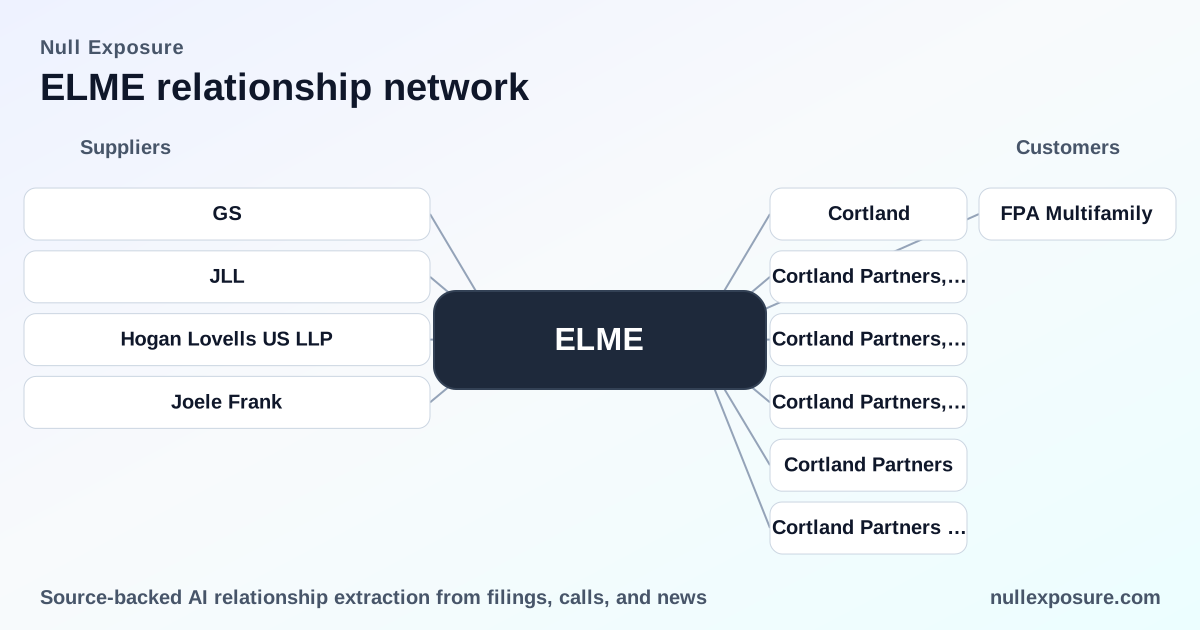
Goldman Sachs Bank USA — Elme entered into a $520 million senior secured term loan with Goldman Sachs Bank USA as lender to finance assets not included in a portfolio sale; the facility has an initial maturity noted as November 9, 2026 with an option to extend one year. This is the principal financing underpinning the remainder of Elme’s liquidation plan (GlobeNewswire press release, Jan 23, 2026; earlier GlobeNewswire release, Nov 13, 2025).
-
Goldman Sachs (generic references / Goldman Sachs & Co.) — News coverage and company statements indicate Goldman Sachs provided a $520 million debt commitment and served as a financial advisor on the portfolio dispositions, positioning the firm as both lender and deal advisor in the transaction set (Bisnow coverage on the portfolio sale; CityBiz reporting on advisors, FY2025).
-
Goldman Sachs & Co. LLC — Specifically named as a financial advisor on the sale of 19 multifamily properties, working alongside other advisor firms to market and execute the portfolio transaction (CityBiz article, FY2025).
-
Jones Lang LaSalle Securities, LLC (JLL) — JLL is listed as a financial advisor to Elme on the portfolio sale, supporting sale process execution and buyer engagement for the 19-property disposition (CityBiz reporting, FY2025).
-
Hogan Lovells US LLP — The law firm is acting as legal counsel to Elme in connection with the portfolio sale and related financing, a role that establishes Hogan Lovells as the principal transaction counsel on disposition and financing documentation (CityBiz article, FY2025).
-
Joele Frank — Retained as strategic communications advisor to manage press and investor communications around the sale and liquidation process, an important role given the sensitivity of REIT liquidation to market perception and stakeholder negotiations (CityBiz article, FY2025).
What these relationships imply for investors
- Concentration risk is high. A few large institutions (Goldman Sachs in multiple capacities, JLL, Hogan Lovells) control the levers of execution — pricing, timing, and financing — which concentrates counterparty exposure and reduces optionality for Elme.
- Financing maturity compresses the timeline. The $520 million term loan with a November 2026 maturity and an extension option for one year creates a finite window to dispose of remaining assets or secure refinancing; refinancing or sale execution failure would materially stress liquidity.
- Internalization reduces vendor complexity but shifts execution burden. Completing in-house property management reduces third-party operational dependency but increases the company’s need to perform sales, disposition logistics, and capital markets negotiation with a smaller internal team.
- Advisor alignment is strategic and transactional. The combination of investment bank advisory, legal counsel, and communications support signals a deliberate, market-driven disposition plan rather than ad hoc asset sales.
Risks and near-term watch items
- Watch the timeline for remaining asset dispositions and the scheduled loan maturity dates; execution slippage would elevate refinancing risk.
- Monitor counterparty concentrations, particularly any change in credit terms or commitment from Goldman Sachs across lending and advisory functions.
- Observe market demand and pricing in the Washington metro multifamily sector, since realized sale prices determine cash available for debt repayment and shareholder distributions.
Explore deeper supplier and counterparty mappings at https://nullexposure.com/ for more context and comparative analytics.
Practical guidance for counterparties and investors
- Lenders and service providers negotiating with Elme should price for compressed timelines and ensure documentation addresses extension and cure mechanics explicitly.
- Equity and debt investors should treat Elme as a liquidation vehicle in execution risk mode: value is dominated by near-term sale proceeds and the credibility of its advisors and lender commitments.
For comprehensive supplier intelligence and to track evolving counterparties across liquidation events, visit https://nullexposure.com/.