Eastern International Ltd. (ELOG): Small-cap logistics with project-era supplier dynamics
Eastern International Ltd. operates as a China-focused logistics provider, monetizing through freight and integrated logistics services and by contracting into project-based work and trading partnerships that generate fee and margin income. Revenue comes from traditional freight operations plus contract and subcontract arrangements tied to specific projects, a mix that produces modest margins but recurring cash flow; investors should evaluate supplier relationships and ownership structure to judge execution risk. For a concise supplier-risk view and relationship tracing, visit https://nullexposure.com/.
How ELOG makes money and what that means for investors
Eastern reports roughly $46M in trailing revenue and a gross profit around $6.0M, producing low single-digit profit and operating margins (profit margin ~3.95%, operating margin ~3.79%). Valuation measures are conspicuous: a trailing P/E of 7.47, Price-to-Sales of 0.293, and EV/EBITDA of 5.25, which position the company as a value-priced small cap with modest profitability and a portfolio of operational relationships that determine near-term growth. Insider control is material (approx. 45.8% insiders) and institutional ownership is negligible (0.009%), which influences governance, disclosure cadence, and potential liquidity for investors.
- Market-cap and liquidity: Market capitalization is about $13.5M with only ~2.94M shares float, which creates limited public liquidity and concentrated decision-making.
- Growth signal: Quarterly revenue growth year-over-year is notable at +27.8%, indicating business expansion against a low-margin base.
If you want a deeper supplier-risk report or a mapped relationship view, check the research hub at https://nullexposure.com/.
Supplier relationships that matter — the complete list
Below are the supplier relationships uncovered in public sources and how they connect to ELOG’s operations.
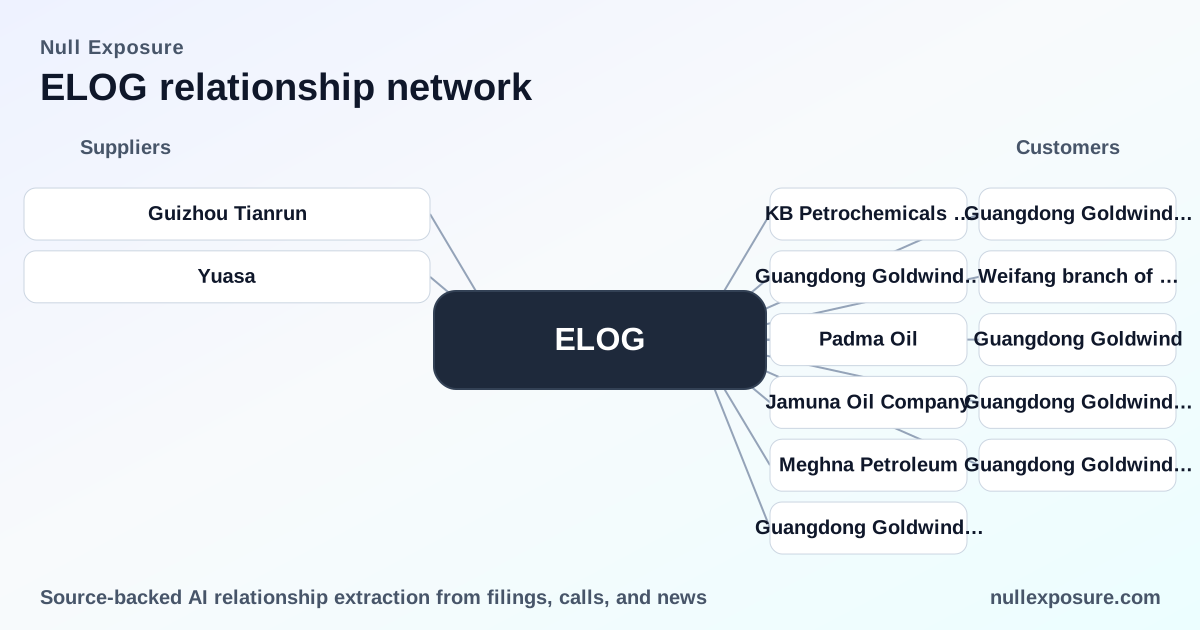
Guizhou Tianrun
Guizhou Tianrun is reported to act as a subcontractor for Phase I (50 MW) of a clean-energy project tied to Eastern, indicating ELOG uses external subcontractors for project delivery and energy-adjacent logistics work; this underlines a project-based contracting posture. Source: Sahm Capital news item covering Eastern’s entry into a clean-energy project (December 24, 2025) — https://www.sahmcapital.com/news/content/eastern-international-lands-first-solar-deal-enters-clean-energy-with-6-million-project-2025-12-24.
Yuasa
A TBS News report referencing FY2021 highlights distribution and trading relationships where Yuasa-branded automotive batteries and related supplies were circulated through Eastern Lubricant Blenders operations, signaling ELOG’s ecosystem includes trading and branded-supplier distribution arrangements beyond pure freight services. This illustrates diversification into traded goods and supplier-backed distribution channels. Source: TBS News coverage of Eastern Lubricant activities (FY2021 context) — https://www.tbsnews.net/economy/stocks/eastern-lubricant-profit-jumps-low-cost-base-oil-imports-349162.
What these supplier links imply for contracting posture and operational risk
The documented relationships show a hybrid operating model. ELOG contracts down — it secures projects and relies on subcontractors for execution (explicit in the Guizhou Tianrun item), and it operates distribution/trading channels that connect to branded suppliers (as reflected in the Yuasa-related reporting). From an investor and counterparty risk perspective, that translates into several company-level signals:
- Contracting posture: Project-driven with subcontracting — core delivery is anchored to project wins rather than exclusively long-term logistics contracts.
- Concentration: High insider ownership and a small public float produce concentrated control, which reduces takeover risk but raises governance and liquidity considerations for investors.
- Criticality: Supplier relationships are operationally important — subcontractors and trading partners are functionally critical to deliver project scope and to enable non-freight revenue lines.
- Maturity: The company is small and early-stage in scale with value-oriented multiples (low P/S and EV/EBITDA) but low margins, indicating that scale and operational efficiency remain the primary levers for margin expansion.
Valuation context and downside levers
Eastern’s current multiples — P/E ~7.5, EV/EBITDA ~5.3, P/S ~0.29 — position it as a deep-value play if revenue stability and contracting execution persist. Key downside risk factors tied to suppliers and operations include:
- Execution risk on project contracts: reliance on subcontractors introduces scheduling and quality risk that can compress already-thin margins.
- Liquidity and governance: with insiders holding nearly half the stock and institutions effectively absent, market-driven oversight is minimal.
- Geographic and sector concentration: operations concentrated in China and in the integrated freight & logistics sector leave the company exposed to regional policy and trade-cycle swings.
Investors who prioritize supplier governance and operational continuity should evaluate contract terms, counterparty credit, and subcontractor performance records. For tools to map and monitor these relationships, see our analysis platform at https://nullexposure.com/.
Practical guidance for investors and operators
- Demand contract-level disclosure when evaluating ELOG: look for terms that allocate liability for delays, subcontractor vetting, and penalty clauses.
- Monitor project pipelines and the operational role of named subcontractors (for example, Guizhou Tianrun) to assess execution risk on near-term revenue.
- For portfolio managers seeking liquidity-sensitive positions, size positions modestly given the small float and concentrated insider ownership.
Bottom line and next steps
Eastern International is a compact logistics operator trading at value-like multiples, with project-driven revenue and supplier relationships that materially affect delivery risk and margin profile. The Guizhou Tianrun subcontract and the Yuasa distribution link demonstrate a hybrid delivery model — project subcontracting plus trading/distribution channels — which both enable revenue diversity and create execution risk.
For a supplier-centric risk scan or to see relationship mappings in context, explore the research tools and reports at https://nullexposure.com/. If you want a tailored supplier risk briefing or an institutional-grade relationship map for ELOG, start at https://nullexposure.com/ and request a focused analysis.