Elutia Inc. (ELUT): Supplier relationships, contractual constraints, and what investors should know
Elutia commercializes drug‑eluting biomatrix technologies for surgical use and monetizes through direct device sales, licensing of biological materials, and strategic asset transactions. The company manufactures proprietary cardiac and soft‑tissue products, sources critical extracellular matrix (ECM) materials through licensing and supply agreements, and has recently realized balance‑sheet moves—including a sale and debt repayment—that reshape near‑term funding for R&D and commercialization. Investors evaluating Elutia should focus on supplier concentration, licensing terms with Cook, and the impact of recent financing and divestiture activity on cash flow and interest expense. For a deeper mapping of counterparties and contractual signals, visit https://nullexposure.com/.
How Elutia operates and where revenue comes from
Elutia generates revenue by selling finished medical devices that incorporate a drug‑eluting biomatrix and by holding and managing licenses to biologic source material used in those devices. According to company filings through FY2025, Elutia reported roughly $12.3 million in trailing‑12‑month revenue and $6.6 million gross profit, but remains EBITDA negative and reliant on financing and strategic transactions to fund product development (company financials, latest quarter 2025). The business model combines manufacturing at Elutia’s Roswell facility, exclusive licensed supply of porcine SIS ECM, and the monetization of non‑core assets when appropriate.
Key commercial relationships every investor must track
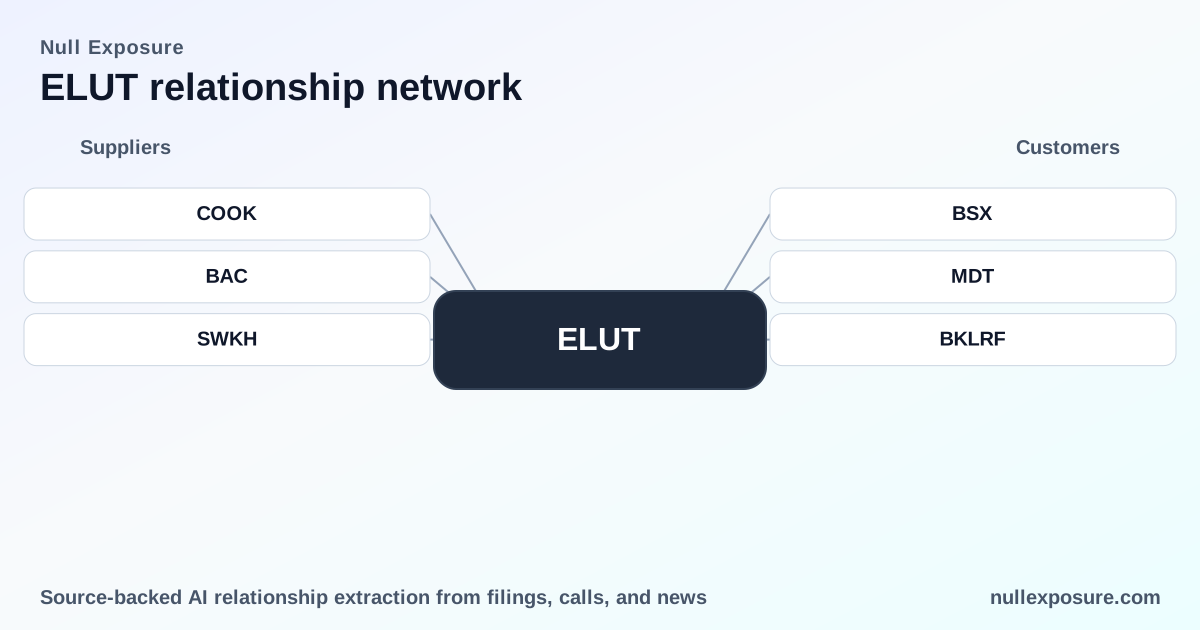
Below are the supplier, advisory, and financing counterparties surfaced in public disclosures and news. Each relationship is summarized in plain English with a source reference.
Cook (Cook Biotech / Evergen)
Elutia uses Cook as the manufacturer and exclusive supplier of the SIS ECM biomaterial for its cardiac and CanGaroo products; Cook produces the material in West Lafayette, Indiana and supplies it under a license and supply agreement. According to Elutia’s FY2024 Form 10‑K, Cook is the sole porcine tissue supplier and the SIS ECM is manufactured at Cook’s facility (FY2024 10‑K filing).
BofA Securities (Bank of America / BofA)
BofA Securities is acting as financial advisor to Elutia in the sale of its BioEnvelope business to Boston Scientific, a transaction publicly reported in March 2026. A March 2026 news release and press coverage noted BofA advised on the BioEnvelope sale, which funds continued development of Elutia’s lead programs (news reports, March 2026).
SWK Holdings
Elutia repaid a $26.9 million senior loan facility with SWK Holdings—covering principal, accrued interest, and exit fees—during Q4, materially reducing interest expense on the company’s books. This repayment was disclosed in a January 2026 press release summarizing preliminary Q4 2025 results and strengthened financial position (company press release via GlobeNewswire/The Manila Times, Jan 2026).
What the contractual constraints tell us about Elutia’s operating model
The public constraints extracted from filings and news paint a coherent picture of how Elutia runs the business and where operational risk concentrates.
-
Long‑dated licensing posture and exclusivity: Elutia holds an exclusive, worldwide license to porcine tissue for certain products through license terms that run to the expiration of the underlying Cook patents (anticipated July 2031). This is a structural advantage for product exclusivity but creates dependency on the contract term and renewal dynamics (company filing evidence).
-
Single‑source manufacturing and supply concentration: Public disclosures state Cook is the exclusive supplier of the SIS ECM used in licensed products and that Elutia converts that material at its Roswell facility. Separately, Elutia receives SimpliDerm through a contract manufacturing relationship with Berkeley after a prior divestiture, with Berkeley currently a single source for that input. Concentration on single suppliers increases operational and supply chain risk.
-
Licensing fee scale and spend posture: The Cook license includes fixed license fee payments—reported as $0.1 million per year for 2021–2026—which signals predictable, modest recurring outflows tied to the license rather than large variable procurement costs. This places Elutia in a licensing/spend band consistent with low‑mid six‑figure annual licensing fees.
-
Global rights with selective co‑exclusivity: The license covers worldwide use of the porcine tissue for specific devices, although certain co‑exclusive rights are retained by Cook. That structure supports global commercialization strategy but introduces contractual limits on exclusivity that investors should model into addressable market assumptions.
-
Service provider dependencies: The company relies on third‑party transport and logistics providers for product distribution; these are operationally material given the need for controlled, timely delivery of medical products.
Collectively, these constraints indicate a mature but concentrated supplier base, long‑dated license economics, and a hybrid manufacturing model (in‑house conversion plus outsourced material production). For more detailed counterparty mapping and contract signals, explore https://nullexposure.com/.
Operational and financial implications for investors
The relationship set drives four practical investment implications:
-
Concentration risk is high and operationally critical. With Cook explicitly named as the exclusive SIS supplier and Berkeley as the single source for SimpliDerm, production interruptions at either counterparty would be material to Elutia’s ability to ship product.
-
Contract maturity and renewal are value drivers. The license running through 2031 creates a finite horizon that investors should watch for renewal negotiations, potential renegotiation risk, and any royalty or fee escalators not disclosed in headline summaries.
-
Balance‑sheet flexibility has improved but execution risk remains. The sale of BioEnvelope (with BofA advising) and the repayment of the SWK loan reduce short‑term interest expense and inject proceeds to fund NXT‑41 development, but Elutia retains negative EBITDA and modest market capitalization (about $45.8 million), which limits runway without further financing or commercial upside (company financials, latest quarter 2025; press coverage, March 2026).
-
Commercial upside is tied to successful scale and diversifying suppliers. To translate its technology into durable margins, Elutia must expand product revenue while reducing single‑supplier dependence and demonstrating consistent manufacturing throughput.
If you want a structured vendor risk view tied to contract terms and renewal dates, visit https://nullexposure.com/ for tailored counterparty intelligence.
Bottom line and recommended next steps for investors
Elutia is a small, niche medical‑device company with unique licensed biology and concentrated supplier relationships that both protect product separation and introduce operational risk. Recent strategic actions—selling BioEnvelope with BofA’s advisory support and repaying a large SWK loan—improve financial flexibility but do not eliminate the reliance on single suppliers or the need for continued capital to commercialize NXT‑41 and other programs.
Actionable points:
- Monitor Cook license renewal timing and any public comments about co‑exclusive rights retained by Cook.
- Watch how proceeds from the BioEnvelope sale are allocated and whether further dilution or debt is introduced.
- Track operational disclosures about supplier redundancy or qualification of alternative sources.
For a concise supplier risk scorecard and contract maturity timeline, check the Elutia counterparty profile at https://nullexposure.com/—and if you want a tailored briefing, the home page has options to request deeper diligence.